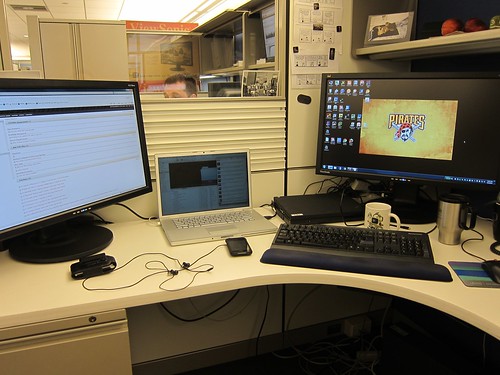
Here's a better photo of the new setup on my desk at work. And once again my MacBook Pro came to work today.
Wednesday, June 22, 2011


Monday, June 20, 2011
The Manhattan loop, or 30 ever-changing miles around a metropolis
I spent part of my Sunday morning and afternoon on my first Manhattan loop of 2011. I've been riding the greenways around the perimeter of the island since 2002, and every year there's something different. Sometimes it's different each month, if you take the never-ending construction in lower Manhattan into account. But I always enjoy seeing the improvements in the route each year, and the areas that are still in dire need of upgrades.
I crossed the East River via the Manhattan Bridge and turned south onto the East River greenway, under the assumption that foot traffic at the South Street Seaport would still be light at 11 AM. While it was, the NBA had set up some sort of fan festival there, so I had to take South Street all the way down to the Staten Island ferry terminal. I took the marked bike paths around the ferry terminal (those are only a year or two old) and found myself in Battery Park. The presence of a few Park Police squad cars convinced me to walk my bike around to the northwest exit of the park, where I picked up the West Side greenway.
There's a new detour around the World Financial Center, and I almost rode into traffic on the West Side Highway before I saw the signs directing cyclists around the back of the WFC and onto the esplanade on the river's edge. Once I was north of the WFC the detour led back onto the greenway, which has been fully developed at least since 2002. The path was busy but it was a straight shot all the way to the George Washington Bridge and the steepest hill I've climbed in New York. The short but steep hill just north of the GWB is always a challenge. I still remember when the northernmost part of this path was a rotting asphalt nightmare and riders had to take the footbridge across the Henry Hudson Parkway onto the streets near the bridge. But it's been a well-paved path for at least seven or eight years.
I took Dyckman Street over to the Harlem River greenway, once used for horse-and-buggy races, and rode south to St. Nicholas Avenue. I turned east onto the bike path on 120th Street, but a bike race blocked my path. I would have loved to watch the races, but it was hot, I was getting tired, and I didn't have much in the way of food. I doubled back onto 118th Street until I passed the race and then took 120th St. over to the northern section of the East River greenway. The sections of this path north of 96th Street are in dire need of repairs. Apparently the city thinks that metal barriers and orange cones are all the repairs giant sinkholes need.
The greenway took me past my old favorite park, Carl Schurz Park, where I spent many hours reading and watching the boats go by when I lived in the neighborhood. Another construction detour forced me onto the street, so I rode over to 2nd Avenue and took that all the way down to 38th Street where I could pick up the greenway again. Along the way, I saw all of the disruption of the 2nd Avenue Subway construction, and thought about how lucky I was that I moved before all of that work began.
The southern sections of the East River greenway haven't changed much in the past few years, though they are long overdue for a repaving. I was grateful for the shade that the FDR overpass provides, as it was the hottest part of the day by the time I reached the Manhattan Bridge to cross the river back to Brooklyn. I got home at 2 PM, 3 1/2 hours after I'd left, with 40 miles on the odometer. The ride through Brooklyn to and from the Manhattan Bridge adds the extra miles, which I forgot before I set out with only a handful of energy bars and two water bottles. Also, I say this every time, but this time I mean it: I'm leaving earlier next time.
I crossed the East River via the Manhattan Bridge and turned south onto the East River greenway, under the assumption that foot traffic at the South Street Seaport would still be light at 11 AM. While it was, the NBA had set up some sort of fan festival there, so I had to take South Street all the way down to the Staten Island ferry terminal. I took the marked bike paths around the ferry terminal (those are only a year or two old) and found myself in Battery Park. The presence of a few Park Police squad cars convinced me to walk my bike around to the northwest exit of the park, where I picked up the West Side greenway.
There's a new detour around the World Financial Center, and I almost rode into traffic on the West Side Highway before I saw the signs directing cyclists around the back of the WFC and onto the esplanade on the river's edge. Once I was north of the WFC the detour led back onto the greenway, which has been fully developed at least since 2002. The path was busy but it was a straight shot all the way to the George Washington Bridge and the steepest hill I've climbed in New York. The short but steep hill just north of the GWB is always a challenge. I still remember when the northernmost part of this path was a rotting asphalt nightmare and riders had to take the footbridge across the Henry Hudson Parkway onto the streets near the bridge. But it's been a well-paved path for at least seven or eight years.
I took Dyckman Street over to the Harlem River greenway, once used for horse-and-buggy races, and rode south to St. Nicholas Avenue. I turned east onto the bike path on 120th Street, but a bike race blocked my path. I would have loved to watch the races, but it was hot, I was getting tired, and I didn't have much in the way of food. I doubled back onto 118th Street until I passed the race and then took 120th St. over to the northern section of the East River greenway. The sections of this path north of 96th Street are in dire need of repairs. Apparently the city thinks that metal barriers and orange cones are all the repairs giant sinkholes need.
The greenway took me past my old favorite park, Carl Schurz Park, where I spent many hours reading and watching the boats go by when I lived in the neighborhood. Another construction detour forced me onto the street, so I rode over to 2nd Avenue and took that all the way down to 38th Street where I could pick up the greenway again. Along the way, I saw all of the disruption of the 2nd Avenue Subway construction, and thought about how lucky I was that I moved before all of that work began.
The southern sections of the East River greenway haven't changed much in the past few years, though they are long overdue for a repaving. I was grateful for the shade that the FDR overpass provides, as it was the hottest part of the day by the time I reached the Manhattan Bridge to cross the river back to Brooklyn. I got home at 2 PM, 3 1/2 hours after I'd left, with 40 miles on the odometer. The ride through Brooklyn to and from the Manhattan Bridge adds the extra miles, which I forgot before I set out with only a handful of energy bars and two water bottles. Also, I say this every time, but this time I mean it: I'm leaving earlier next time.
Friday, June 10, 2011
No Concerts in the Parks this summer for the Philharmonic
On Tuesday the New York Philharmonic announced that they were canceling their free summer Concerts In The Parks for 2011. The orchestra said that the musicians need time off and that they will perform a free concert with tenor Andrea Bocelli in September in Central Park. But the announcement seemed to have caught parks officials and caterers (not to mention the general public) by surprise. I can't find it now, but I read an article yesterday that quoted an Upper West Side caterer who said she had prepared bags for pre-made meals that she sells to hungry concert-goers.
I know that the orchestra is busy year-round -- their season ends in late June and begins in September, with a stop in Vail, Colorado for a music festival -- but it's odd that they used "scheduling conflicts" as an excuse. I have a feeling that some of the sponsors decided not to participate this year. Those concerts may be free to the public (and partially taxpayer-funded, as the New York Daily News pointed out in an editorial yesterday), but they're not free by any stretch.
I don't think the orchestra is obligated to perform in the parks each summer. I appreciate that they do it. For some New Yorkers, it's the only exposure they get to classical music all year. And while the concerts have devolved into excuses for people to picnic in the park and chat with friends, sometimes to the detriment of the rest of us who are just trying to enjoy the music, I think these concerts still fulfill a vital cultural role in New York. The Philharmonic says the concerts will return next summer. I hope that they do.
I know that the orchestra is busy year-round -- their season ends in late June and begins in September, with a stop in Vail, Colorado for a music festival -- but it's odd that they used "scheduling conflicts" as an excuse. I have a feeling that some of the sponsors decided not to participate this year. Those concerts may be free to the public (and partially taxpayer-funded, as the New York Daily News pointed out in an editorial yesterday), but they're not free by any stretch.
I don't think the orchestra is obligated to perform in the parks each summer. I appreciate that they do it. For some New Yorkers, it's the only exposure they get to classical music all year. And while the concerts have devolved into excuses for people to picnic in the park and chat with friends, sometimes to the detriment of the rest of us who are just trying to enjoy the music, I think these concerts still fulfill a vital cultural role in New York. The Philharmonic says the concerts will return next summer. I hope that they do.
Friday, June 03, 2011
A few quick thoughts about Thursday night at the Philharmonic
It's not a proper New York Philharmonic season for me if I don't see Anne-Sophie Mutter perform. Her reading of Beethoven's Romance in F was lyrical and sweet. Sebastian Currier's Time Machines, a concerto he composed for Ms. Mutter, was an unusual seven-movement work with touches of Barber, Glass, and Reich in places. I especially enjoyed the fifth movement, titled "entropic time," in which the themes and cohesion of the music gradually disintegrated into snippets of phrases and random echoes from different instruments of the orchestra.
Bruckner's Symphony No. 2 was well-played throughout but it was the third movement that drew me into the work. Alan Gilbert led a ferocious reading of the Scherzo that had me on the edge of my seat. The fury of the strings combined with blasts from the brass and loud bursts from the timpani energized the orchestra and carried over to the finale. It had been 40 years since the Philharmonic last performed this symphony. In the program notes Gilbert states that Bruckner is a composer whose music he could conduct every day for the rest of his life. I hope that means more Bruckner on Philharmonic programs in the future.
Bruckner's Symphony No. 2 was well-played throughout but it was the third movement that drew me into the work. Alan Gilbert led a ferocious reading of the Scherzo that had me on the edge of my seat. The fury of the strings combined with blasts from the brass and loud bursts from the timpani energized the orchestra and carried over to the finale. It had been 40 years since the Philharmonic last performed this symphony. In the program notes Gilbert states that Bruckner is a composer whose music he could conduct every day for the rest of his life. I hope that means more Bruckner on Philharmonic programs in the future.
Friday, May 27, 2011
Return to "Foundation"
I don't have any major summer reading projects this year. I had planned to read Infinite Jest this summer, but got pulled into an online reading project last fall and finished it in March. I do have a sizable stack of books at home just waiting to be read, so I'll work my way through those. One will be Noah Andre Trudeau's Gettysburg, since I'm going to a wedding there in July and I'd like to know more about the battle before I see the battlefield. I have a few other non-fiction history books to read, such as a book on the Jewish Resistance during WWII and David McCullough's book about the Johnstown Flood.
But before I dive into all of that boring history nonsense, I'm re-reading Isaac Asimov's Foundation novels. I devoured Asimov's fiction (and some of his non-fiction) as a kid. I tore through the Robot novels, the Empire novels, and the Foundation series, all before I was in high school. I remember them as fast reads but I don't recall much of the detail. I do remember enjoying the Foundation novels more than any of his other books. I think it was the concept of psychohistory that captivated me more than the ideas of robots solving crimes or a decaying galactic Empire. When I was home last October, I grabbed all five of the books I have in the series (not counting the two prequel novels, which Asimov wrote much later in his life) and brought them back to New York. I think I'll read a Foundation novel, then read some non-fiction, then read another Foundation novel. I think of them as palate cleansers. Also, it means I'll spread out the fun over the summer.
I rarely re-read books. The last time I remember re-reading anything was 2001, when I read the Lord Of The Rings trilogy for the third time, in preparation for the movies. But every once in a while I think it's worth revisiting books that I've loved. I listen to the same music over and over (though I introduce new albums all the time, I return to my favorites far more often) and I re-watch movies I love. Why not re-read books and see what I missed the first time around? Also, it's an excuse for me to keep all those books on my shelves. I can always say "hey, I might want to read that again" when it comes time to clean the apartment.
But before I dive into all of that boring history nonsense, I'm re-reading Isaac Asimov's Foundation novels. I devoured Asimov's fiction (and some of his non-fiction) as a kid. I tore through the Robot novels, the Empire novels, and the Foundation series, all before I was in high school. I remember them as fast reads but I don't recall much of the detail. I do remember enjoying the Foundation novels more than any of his other books. I think it was the concept of psychohistory that captivated me more than the ideas of robots solving crimes or a decaying galactic Empire. When I was home last October, I grabbed all five of the books I have in the series (not counting the two prequel novels, which Asimov wrote much later in his life) and brought them back to New York. I think I'll read a Foundation novel, then read some non-fiction, then read another Foundation novel. I think of them as palate cleansers. Also, it means I'll spread out the fun over the summer.
I rarely re-read books. The last time I remember re-reading anything was 2001, when I read the Lord Of The Rings trilogy for the third time, in preparation for the movies. But every once in a while I think it's worth revisiting books that I've loved. I listen to the same music over and over (though I introduce new albums all the time, I return to my favorites far more often) and I re-watch movies I love. Why not re-read books and see what I missed the first time around? Also, it's an excuse for me to keep all those books on my shelves. I can always say "hey, I might want to read that again" when it comes time to clean the apartment.
Saturday, May 14, 2011
Don't kill off high school English!
As an English major in college and a fan of great reading and writing, I read Kim Brooks' essay "Death to high school English" in Salon with more than just casual interest. Brooks' descriptions of her students' high school English classes sound similar to my own experience with the same curriculum twenty years ago. And I could see the roots of the English education that students receive now.
My parents claim that I would read the TV Guide to them before I was two years old. I was a "gifted" student in elementary and middle school. In my school district, the "gifted" class was mostly a double period of English, with some special projects in other areas (never math and science, though) thrown in. I was probably atypical even then; I would read longer books than my classmates, like novels by Asimov and Clarke, and even George Orwell's 1984 in 1984 when I was 10. (I admit that I was too young to understand much of that book, but I wanted to read it anyway.)
When I got to high school, the students in the "gifted" program merged into the rest of the class year, and while we had a more advanced English class, we read much of the same material as everyone else in our freshman year. I remember reading Romeo and Juliet, then watching Zeffirelli's movie of the play. Then we watched West Side Story, because why not? It's the same story, or so our teacher told us. In my sophomore English class, the material became more challenging, and our teacher assigned a few of us Faulkner's Light In August as a small group project. We had to give a presentation to the class, and after our bumbling effort she acknowledged that the book had probably been too difficult for us. (It definitely turned me off to Faulkner -- I haven't read any of his other books yet.) We wrote papers and took exams as well, but there were always group projects.
I took AP English my junior and senior years, and these classes were the reason I became an English major in college. We read some of the same books and plays as our non-AP classmates, in particular Richard III, Macbeth, and King Lear in 11th grade and Hamlet in 12th grade. And we had group projects. But we also had surprise essay tests in junior year, which I realized too late were meant to prepare us for the AP English test. (I never took the AP English test.) Our 11th grade teacher taught us the MLA style manual and worked with our AP History teacher on grammar and spelling, since many of us took history as well. She was tough but fair, never fun and seldom funny, but we learned a lot.
My senior year English teacher took matters a step further. We kept a journal four or five days a week, in which we had to fill two pages. At first, she would give us a topic every day, but as the year went on and our ability to fill those two pages (and sometimes more) increased, she would give us a "free topic." My friends and I used those free topics to write about our lives, comment on the news, and even dabble in fiction. I researched and wrote a long paper on humor in literature and a senior theme on science fiction. She was also tough but fair, and she encouraged us to be creative and find our own voices.
I think I enjoyed my music and history classes a little more, but when I think about high school I remember reading Beckett's Waiting For Godot aloud as a class and writing an almost passionate explanation of Godot as God. I think about writing that science fiction paper and editing it until it was perfect. I think about those English classes and how they prepared me for college-level writing. I left for Georgetown thinking that I would major in history, but my experiences in high school English and a few classes with excellent professors showed me that English was the better path. But I was in high school English classes with other bright, creative thinkers. I don't know what the rest of my classmates were doing, but I have a feeling it was more along the lines of what Brooks describes.
Brooks points out all the deficiencies of the modern high school English curriculum but doesn't offer any suggestions on how to improve it. Problems like class size, teacher workload, and classroom time aren't going away and are likely to get worse. She talks about the need for greater emphasis on teaching how to research and on teaching style and grammar. But the bottom line is here, from a discussion with her friend Amelia Shapiro, a writing tutor in Hawaii:
My parents claim that I would read the TV Guide to them before I was two years old. I was a "gifted" student in elementary and middle school. In my school district, the "gifted" class was mostly a double period of English, with some special projects in other areas (never math and science, though) thrown in. I was probably atypical even then; I would read longer books than my classmates, like novels by Asimov and Clarke, and even George Orwell's 1984 in 1984 when I was 10. (I admit that I was too young to understand much of that book, but I wanted to read it anyway.)
When I got to high school, the students in the "gifted" program merged into the rest of the class year, and while we had a more advanced English class, we read much of the same material as everyone else in our freshman year. I remember reading Romeo and Juliet, then watching Zeffirelli's movie of the play. Then we watched West Side Story, because why not? It's the same story, or so our teacher told us. In my sophomore English class, the material became more challenging, and our teacher assigned a few of us Faulkner's Light In August as a small group project. We had to give a presentation to the class, and after our bumbling effort she acknowledged that the book had probably been too difficult for us. (It definitely turned me off to Faulkner -- I haven't read any of his other books yet.) We wrote papers and took exams as well, but there were always group projects.
I took AP English my junior and senior years, and these classes were the reason I became an English major in college. We read some of the same books and plays as our non-AP classmates, in particular Richard III, Macbeth, and King Lear in 11th grade and Hamlet in 12th grade. And we had group projects. But we also had surprise essay tests in junior year, which I realized too late were meant to prepare us for the AP English test. (I never took the AP English test.) Our 11th grade teacher taught us the MLA style manual and worked with our AP History teacher on grammar and spelling, since many of us took history as well. She was tough but fair, never fun and seldom funny, but we learned a lot.
My senior year English teacher took matters a step further. We kept a journal four or five days a week, in which we had to fill two pages. At first, she would give us a topic every day, but as the year went on and our ability to fill those two pages (and sometimes more) increased, she would give us a "free topic." My friends and I used those free topics to write about our lives, comment on the news, and even dabble in fiction. I researched and wrote a long paper on humor in literature and a senior theme on science fiction. She was also tough but fair, and she encouraged us to be creative and find our own voices.
I think I enjoyed my music and history classes a little more, but when I think about high school I remember reading Beckett's Waiting For Godot aloud as a class and writing an almost passionate explanation of Godot as God. I think about writing that science fiction paper and editing it until it was perfect. I think about those English classes and how they prepared me for college-level writing. I left for Georgetown thinking that I would major in history, but my experiences in high school English and a few classes with excellent professors showed me that English was the better path. But I was in high school English classes with other bright, creative thinkers. I don't know what the rest of my classmates were doing, but I have a feeling it was more along the lines of what Brooks describes.
Brooks points out all the deficiencies of the modern high school English curriculum but doesn't offer any suggestions on how to improve it. Problems like class size, teacher workload, and classroom time aren't going away and are likely to get worse. She talks about the need for greater emphasis on teaching how to research and on teaching style and grammar. But the bottom line is here, from a discussion with her friend Amelia Shapiro, a writing tutor in Hawaii:
My experience in high school was that writing was something fun. I looked forward to writing in that journal senior year. I still look forward to writing, even if it's just emails at work. Despite all the obstacles, I hope that more students can see the value of good writing skills, and that those skills are the most important thing they can take away from their twelve years in the school system. Any animal can eventually pound out a barely coherent email or text message. Writing is what makes us human.
When I ask her why she thinks there's such resistance to prioritizing and teaching writing, given its numerous applications, given its overlap with critical thinking skills, analytical skills, basic communication skills, she hesitates for a moment, then answers in three words: "It's not fun."
Wednesday, May 11, 2011
Were you voted "most likely to succeed?"
I was voted "Most Musical" in high school and I think I've lived up to that as best I could. But I hadn't thought about it at all until I saw this article. If you're 30 and still dwelling on something from high school, you might want to talk to a professional. You've got bigger problems on your plate.
Also, this (from Gawker writer Jeff Neumann):
Amen, brother.
Also, this (from Gawker writer Jeff Neumann):
The takeaway here? High school still sucks long after it's over.
Amen, brother.
Sunday, May 01, 2011
Emanuel Ax and Mahler at the NY Philharmonic
Saturday evening's concert opened with a solo performance of Debussy's Pagodes, a “slide show” for piano (as Ax and music director Alan Gilbert explained before the concert). Gilbert said that they decided earlier in the week to perform the Debussy work back-to-back with Olivier Messiaen's Couleurs de la cité céleste, as the two pieces were similar in style and theme. The Debussy was a short but pleasant work, and Ax's work was delightful and charming. Gilbert, who had been standing at the podium through Ax's performance, then cued the small ensemble (horns, trumpets, trombones, winds, and percussion) for the Messiaen piece. I'm not a fan of Messiaen's music. The only thing I could think during the performance (which was excellent, by the way) was that his music sounds like what happens when you try to make sense of a two-year-old banging on a piano. His music doesn't sound like music to me. It's barely controlled random notes. And I say this having performed Messiaen with NYRO a few years ago. I didn't understand it then either.
After intermission, I returned to the hall to a stage filled with chairs and percussion for Mahler's Symphony No. 5. I heard Gustavo Dudamel lead the Philharmonic in this work a little over two years ago, and I think Saturday night's performance with Alan Gilbert was ever so slightly better. Gilbert was in full control at the podium, using every inch of space he had to hold the massive ensemble together. Each movement had moments that gave me chills and I hung on nearly every note. Phil Smith on trumpet and Phil Myers on horn were both magnificent, and each received well-deserved cheers at the end of the piece. I've been to every New York Philharmonic Mahler concert this year, and I think this one was my favorite. I'm going to be thinking about this performance for a long time, or at least until they open next season with Mahler's Symphony No. 2, my all-time favorite.
After intermission, I returned to the hall to a stage filled with chairs and percussion for Mahler's Symphony No. 5. I heard Gustavo Dudamel lead the Philharmonic in this work a little over two years ago, and I think Saturday night's performance with Alan Gilbert was ever so slightly better. Gilbert was in full control at the podium, using every inch of space he had to hold the massive ensemble together. Each movement had moments that gave me chills and I hung on nearly every note. Phil Smith on trumpet and Phil Myers on horn were both magnificent, and each received well-deserved cheers at the end of the piece. I've been to every New York Philharmonic Mahler concert this year, and I think this one was my favorite. I'm going to be thinking about this performance for a long time, or at least until they open next season with Mahler's Symphony No. 2, my all-time favorite.
Friday, April 22, 2011
The Philadelphia Orchestra's bankruptcy filing and the state of classical music today
I was as dismayed as everyone else in the classical music community when I read that the Philadelphia Orchestra had declared bankruptcy. It's a tough time for American orchestras. The Detroit Symphony Orchestra's musicians' months-long strike ended just a few weeks ago. The New Mexico Symphony Orchestra folded, as have a few others recently. But Philadelphia is one of the most renowned American orchestras, on a level with the New York Philharmonic, the Cleveland Orchestra, and the Chicago Symphony Orchestra. It's difficult to see an orchestra with that kind of history in financial straits. However, bankruptcy is not the end of a business. It's a chance to reorganize, get clear of debt and continue operating. It's a bad thing for an organization's credit, but it's better than shutting down completely. The Philadelphia Orchestra isn't going anywhere.
But as this commenter on the New York Times pointed out, modern orchestras are not lean, mean musical machines. They're bloated, with far more musicians on the regular payroll than are required by most classical works. They have a limited repertoire. They play the same concert three to five times a week. And let's not even get into the aging audience for this music.
On the other hand, I like this quote from Arts Beat's Daniel Wakin:
I do hope the Philadelphia Orchestra finds a way through its current financial problems and comes out the other side stronger than ever. But I think it will take some serious re-evaluation of the presentation and performance of classical music to get there. Other orchestras should keep a close watch on developments in Philadelphia before their organizations reach the same state.
But as this commenter on the New York Times pointed out, modern orchestras are not lean, mean musical machines. They're bloated, with far more musicians on the regular payroll than are required by most classical works. They have a limited repertoire. They play the same concert three to five times a week. And let's not even get into the aging audience for this music.
On the other hand, I like this quote from Arts Beat's Daniel Wakin:
Some have argued too that there is nothing wrong with orchestras serving — in part — the function of museums, keeping the classics on view.That's an argument for the status quo. Bach, Beethoven, and Mozart aren't writing any new music, and there's a good reason orchestras keep programming Beethoven's Fifth Symphony: people will pay to hear it. No one complains when Bruce Springsteen sings "Born To Run" in concert for the 10,000th time. And regardless of whether you listen to classical music, it's a link to our shared musical past. It's important to keep this art form around, just as we wouldn't throw out a Picasso painting or a Giacometti sculpture.
I do hope the Philadelphia Orchestra finds a way through its current financial problems and comes out the other side stronger than ever. But I think it will take some serious re-evaluation of the presentation and performance of classical music to get there. Other orchestras should keep a close watch on developments in Philadelphia before their organizations reach the same state.
Thursday, April 14, 2011
Masur conducts Liszt, Gubaidulina and Brahms with the New York Philharmonic
Last night's concert by the New York Philharmonic was something of a "greatest hits" show bookending a brand-new song. And we had the rare experience of seeing two different conductors on the same program. Kurt Masur, the scheduled conductor for the program, had an temporary eye infection that "[impeded] his ability to see the score" (according to a program insert from the Philharmonic), so he conducted the opening and closing works on the program, and stepped aside in favor of New York Philharmonic Assistant Conductor Daniel Boico for Sofia Gubaidulina's Two Paths: Concerto for Two Violas and Orchestra.
The Philharmonic opened the concert with Franz Liszt's symphonic poem Les Preludes, one of my favorites. Masur took the podium and received loud cheers before the orchestra made a sound. He conducted this work (and the Brahms symphony after intermission) from memory and without a baton. Throughout the concert, his conducting consisted more of cues and occasional indications of tempo changes than what I think of as actual conducting. But Masur is in his 80s and while he moved well, he looked his age. He is also Music Director Emeritus of the Philharmonic, and as his audience reception showed, he is still beloved by audiences and familiar with the orchestra and its musicians. I got the feeling that Masur could have communicated whatever he needed to the musicians with his eyebrows and the concert would have been fantastic. And opening with Les Preludes is sort of like Bruce Springsteen opening a show with "Born To Run." It's a great piece of music, an audience favorite, a showcase for the entire orchestra, and music everyone in the group knows well. And it was exciting to hear. The brass fanfares were impressive, but what I enjoyed even more was the balance among all the instrument groups. I heard melodies in the piece that I hadn't heard before. I think I say that often, but it was certainly true last night.
Daniel Boico took the podium for the Gubaidulina concerto. His conducting was almost the polar opposite of Masur's: clear and precise beats for every measure, left hand cues when necessary, and he kept a close eye on the score. To be fair, these concerts are only the second time the Philharmonic has performed this piece, so everyone in the room was paying extra attention, including Boico. He had the task of being pressed into service as conductor for this piece at the last minute, and to a neophyte conductor like myself, that seems like a massive challenge. But what an opportunity! Boico performed admirably, managing the music and the soloists. Principal Violist Cynthia Phelps and Associate Principal Rebecca Young were equally impressive as the soloists (they also premiered this work with the Philharmonic in 1999, under Masur). Phelps took the higher part while Young explored the lower registers of the viola. The music became a conversation between the soloists and the rest of the orchestra, including solo turns from Carter Brey on cello, Michelle Kim on violin, and from the winds. It was a melancholic and mysterious piece, and well suited to the dusky tones of the violas. I really enjoyed it, and not just as a violist. I'll have to listen to the radio broadcast of this concert to hear it again.
After intermission, Masur returned to the podium for Johannes Brahms' Symphony No. 1, another personal and audience favorite. Phelps and Young also returned to the stage, as the first stand in the viola section. I thought that was interesting; I'd expected them to have the rest of the night off since they had already performed as soloists. Masur took the tempi in the Brahms just a touch slower than other versions I've heard. Maybe the two were unrelated, but I thought that the slightly slower tempi enhanced the tension in the first movement and brought out some of the melodies and harmonies that might otherwise remain hidden. At the end of the work, the rousing finale brought most of the audience to its feet and Masur received another loud and extended ovation. The audiences in New York really love his work. I hope he keeps coming back here to conduct as long as he's able to do so.
The Philharmonic opened the concert with Franz Liszt's symphonic poem Les Preludes, one of my favorites. Masur took the podium and received loud cheers before the orchestra made a sound. He conducted this work (and the Brahms symphony after intermission) from memory and without a baton. Throughout the concert, his conducting consisted more of cues and occasional indications of tempo changes than what I think of as actual conducting. But Masur is in his 80s and while he moved well, he looked his age. He is also Music Director Emeritus of the Philharmonic, and as his audience reception showed, he is still beloved by audiences and familiar with the orchestra and its musicians. I got the feeling that Masur could have communicated whatever he needed to the musicians with his eyebrows and the concert would have been fantastic. And opening with Les Preludes is sort of like Bruce Springsteen opening a show with "Born To Run." It's a great piece of music, an audience favorite, a showcase for the entire orchestra, and music everyone in the group knows well. And it was exciting to hear. The brass fanfares were impressive, but what I enjoyed even more was the balance among all the instrument groups. I heard melodies in the piece that I hadn't heard before. I think I say that often, but it was certainly true last night.
Daniel Boico took the podium for the Gubaidulina concerto. His conducting was almost the polar opposite of Masur's: clear and precise beats for every measure, left hand cues when necessary, and he kept a close eye on the score. To be fair, these concerts are only the second time the Philharmonic has performed this piece, so everyone in the room was paying extra attention, including Boico. He had the task of being pressed into service as conductor for this piece at the last minute, and to a neophyte conductor like myself, that seems like a massive challenge. But what an opportunity! Boico performed admirably, managing the music and the soloists. Principal Violist Cynthia Phelps and Associate Principal Rebecca Young were equally impressive as the soloists (they also premiered this work with the Philharmonic in 1999, under Masur). Phelps took the higher part while Young explored the lower registers of the viola. The music became a conversation between the soloists and the rest of the orchestra, including solo turns from Carter Brey on cello, Michelle Kim on violin, and from the winds. It was a melancholic and mysterious piece, and well suited to the dusky tones of the violas. I really enjoyed it, and not just as a violist. I'll have to listen to the radio broadcast of this concert to hear it again.
After intermission, Masur returned to the podium for Johannes Brahms' Symphony No. 1, another personal and audience favorite. Phelps and Young also returned to the stage, as the first stand in the viola section. I thought that was interesting; I'd expected them to have the rest of the night off since they had already performed as soloists. Masur took the tempi in the Brahms just a touch slower than other versions I've heard. Maybe the two were unrelated, but I thought that the slightly slower tempi enhanced the tension in the first movement and brought out some of the melodies and harmonies that might otherwise remain hidden. At the end of the work, the rousing finale brought most of the audience to its feet and Masur received another loud and extended ovation. The audiences in New York really love his work. I hope he keeps coming back here to conduct as long as he's able to do so.
Sports bloggers as Muppets
I don't know if there's anyone who reads my blog and doesn't follow me on Twitter or Facebook, but if you're out there, you need to read Dan Levy's post on sports bloggers as characters from the Muppets, Sesame Street, and Fraggle Rock. I've enjoyed Dan's daily podcast for three or four years now and I'm going to miss having it as part of my daily routine. This post is possibly the best farewell I've ever seen. It's a labor of love that deserves a read.
Monday, April 11, 2011
Supporting the Prospect Park West bike lane
This morning I rode my slowest mile in recent memory, but it was for a great cause. Park Slope residents organized We Ride The Lanes, a family- and community-oriented ride in support of the Prospect Park West bike lane. Kids and adults on bikes of every shape and size rode from Grand Army Plaza to the traffic circle at 15th Street. I didn't partake, but there were cupcakes, lemonade, and smiles all around at the end of the ride. (Then I rode 18 miles in the park, because why not.) There's a video of the event here, and I can be seen at about the 0:55 mark in the extreme upper left corner, waiting my turn to ride the lane.
As I was riding along the bike lane with hundreds of fellow cyclists, I realized that I just don't understand the fight over this bike lane. It's just a bike lane! We have much bigger problems in New York than this 20-block stretch of pavement alongside a public park in a residential neighborhood. Transportation Alternatives, Councilman Brad Lander, and others have pointed out the safety benefits of the lane. The traffic data shows cars are moving slower on Prospect Park West and that accidents for pedestrians and cyclists are down. This lane is a good thing for the neighborhood. I would hope that those opposed to this lane realize the sheer ridiculousness of the argument and turn their activism toward more urgent causes.
As I was riding along the bike lane with hundreds of fellow cyclists, I realized that I just don't understand the fight over this bike lane. It's just a bike lane! We have much bigger problems in New York than this 20-block stretch of pavement alongside a public park in a residential neighborhood. Transportation Alternatives, Councilman Brad Lander, and others have pointed out the safety benefits of the lane. The traffic data shows cars are moving slower on Prospect Park West and that accidents for pedestrians and cyclists are down. This lane is a good thing for the neighborhood. I would hope that those opposed to this lane realize the sheer ridiculousness of the argument and turn their activism toward more urgent causes.
Friday, April 01, 2011
Wikipedia has all the answers
I was watching the 25th anniversary Les Miserables concert on PBS and it finally bothered me that all of the lower-class characters speak and sing with British Cockney accents. Why? Why not French accents? Don't get me wrong: I love this musical. But I've always wondered: why the British accents for the characters?
Wikipedia knows: it's used to represent Parisian criminal 'argot.'
Well, that was anticlimactic.
Wikipedia knows: it's used to represent Parisian criminal 'argot.'
Well, that was anticlimactic.
Tuesday, March 22, 2011
Hey, I'm playing a concert this weekend!
Saturday night, the usual time and place. We're playing Vaughan Williams, Martinu, and Humperdinck, though not in that order.
http://myemail.constantcontact.com/REMINDER--New-York-Repertory-Orchestra-Spring-Concert---Saturday--March-26--2011.html?soid=1102230218778&aid=JBK6Crn62_o
http://myemail.constantcontact.com/REMINDER--New-York-Repertory-Orchestra-Spring-Concert---Saturday--March-26--2011.html?soid=1102230218778&aid=JBK6Crn62_o
Friday, March 11, 2011
The NSO takes on Messiaen's "Turangalila"
My brother and his girlfriend are going to hear Olivier Messiaen's gargantuan "Turangalila-Symphonie" performed by the National Symphony Orchestra this weekend in Washington, DC. I'm not a big fan of Messiaen's music but I'd go see this work in concert in a heartbeat. It calls for a massive orchestra with obsolete instruments and makes demands on the players and audiences that few pieces do. In short, it's a spectacle. And I love spectacles, musical or otherwise. It's disappointing that there were "hundreds of empty seats" at the Kennedy Center last night. I think that New York audiences would turn out for this piece. (A quick check of the New York Philharmonic's history shows that they've performed it twice, in 1988 and 2000, so it must have been popular enough for a second hearing.) I look forward to hearing my brother's review of the performance.
Saturday, March 05, 2011
At the Philharmonic: Szymanowski and Mahler
I got a ticket for this concert for Mahler's Symphony No. 4, so Karol Szymanowski's Violin Concerto No. 1 with concertmaster Glenn Dicterow as soloist was a bonus. The orchestra for the concerto was easily the largest I've ever seen for a solo work: lots of strings, full wind and brass sections, an armada of percussion, a piano, celeste, and I'm sure I'm forgetting something. It was a formidable mass of instruments for guest conductor Daniel Harding to manage against Dicterow's solo violin. The music was dense and thick, as one might expect with forces of that size. Harding kept the orchestra from overwhelming the soloist, while Dicterow played with conviction. He's not a flashy soloist, more conservative than risk-taking, but he plays as if the violin was an extension of his body. I've watched Dicterow for a number of years both as a soloist and as concertmaster, and he always looks as if the violin is as much a part of him as his arms or legs. Szymanowski's music straddled a line between late Romanticism and early modernism, with Asian melodic lines sprinkled throughout. I wasn't about to leave the concert humming any of the tunes, but I'd listen to this piece again, especially if Dicterow is playing.
Harding is only 35, but he showed no signs of hesitation or tentativeness on the podium. His crisp movements reminded me of other young conductors I've seen, like the Philharmonic's own music director, Alan Gilbert. Harding didn't waste motion or conduct with an overly flashy or fluid style. He was precise and exact. I can't imagine what it would be like to be that young and that talented, to command the respect of musicians twice his age with decades of experience. He seemed unaffected by the position and the orchestra appeared to have enjoyed working with him. I hope he returns to Avery Fisher Hall soon.
After intermission the Philharmonic returned to the stage for Mahler's Symphony No. 4. It's Mahler's smallest symphony, both in terms of length and in orchestration. He excluded the trombones and tuba from his orchestra, reduces his normal battalion of percussion, and only has four horns and a more manageable wind section than his usual oversize symphonies require. It's long been my least favorite Mahler symphony. I first heard it (or saw it) on TV in England in 1989 while on vacation visiting my grandparents. It was a terrible way to see and hear this work. I didn't get any sense of the musical flow, I thought the melodies made no sense at all, and the finale, a soprano solo song about life in Heaven, underwhelmed me. So I avoided this symphony for a long time. It's only recently that as I've explored Mahler's music in depth that I returned to the Fourth and discovered how wonderful and lovely this symphony can be.
The second movement was interesting to watch as associate concertmaster Sheryl Staples switched violins several times with a spare, deliberately out-of-tune instrument on a chair in front of her. The interplay among her, clarinetist Mark Nuccio, and principal horn Philip Myers was entertaining as well. The massive E major chord in the third movement, signifying the glorious light of Heaven, gave me chills. The end of the third movement flowed directly into the finale as soprano Lisa Milne walked from the rear of the stage to the front to sing the words that describe Heaven as a place of childlike wonder, where everyone is free from worry and enjoys unimaginable food and drink prepared by saints and angels. It reads a bit hokey but it was blissful to hear. At the end of the symphony, the last notes came from the bass section and were barely audible. As they faded out, Harding kept his baton up, barely moving it as the sound faded. There were several seconds where no sound could be heard and no one in the audience dared to so much as breathe. I've never heard a concert hall go silent like that. At last, Harding lowered his hands, and the audience applauded vigorously for what was a fantastic performance.
Wednesday, March 02, 2011
James Levine resigns as Boston Symphony Orchestra music director
One day after cancelling the remainder of his appearances this season with the Boston Symphony Orchestra, music director James Levine stepped down from his post, citing his ongoing health problems as preventing him from fulfilling his duties. He's missed many performances in Boston and with the Metropolitan Opera in New York over the past few years. He had rotator cuff surgery and other surgeries during that time. His continued absences made things difficult for both organizations.
It's too bad that Levine's tenure in Boston has to end this way. And I'm a little surprised that it happened so quickly. But like a professional athlete, he knew that it was time to go. The workload of managing a top-flight symphony orchestra is heavy enough, and adding his responsibilities at the Met (a post that he will maintain) was clearly too much for someone with his health problems. With only one job, Levine will be able to focus on the Met's needs and appear as a guest conductor with orchestras if he wants. I've enjoyed watching him at the Met and I hope he's able to continue in that position for as long as he wants.
It's too bad that Levine's tenure in Boston has to end this way. And I'm a little surprised that it happened so quickly. But like a professional athlete, he knew that it was time to go. The workload of managing a top-flight symphony orchestra is heavy enough, and adding his responsibilities at the Met (a post that he will maintain) was clearly too much for someone with his health problems. With only one job, Levine will be able to focus on the Met's needs and appear as a guest conductor with orchestras if he wants. I've enjoyed watching him at the Met and I hope he's able to continue in that position for as long as he wants.
Monday, February 28, 2011
Today in "I feel old..."
Daniel Harding is 35 and making his debut with the New York Philharmonic this weekend. I tried to remember if I ever conducted a rehearsal of anything when I was 16. I don't think so. If I did, it certainly wasn't Schoenberg's Pierrot Lunaire. It would have been something like an arrangement of songs from Les Miserables or The Phantom of the Opera, both staples of my youth orchestra's repertoire. A videotape of those pieces wouldn't be worth much today.
If anyone does have footage of my brief appearance on stage at Georgetown University's Gaston Hall conducting the Georgetown U. Orchestra with a plastic chicken, I'd like to see it.
If anyone does have footage of my brief appearance on stage at Georgetown University's Gaston Hall conducting the Georgetown U. Orchestra with a plastic chicken, I'd like to see it.
Thursday, February 17, 2011
RIP Sidney Harth
My mother passed along the obituary for Sidney Harth, who passed away a few days ago. I never got to hear him play the violin, but I saw him conduct the Pittsburgh Symphony Orchestra in 1987 at Indiana University of Pennsylvania and then I had the privilege of working with him a few years later at the 1991 MENC All-Eastern Orchestra Festival in Pittsburgh. OK, "worked with" is being generous, since I was in the far back of the viola section. He was a firm and knowledgeable conductor for that weekend. We only played one piece, Tchaikovsky's Francesca da Rimini, and he made sure we were fully prepared to play every note. We were so well-prepared that one afternoon of the three-day festival he decided we would sight-read instead of rehearse. So he split the orchestra in half (by having us take turns) and half of us read Schumann's Symphony No. 3 while the other half read a Brahms symphony. I got to play the Schumann, which was a real treat for me as it quickly became one of my favorite symphonies. I still have the recording of our rendition of the Tchaikovsky. I only wish we'd been able to play at Heinz Hall instead of a massive concrete hall in the Lawrence Convention Center; the sound would have been so much better in a proper space.
It's hard for me to believe that was twenty years ago. I remember it like it was last week.
It's hard for me to believe that was twenty years ago. I remember it like it was last week.
Saturday, January 29, 2011
Beethoven, Sibelius, and Nielsen: "New" music at the New York Philharmonic
This weekend's New York Philharmonic concerts featured works by Sibelius and Nielsen that the orchestra hasn't performed in years, if at all. There was Beethoven too, if you like hearing music you've heard dozens of times before. (Not that I have any problems with Beethoven -- I love the guy -- but it's wonderful to hear something unfamiliar now and then.) The music wasn't unfamiliar to me, though; I played the two Beethoven works and the Nielsen symphony with NYRO several years ago.
The concert opened with Beethoven's Symphony No. 8 in F. I would call it a boisterous reading, with great work from the two horns in the third movement, excellent attention to dynamics (especially the recapitulation in the first movement, when the upper strings and winds play fortississimo and drown out the melody in the cellos) and I especially enjoyed watching the timpanist playing like mad on three drums at the end of the piece. (Although there's only two drums in the score, so I don't know what he was doing, but it looked amazing from where I sat.)
A smaller Philharmonic came onstage for Beethoven's concert aria "Ah, perfido!" Soprano Karita Mattila brought the singer's words to life, portraying a scorned woman going through a variety of emotions through ten minutes of music. Music Director Alan Gilbert kept the orchestra out of her way, but also brought out the woodwinds when their lines and Mattila's intersected and complemented each other.
After intermission, the Philharmonic and Mattila performed three songs by Jean Sibelius. I'd never heard these songs before (and neither had New York audiences -- two of the three had never been performed by the Philharmonic before, and the third one not since 1965) but they were unmistakably Sibelius. I'd know those harmonies anywhere. Once again, Mattila's voice was perfect for this music.
Finally, the Philharmonic marshaled all of its forces for Carl Nielsen's Symphony No. 2, "The Four Temperaments." I've noted before in this space that Nielsen's music is not as popular here as it would seem to deserve. I hope that's changing. In the program notes, Gilbert wrote of his love for Scandinavian music (from his years as music director of the Royal Stockholm Philharmonic Orchestra) and his puzzlement at the lack of exposure to Nielsen's works. He wrote that he plans to program all of Nielsen's symphonies over the next few years, which excites me as a musician and a fan. The last time the Philharmonic had played Nielsen's 2nd was in 1973, shortly before I was born. That's too long.
The first movement was crisp and stormy, with the winds and brass completely on point with short, loud blasts. The second movement, with its languid phrases, put some of the people around me to sleep. The ones who weren't sleeping applauded between movements, which baffled me. Who are these people? We don't clap between movements here! Yes, I'm a stickler for concert etiquette. The third movement, representing melancholia, was moving and powerful. I just adore the long brass and string melodies in this movement, and the orchestra played them beautifully. The last movement was spirited and bold and brought the concert to a close that the audience really seemed to appreciate. I felt sorry for the few patrons I saw leaving at intermission. What a treat they missed!
The concert opened with Beethoven's Symphony No. 8 in F. I would call it a boisterous reading, with great work from the two horns in the third movement, excellent attention to dynamics (especially the recapitulation in the first movement, when the upper strings and winds play fortississimo and drown out the melody in the cellos) and I especially enjoyed watching the timpanist playing like mad on three drums at the end of the piece. (Although there's only two drums in the score, so I don't know what he was doing, but it looked amazing from where I sat.)
A smaller Philharmonic came onstage for Beethoven's concert aria "Ah, perfido!" Soprano Karita Mattila brought the singer's words to life, portraying a scorned woman going through a variety of emotions through ten minutes of music. Music Director Alan Gilbert kept the orchestra out of her way, but also brought out the woodwinds when their lines and Mattila's intersected and complemented each other.
After intermission, the Philharmonic and Mattila performed three songs by Jean Sibelius. I'd never heard these songs before (and neither had New York audiences -- two of the three had never been performed by the Philharmonic before, and the third one not since 1965) but they were unmistakably Sibelius. I'd know those harmonies anywhere. Once again, Mattila's voice was perfect for this music.
Finally, the Philharmonic marshaled all of its forces for Carl Nielsen's Symphony No. 2, "The Four Temperaments." I've noted before in this space that Nielsen's music is not as popular here as it would seem to deserve. I hope that's changing. In the program notes, Gilbert wrote of his love for Scandinavian music (from his years as music director of the Royal Stockholm Philharmonic Orchestra) and his puzzlement at the lack of exposure to Nielsen's works. He wrote that he plans to program all of Nielsen's symphonies over the next few years, which excites me as a musician and a fan. The last time the Philharmonic had played Nielsen's 2nd was in 1973, shortly before I was born. That's too long.
The first movement was crisp and stormy, with the winds and brass completely on point with short, loud blasts. The second movement, with its languid phrases, put some of the people around me to sleep. The ones who weren't sleeping applauded between movements, which baffled me. Who are these people? We don't clap between movements here! Yes, I'm a stickler for concert etiquette. The third movement, representing melancholia, was moving and powerful. I just adore the long brass and string melodies in this movement, and the orchestra played them beautifully. The last movement was spirited and bold and brought the concert to a close that the audience really seemed to appreciate. I felt sorry for the few patrons I saw leaving at intermission. What a treat they missed!
Subscribe to:
Posts (Atom)