My friend James played a few songs at Hank's Saloon in Brooklyn last Friday evening, and I was there to document it. Rather than just upload the videos, I discovered that iMovie has some really cool features to enhance your projects. You can put titles in front of your videos! And did you know iMovie comes with fade-in and fade-out transitions? Totally cool! So I punched up this set of videos with some sweet effects, thanks to those wizards at Apple. Seriously, those guys make some cool stuff. Have you seen this phone that they sell? I think it's called the iPhone!
Wednesday, December 15, 2010


Wednesday, December 08, 2010
NY Philharmonic, December 7, 2010: Beethoven & Mahler
I was interested in last night's concert more than usual, as the program featured a Mahler work that I hadn't heard before: Des Knaben Wunderhorn, or "The Youth's Magic Horn," a collection of songs that inspired Mahler throughout his career. But before I could experience the thrill of "new" Mahler, there was the small matter of Beethoven's Symphony No. 2.
I played Beethoven's 2nd with NYRO a few years ago, so I'm more than a little familiar with the music. I spent most of the first half of the concert comparing the Philharmonic's (and Sir Colin Davis's) interpretation with ours. Davis had a sparing conducting technique for the Beethoven. He rarely used his left hand, and doing little more with his right than keeping the beat and giving an occasional cue. The orchestra showed a good dynamic contrast throughout the work, and I noticed a different bowing than NYRO's for a critical section of the second movement. I had trouble paying attention for the last movement as I was trying to suppress a cough until the end of the piece. Still, it was a energetic reading of the piece that reminded me how much I enjoyed playing it.
I knew of the Wunderhorn as a source of material for Mahler's symphonies, but not as a stand-alone work. The texts are sad, funny, and slightly profane, with words that nearly beg to be set to music. As the Philharmonic's program notes mentioned, many composers utilized the poems, including Schumann, Mendelssohn, and Brahms. Mahler incorporated some of the poems into his symphonies, and the rest became a song cycle. I especially enjoyed "Des Antonius von Padua Fischpredigt" ("St. Anthony of Padua's Sermon To The Fishes") as I recognized the music immediately. Like many other composers (Bach, Handel, Beethoven, and Mozart, just to name a few off the top of my head) Mahler was not above reusing his music in different works. I'd forgotten that Mahler also used the music from this song setting as the third movement of his Symphony No. 2. "Revelge" ("Reveille") and "Der Tamboursg’sell" ("The Drummer Boy") were haunting, with martial fanfares posed against mournful melodies and lyrics. "Lob des hohen Verstandes" ("Praise from an Advanced Intellect"), which described a singing contest between a cuckoo and a nightingale judged by a donkey, was as funny as it was musical. Clarinetist Mark Nuccio deserved recognition for his role as the cuckoo. And I liked the interplay between soloists Dorothean Roschmann and Ian Bostridge, who acted out some of the dialogue in the texts in addition to their singing. At first they were hard to hear over the orchestra but their voices grew stronger throughout the performance. Davis kept the entire ensemble balanced and kept the orchestra out of their way. I might have to seek out a recording of Des Knaben Wunderhorn to add to my already-extensive and ever-growing collection of Mahler's music.
I played Beethoven's 2nd with NYRO a few years ago, so I'm more than a little familiar with the music. I spent most of the first half of the concert comparing the Philharmonic's (and Sir Colin Davis's) interpretation with ours. Davis had a sparing conducting technique for the Beethoven. He rarely used his left hand, and doing little more with his right than keeping the beat and giving an occasional cue. The orchestra showed a good dynamic contrast throughout the work, and I noticed a different bowing than NYRO's for a critical section of the second movement. I had trouble paying attention for the last movement as I was trying to suppress a cough until the end of the piece. Still, it was a energetic reading of the piece that reminded me how much I enjoyed playing it.
I knew of the Wunderhorn as a source of material for Mahler's symphonies, but not as a stand-alone work. The texts are sad, funny, and slightly profane, with words that nearly beg to be set to music. As the Philharmonic's program notes mentioned, many composers utilized the poems, including Schumann, Mendelssohn, and Brahms. Mahler incorporated some of the poems into his symphonies, and the rest became a song cycle. I especially enjoyed "Des Antonius von Padua Fischpredigt" ("St. Anthony of Padua's Sermon To The Fishes") as I recognized the music immediately. Like many other composers (Bach, Handel, Beethoven, and Mozart, just to name a few off the top of my head) Mahler was not above reusing his music in different works. I'd forgotten that Mahler also used the music from this song setting as the third movement of his Symphony No. 2. "Revelge" ("Reveille") and "Der Tamboursg’sell" ("The Drummer Boy") were haunting, with martial fanfares posed against mournful melodies and lyrics. "Lob des hohen Verstandes" ("Praise from an Advanced Intellect"), which described a singing contest between a cuckoo and a nightingale judged by a donkey, was as funny as it was musical. Clarinetist Mark Nuccio deserved recognition for his role as the cuckoo. And I liked the interplay between soloists Dorothean Roschmann and Ian Bostridge, who acted out some of the dialogue in the texts in addition to their singing. At first they were hard to hear over the orchestra but their voices grew stronger throughout the performance. Davis kept the entire ensemble balanced and kept the orchestra out of their way. I might have to seek out a recording of Des Knaben Wunderhorn to add to my already-extensive and ever-growing collection of Mahler's music.
Wednesday, December 01, 2010
Stradiwho-vius?
On my visit to the Smithsonian's American History museum last Friday, I saw their small (compared to New York's Metropolitan Museum of Art) collection of musical instruments. What the collection lacked in size it made up in content. They had an entire Stradivarius quartet of instrument, including the only Stradivarius viola that I can recall seeing in person. In fact, I wasn't entirely aware that Stradivari made any violas. It seemed a shame to have the instruments locked away in display cases, but from the audio clips playing in the gallery I assume they see an occasional performance.
I also got to see the World War II memorial for the first time. I was against the construction of this memorial when it was proposed back when I still lived in Washington, DC. I'm still not convinced that the veterans of WWII deserve a more majestic memorial than the veterans of the Korean or Vietnam wars. But the WWII memorial pays tribute to our country's role in that war while fitting into the expanse of the National Mall. Walking around the fountains and reading the names of the major battles of the Atlantic and Pacific theaters, I remembered the scope of that conflict and the sheer effort the entire country devoted to it. If we're going to have a monument to our role in that war, I think that memorial was the best we could do.
I also got to see the World War II memorial for the first time. I was against the construction of this memorial when it was proposed back when I still lived in Washington, DC. I'm still not convinced that the veterans of WWII deserve a more majestic memorial than the veterans of the Korean or Vietnam wars. But the WWII memorial pays tribute to our country's role in that war while fitting into the expanse of the National Mall. Walking around the fountains and reading the names of the major battles of the Atlantic and Pacific theaters, I remembered the scope of that conflict and the sheer effort the entire country devoted to it. If we're going to have a monument to our role in that war, I think that memorial was the best we could do.
Wednesday, November 24, 2010
I'm breaking my own law tomorrow
It's been ten wonderful years since I last went home for Thanksgiving. For Thanksgiving 2000, my then-wife and I rented a car (which turned out to be a minivan when it was the last car they had) and drove from Greenwich Village to Johnstown after work on the night before the holiday. The drive home only took six hours, even with a long wait to get through the Holland Tunnel, and we arrived at my mom's house around 1 AM. I don't remember much of the holiday itself, though I think we ate well, watched football, saw a movie, and I occasionally dialed into my office network to check e-mail as there was a massive rollout going on in Brussels that weekend.
The return trip was another story. We left Johnstown around noon on Sunday, expecting to be back in New York for dinner. We got stuck in traffic on the Pennsylvania turnpike, and then in a long traffic jam of post-game traffic near the Meadowlands. I think we returned the car around 9 or 10 PM, just before the office closed. After that experience, we vowed never to travel for a four-day holiday weekend again. Over the next decade, we had Thanksgiving dinner at home or at restaurants with friends or by ourselves, then after my divorce, I had dinner with friends at various locations. It's been a delicious run.
This year, I'm going home again. I'm putting my faith in Amtrak and taking a train to Maryland at 9 AM tomorrow morning, which will hopefully get me to my dad's house in time for an early-afternoon feast. May God have mercy on the rail system if there's another Penn Station power outage or other mishap tomorrow morning. I'm coming back to the city on Saturday afternoon to avoid the crush of people returning on Sunday. It all feels a bit like a fool's errand, but it will be great to be home for dinner. I'll miss the Macy's parade, but I think I'll live. There's only so much inane banter I can take from my morning show hosts.
Happy Thanksgiving! Safe travels to everyone.
The return trip was another story. We left Johnstown around noon on Sunday, expecting to be back in New York for dinner. We got stuck in traffic on the Pennsylvania turnpike, and then in a long traffic jam of post-game traffic near the Meadowlands. I think we returned the car around 9 or 10 PM, just before the office closed. After that experience, we vowed never to travel for a four-day holiday weekend again. Over the next decade, we had Thanksgiving dinner at home or at restaurants with friends or by ourselves, then after my divorce, I had dinner with friends at various locations. It's been a delicious run.
This year, I'm going home again. I'm putting my faith in Amtrak and taking a train to Maryland at 9 AM tomorrow morning, which will hopefully get me to my dad's house in time for an early-afternoon feast. May God have mercy on the rail system if there's another Penn Station power outage or other mishap tomorrow morning. I'm coming back to the city on Saturday afternoon to avoid the crush of people returning on Sunday. It all feels a bit like a fool's errand, but it will be great to be home for dinner. I'll miss the Macy's parade, but I think I'll live. There's only so much inane banter I can take from my morning show hosts.
Happy Thanksgiving! Safe travels to everyone.
Friday, November 19, 2010
Monday, November 15, 2010
My weekend in classical music
I was back at Avery Fisher Hall on Saturday night for the New York Philharmonic's performance of Mendelssohn's oratorio Elijah, featuring bass-baritone Gerald Finley in the title role. The New York Times had given this week's concerts a middling review, saying that the performance lacked energy and that the chorus and soloists needed to enunciate more clearly to be heard over the orchestra. Maybe Alan Gilbert tweaked the dynamics between Wednesday night and Saturday, because I didn't notice any of those problems. It's a fast-moving oratorio; Mendelssohn doesn't waste time with long, repetitve arias, something that I appreciate after sitting through performances of Bach's St. Matthew Passion and Handel's Messiah. (I love both works, but 3+ hours of music with no action is hard on the ear and the brain.) Elijah came in at just under 2 1/2 hours and it never lacked for drama. Finley was captivating in the title role, and the scene where he challenged the chorus (playing the role of the priests of Baal in the scene) to implore their god to light a fire under a sacrifice, was especially exciting.
On Sunday evening I went to Barbes for a recital by violist Jennifer Stumm. I heard about the recital when she mentioned it on Twitter last week. I found her through her friend Susie Park, a violinist who performed with NYRO last February. It's the power of Twitter! Anyway, Jennifer played a challenging program of music by modern Hungarian and Polish composers before some more conventional works by Britten and Bach. In particular, I enjoyed her first work, a sonata by Georgy Ligeti played entirely on the C string. The piece had some impossibly high harmonics on that string. Notes on that string that are close to the bridge can be difficult to reach because of the viola's size, but she had no trouble hitting any of them. Jennifer's last piece was Bach's Cello Suite No. 5 in E flat, one of my favorites. I liked her interpretations of the different movements, a few of which I've attempted to play (poorly) over the years. Listening to her play made me want to run home and practice more.
On Sunday evening I went to Barbes for a recital by violist Jennifer Stumm. I heard about the recital when she mentioned it on Twitter last week. I found her through her friend Susie Park, a violinist who performed with NYRO last February. It's the power of Twitter! Anyway, Jennifer played a challenging program of music by modern Hungarian and Polish composers before some more conventional works by Britten and Bach. In particular, I enjoyed her first work, a sonata by Georgy Ligeti played entirely on the C string. The piece had some impossibly high harmonics on that string. Notes on that string that are close to the bridge can be difficult to reach because of the viola's size, but she had no trouble hitting any of them. Jennifer's last piece was Bach's Cello Suite No. 5 in E flat, one of my favorites. I liked her interpretations of the different movements, a few of which I've attempted to play (poorly) over the years. Listening to her play made me want to run home and practice more.
Wednesday, November 10, 2010
Saturday at the Rock and Roll Hall of Fame
I was back in Ohio last weekend to see my girlfriend (who lives in Kent) and she suggested that we spend part of my visit at the Rock and Roll Hall of Fame, located on the shore of Lake Erie near downtown Cleveland. We drove up on a gray, snowy Saturday morning, a cold wind whipping off the lake and making the Hall the only destination we'd want to visit in Cleveland proper that day.
From the outside, the Hall reminded me of the pyramid entrance to the Louvre in Paris, which makes sense as I.M. Pei designed both. I've been to the Experience Music Project in Seattle, so I had an idea of how a museum might present the history of rock. Many exhibits showed off guitars donated by legendary musicians, and I enjoyed playing "I recognize that one!" based on my limited knowledge of guitars from my friend James. Our visit to the Hall began on the lower level, with a display of Elvis Presley costumes and memorabilia. There was a temporary exhibit of Elvis photos by Alfred Wertheimer, a few of which I saw in the Brooklyn Museum's "I Shot Rock and Roll" show in January. Other displays on this floor featured the Beatles, the Rolling Stones, and rock musicians and bands from Ohio. Another exhibit showed costumes and instruments from bands such as U2, The Band, and The Who. I may or may not have bowed in an "I'm not worthy!" fashion in front of The Who's display, which included Roger Daltrey's fringed suit from The Rolling Stones' Rock & Roll Circus and one of John Entwistle's bass guitars. Another display had Michael Jackson's zombie costume from the "Thriller" video. The Hall has a strict "no photos" policy, so the images of these artifacts will have to live on in my memory alone.
Another part of the Hall presented the history of sound recording, starting with Thomas Edison's wax cylinders and early phonographs through wire recorders, tape decks, and finally the iPod. Guitar innovator and legend Les Paul had his own display as well, with examples of his initial attempts at electric guitars. The centerpiece of the Hall was the inductee gallery. Video screens at the entrance showed highlights from induction ceremonies in years past. The gallery itself is a large theater where three giant screens played songs and videos from each inductee. A circular walkway leading up to the next level featured an honor wall with names and signatures of each inductee in alphabetical order. The hour-long inductee video looked like it would be fun to watch in its entirety if you wanted to take a break from walking around, but we only watched about a minute of it. At the end of the walkway, outside of the theater, were several touchscreen computer terminals with access to nearly every song ever recorded by each inductee. I enjoyed looking at all of the inductees' names on the wall, and I think eventually the best presentation of the inductees might be a combination of the wall, the video, and the computer terminals. Let visitors choose which artists they want to learn more about by touching the name on the wall and listening to music by that artist. It's not technically practical right now, but that's the way I imagine the exhibit might work in the future.
At the uppermost level of the museum was the temporary gallery, currently featuring an exhibit on Bruce Springsteen. I'm not a huge Bruce fan, but I was excited to see the Fender Esquire guitar from the covers of Born to Run and Born in the USA just hanging on the wall. The gallery also held his outfit from the cover of Born in the USA and notebooks with lyrics and song notes. This part of the museum would be worth the price of admission for any and all Springsteen fans. It's only there through the end of the year, so if you're looking for an excuse to go to Cleveland, go forth and rock.
Wednesday, November 03, 2010
In the aftermath of Tuesday's elections, I'm keeping in mind what I wrote six years ago when George W. Bush won re-election. I'm not married anymore, but I do have two cats who don't care who's in power in Washington. They need to be fed every day no matter who's making policy. Their lives (and mine) won't change as a result of a power shift.
Also, I'm so apathetic about politics now that I doubt much will get accomplished with a divided Congress and an antagonistic Republican party running the House. Hooray for more of the same.
Also, I'm so apathetic about politics now that I doubt much will get accomplished with a divided Congress and an antagonistic Republican party running the House. Hooray for more of the same.
Wednesday, October 27, 2010
Scheherazade
On Thursday night, NYRO begins rehearsals for our December concert. The program will be Samuel Barber's Music For A Scene from Shelley, Schumann's Cello Concerto with Eric Jacobsen as soloist, and my all-time, top of the list favorite piece of classical music, Nikolai Rimsky-Korsakov's Scheherazade.
I fell in love with Scheherazade early in high school. I'd heard excerpts from it on the radio but it wasn't until I bought a cassette recording of the piece that I was able to listen to the entire work from beginning to end. I adored the structure of the work, the way Rimsky-Korsakov used music to tell stories from the Arabian Nights. And the orchestration is amazing. Scheherazade was the first orchestral score that I bought, and I spent hours looking through it and conducting from it in front of the stereo in my bedroom.
I've been waiting for twenty years to play this piece. I missed it by one season when I played with the Johnstown Symphony Orchestra. I graduated from high school in 1992 and went to college at Georgetown, and the JSO performed it in the spring of 1993. I came home for the concert, and while I enjoyed hearing my colleagues play, I dearly wanted to be on the stage with them. A few years later, I was out of college and living in Washington, DC when I heard that the Georgetown University Orchestra planned to play Scheherazade. I contacted the music director and she welcomed me back to the group. But after a couple of rehearsals we'd only played part of the fourth movement and it was clear we weren't going to pull off the entire work. So I pulled out. Thus ended my brief orchestral comeback of 1999.
To say that I'm excited about playing Scheherazade would be a bit of an understatement. I'm positively giddy. But I've looked at the music and realized why I never looked at the viola part before. It's almost all filler. Rimsky-Korsakov was a master of orchestration, and the viola part fills in the harmony and only occasionally plays something resembling the melody. It's not going to be a "fun" part to play. But I'm still looking forward to taking the piece apart and putting it back together again in rehearsals. I just hope I don't get sick of it by December 18.
Tuesday, October 19, 2010
No love for Carl Nielsen?
This weekend, the New York Repertory Orchestra is performing Carl Nielsen's Symphony No. 4, "The Inextinguishable." Before we started rehearsing the symphony, I didn't know much more about the piece than its two sets of timpani that "duel" in the last movement. The entire work has grown on me over the past six weeks and I can't wait to play it on Saturday night. As of yesterday, my mother was still thinking about coming to New York for the concert, in part because Nielsen 4 is one of her favorite pieces and she's never heard it live before. I found that hard to believe, given the popularity and accessibility of the symphony. In addition to the fireworks of the outer movements, the second movement is a quiet showcase for the winds and the third movement features a sweeping melody that gives the symphony its "inextinguishable" character. I assumed that she'd heard it in concert at some point during her many years as a Pittsburgh Symphony Orchestra season-ticket holder.
The PSO doesn't have a database of its performance history, but my other favorite orchestra, The New York Philharmonic, does. I looked up Carl Nielsen and I was surprised to see that of his six symphonies, only four of them have ever been performed by the orchestra. Symphonies No. 4 and 5 have been played the most, with four and five subscription performances (sets of concerts), respectively. Neither one has been on a Philharmonic program since 2003. Nielsen's Symphony No. 2, "The Four Temperaments," which NYRO played in May 2007, has had only one NY Philharmonic subscription performance, in 1973. Symphony No. 3 had one subscription performance in 1965. By way of comparison, Jean Sibelius's Symphony No. 3, not one of his most famous works (but one that NYRO has also performed recently), has had eight performances, the last in 2006.
Looking elsewhere in Nielsen's body of work, his Violin Concerto has has two performances, though none since 1989. That may have more to do with the work's place in the virtuoso repertoire than the Philharmonic's program choices. And Nielsen's Clarinet Concerto had two performances by the orchestra's now-retired longtime principal, Stanley Drucker, the last in 1982.
The point is that if Carl Nielsen's music is this unpopular with the New York Philharmonic, one of the busiest orchestras in the world, one could assume that his music is equally unpopular with other major orchestras. I do realize that I'm extrapolating from a small sample size, but I can only work with the data I have. Maybe someone well-placed at the Philharmonic will hear our concert this weekend and more of Nielsen's music will find its way onto upcoming programs.
The PSO doesn't have a database of its performance history, but my other favorite orchestra, The New York Philharmonic, does. I looked up Carl Nielsen and I was surprised to see that of his six symphonies, only four of them have ever been performed by the orchestra. Symphonies No. 4 and 5 have been played the most, with four and five subscription performances (sets of concerts), respectively. Neither one has been on a Philharmonic program since 2003. Nielsen's Symphony No. 2, "The Four Temperaments," which NYRO played in May 2007, has had only one NY Philharmonic subscription performance, in 1973. Symphony No. 3 had one subscription performance in 1965. By way of comparison, Jean Sibelius's Symphony No. 3, not one of his most famous works (but one that NYRO has also performed recently), has had eight performances, the last in 2006.
Looking elsewhere in Nielsen's body of work, his Violin Concerto has has two performances, though none since 1989. That may have more to do with the work's place in the virtuoso repertoire than the Philharmonic's program choices. And Nielsen's Clarinet Concerto had two performances by the orchestra's now-retired longtime principal, Stanley Drucker, the last in 1982.
The point is that if Carl Nielsen's music is this unpopular with the New York Philharmonic, one of the busiest orchestras in the world, one could assume that his music is equally unpopular with other major orchestras. I do realize that I'm extrapolating from a small sample size, but I can only work with the data I have. Maybe someone well-placed at the Philharmonic will hear our concert this weekend and more of Nielsen's music will find its way onto upcoming programs.
The Slater story comes to an end (for now)
As I expected all along, Steven Slater pleaded guilty to two counts of criminal mischief this morning and took a deal that would keep him out of jail. He'll have to pay JetBlue $10,000 to cover the cost of the emergency slide as well.
I have yet to be contacted by the media for my thoughts on the story, so I'll put them here. Don't call me: I couldn't care less what happens to this guy. Although I fully expect that he has a future in reality TV. He'll be the host of a show on Bravo or some other two-bit network within a year. He has to find some way to pay that fine.
I have yet to be contacted by the media for my thoughts on the story, so I'll put them here. Don't call me: I couldn't care less what happens to this guy. Although I fully expect that he has a future in reality TV. He'll be the host of a show on Bravo or some other two-bit network within a year. He has to find some way to pay that fine.
Wednesday, October 13, 2010
A weekend back home
I've traveled a lot in the past few months. There was a trip to Chicago, my vacation in Europe, and my infamous trip to Pittsburgh in August for Walkoff Walk's HEIST that featured a flight attendant's bizarre behavior on my way home. And I threw in a quick visit to see my family in Maryland for good measure. But I hadn't been back to Johnstown in almost two years, so when I saw an opportunity to go home for a weekend, I booked another JetBlue flight to Pittsburgh.
I knew that we'd have trouble with the traffic in Pittsburgh, but I wasn't quite prepared for the 90 minutes it took us to get from the airport to Monroeville. We became increasingly annoyed with the GPS receiver's (nicknamed "Carol") constant updates on our ETA and reminders that "you are still on the shortest route" so we turned her off and decided to navigate from memory. Both of us grew up in Johnstown (we went to school together) and we assumed we'd know the way home. However, in the dark we got a little confused, made a wrong turn, and we wound up going the wrong way for about 15 miles. We gave up and let Carol guide us back to town. And we let her direct us back to the airport on Sunday afternoon.
Since the weather was gorgeous, we looked for outdoor activities for Saturday. Neither of us had been to Ligonier in years so we drove over to walk around and explore Fort Ligonier, an old British outpost from the French & Indian War. On the way, we realized it was Fort Ligonier Days, an annual festival scheduled around the date of the Battle of Fort Ligonier. While the festival meant we'd have lots of company in town, it also meant we'd have arts, crafts, and food options. Nearly every little kid we saw had a hand-carved pop-gun, many of which I assume wound up "lost" in the back of a closet at home once the kids fell asleep.
The highlights of the visit to the fort included a cast of re-enactors dressed as soldiers (British and French), Native Americans, and civilians. Inside the fort, meat roasted over open pits and the re-enactors looked like they were prepared to camp out all weekend. They fired off several cannons, each one louder and smokier than the last. Then they re-enacted the battle, though with a much smaller cast than was present in 1758. I did appreciate the re-enactors' commitment to the costumes. Despite the sunny weather and temperatures in the upper 70s, they all wore wool coats and vests and long socks. But I can't explain why one guy wore what looked like a Civil War-era Union uniform. Maybe it was "dress in period costume, get in free" day.
Thursday, October 07, 2010
A few overdue NY Philharmonic items
If you read my blog for New York Philharmonic news (and who doesn't?) then you might enjoy Alan Gilbert's new blog over at Musical America. His first post started out perfectly, with the declaration that he wasn't going to expound on what it means to be the music director of a major American orchestra in 2010. Instead, his blog focuses on the little things, like the daily life of a modern music director. He discussed how he doesn't have as much time as he'd like to study the music he's conducting, as his day is occupied with so many other non-musical concerns like meetings and planning. He also said he's not going to write frequently, but obviously the man has enough to do without "feeding the beast" regularly, as he puts it in his second post.
Speaking of the New York Philharmonic, I attended my first concert of the season last Wednesday (September 29), a performance of Mahler's Symphony No. 6. I'd never heard this symphony live before and to be honest, it's a difficult one for me to get into. The last movement in particular is long and winding, and every time I've listened to it at home or work I've been distracted. At Avery Fisher Hall, with no distractions other than patrons coughing, I was able to focus on the music. And it's terrifying at times. It's easily Mahler at his most frightening. And just when triumph seems poised to break through the fear, there's a hammer blow that brings the music back to the tragic. The hammer blows are clear on every recording I've heard, but since I'd never seen the symphony in performance I had no idea how the percussion section would play them. I expected to see a hardware store sledgehammer and some kind of drum. Instead, there was a large wooden box at the back of the percussion section. Three times in the last movement, one of the percussionists walked over and took hold of the handle of a giant, cartoonish wooden sledgehammer and prepare for the blow. A few measures before the cue, he lifted the sledgehammer over his head and, right on the downbeat, brought it crashing onto the wooden box. It was a scary and impressive sound. I was equally impressed with his ability to get the blow exactly on the downbeat. And I loved the precision of the section as they moved around and changed instruments, on stage and offstage, throughout the symphony. That's what you get with a world-class percussion section.
Speaking of the New York Philharmonic, I attended my first concert of the season last Wednesday (September 29), a performance of Mahler's Symphony No. 6. I'd never heard this symphony live before and to be honest, it's a difficult one for me to get into. The last movement in particular is long and winding, and every time I've listened to it at home or work I've been distracted. At Avery Fisher Hall, with no distractions other than patrons coughing, I was able to focus on the music. And it's terrifying at times. It's easily Mahler at his most frightening. And just when triumph seems poised to break through the fear, there's a hammer blow that brings the music back to the tragic. The hammer blows are clear on every recording I've heard, but since I'd never seen the symphony in performance I had no idea how the percussion section would play them. I expected to see a hardware store sledgehammer and some kind of drum. Instead, there was a large wooden box at the back of the percussion section. Three times in the last movement, one of the percussionists walked over and took hold of the handle of a giant, cartoonish wooden sledgehammer and prepare for the blow. A few measures before the cue, he lifted the sledgehammer over his head and, right on the downbeat, brought it crashing onto the wooden box. It was a scary and impressive sound. I was equally impressed with his ability to get the blow exactly on the downbeat. And I loved the precision of the section as they moved around and changed instruments, on stage and offstage, throughout the symphony. That's what you get with a world-class percussion section.
Wednesday, September 29, 2010
Losing my Rocky Horror Picture Show virginity
Sunday, September 26 was the 35th anniversary of the premiere of the Rocky Horror Picture Show. I read this blog post on Monday, having missed all other notices that the anniversary was upon us. As a teenager many of my friends were at least familiar with RHPS, but not me. I hardly knew what "Time Warp" was, other than a song and dance from a movie that I thought had men wearing corsets and fishnets in it. When I was in college, several of my friends told me how funny the movie was and that I should go to a screening with them. But they warned me that as a RHPS "virgin," I'd have to stand up before the movie and be ridiculed. And I wouldn't know any of the "shout-ins," so much of the movie might be lost on me. I refused to partake in something so childish, so I put off seeing the movie.
In October 1995, during my senior year at Georgetown, someone from the Georgetown Program Board (a student activities planning group) asked members of Mask & Bauble (the most prominent theater group) to put together a live cast for a Rocky Horror screening at The Pub (once the on-campus bar, then a restaurant and program space). I was dating my now-ex-wife Liz at the time, and she was and is one of the biggest Rocky Horror fans I know. She got involved in the planning right away and claimed one of the roles (Columbia) for herself. She pleaded with me to be a part of the production with her. I tried but I couldn't say no and we decided that since I'd never seen the movie or the musical, it would be best if I took the role of Brad. Seeing as I how I was then and still am a bit of an uptight guy, the part seemed like a natural fit. We found other less-inhibited students and alumni willing to take on the rest of the roles. We gathered the night before the screening to watch the movie and plan our live-action parts. Ours would be a sloppy affair but to our benefit I was the only member of the cast who had no idea what he was doing.
The next evening, Liz and I met at my apartment and got into costume. We fortified ourselves with a few shots of Stoli and took the rest of the vodka with us in a plastic water bottle to share with the rest of the cast. When we arrived at The Pub we found a crowd already gathered and the audio and video systems ready to go. However, we were missing one crucial item: the movie itself. Someone from the GPB was supposed to have brought along a copy but either they'd forgotten it or they never showed up. Luckily, the cast member who'd hosted us the night before lived nearby and still had the copy of the film that we'd watched the night before. While she ran home to get it, Liz and the rest of the cast entertained the audience and ridiculed the virgins. The live show went off mostly without problems. We managed to act out the first hour of the movie, though we ran out of steam by the dinner party scene and watched the rest of the movie with the audience. Before we left someone took a picture of all of us in costume. I think I might have that photo at home; if I can find it I'll update this post.
That was the one and only time I saw RHPS in a theater setting. In 2000 I went to see the Broadway revival of the musical, and I've listened to the soundtrack dozens of times. I even sang "Sweet Transvestite" at karaoke a few years ago. But I've never been to another live cast screening. I should add that to the list of things I need to do here in New York.
In October 1995, during my senior year at Georgetown, someone from the Georgetown Program Board (a student activities planning group) asked members of Mask & Bauble (the most prominent theater group) to put together a live cast for a Rocky Horror screening at The Pub (once the on-campus bar, then a restaurant and program space). I was dating my now-ex-wife Liz at the time, and she was and is one of the biggest Rocky Horror fans I know. She got involved in the planning right away and claimed one of the roles (Columbia) for herself. She pleaded with me to be a part of the production with her. I tried but I couldn't say no and we decided that since I'd never seen the movie or the musical, it would be best if I took the role of Brad. Seeing as I how I was then and still am a bit of an uptight guy, the part seemed like a natural fit. We found other less-inhibited students and alumni willing to take on the rest of the roles. We gathered the night before the screening to watch the movie and plan our live-action parts. Ours would be a sloppy affair but to our benefit I was the only member of the cast who had no idea what he was doing.
The next evening, Liz and I met at my apartment and got into costume. We fortified ourselves with a few shots of Stoli and took the rest of the vodka with us in a plastic water bottle to share with the rest of the cast. When we arrived at The Pub we found a crowd already gathered and the audio and video systems ready to go. However, we were missing one crucial item: the movie itself. Someone from the GPB was supposed to have brought along a copy but either they'd forgotten it or they never showed up. Luckily, the cast member who'd hosted us the night before lived nearby and still had the copy of the film that we'd watched the night before. While she ran home to get it, Liz and the rest of the cast entertained the audience and ridiculed the virgins. The live show went off mostly without problems. We managed to act out the first hour of the movie, though we ran out of steam by the dinner party scene and watched the rest of the movie with the audience. Before we left someone took a picture of all of us in costume. I think I might have that photo at home; if I can find it I'll update this post.
That was the one and only time I saw RHPS in a theater setting. In 2000 I went to see the Broadway revival of the musical, and I've listened to the soundtrack dozens of times. I even sang "Sweet Transvestite" at karaoke a few years ago. But I've never been to another live cast screening. I should add that to the list of things I need to do here in New York.
Tuesday, September 28, 2010
Taking my music on the road
I was in Baltimore and Bowie last weekend visiting my family, of whom I see far too little. My brother had an extra ticket for Friday night's concert by the Baltimore Symphony Orchestra so I left work early to meet him. The BSO performs at Joseph Meyerhoff Symphony Hall, a modern orchestra hall with curved surfaces for exceptional acoustics. The concert consisted of Gustav Mahler's arrangements of Bach's orchestral suites and Mahler's Symphony No. 7. The orchestra was amazing in their own right, but the sound inside the hall was amazing. During the Bach piece, the harpsichord was crystal-clear from our seats in the balcony. Mahler's 7th was just as impressive. The fourth movement features a mandolin and guitar, and these players sat at the furthest point from us, behind the first violins. But their notes came out as clearly as if they were sitting next to me. And of course the other instrument groups like the horns and woodwinds sounded incredible. While I prefer the NY Philharmonic, I'm a little envious of the concert hall in Baltimore.
Before the concert I looked at the photos of the musicians in the lobby. I recognized the name of the assistant principal cellist but didn't place it until I saw it in the program. He used to moonlight with the Georgetown University Orchestra when I was there. Our music director studied at Peabody Conservatory in Baltimore and she would bring several students with her as "ringers" to fill out the string sections for our concerts. Dariusz Skoraczewski was one of the two "Dariuses" that she would bring in, the other being a violinist. The girls in the orchestra used to swoon over these two, but they didn't seem to notice or care. It's also possible that they didn't speak much English and therefore didn't understand what was going on. I hadn't thought about either of them since college but as soon as I saw the name Skoraczewski I remembered the swooning. It's good to see he's had such a successful career since those days.
I brought my viola with me on the trip so my brother (a violinist) could give me a few pointers about my playing. I haven't had a lesson in many years and I know my technique has suffered. He showed me a few things I was doing wrong with my bow and readjusted my viola's bridge, both of which resulted in some odd sounds coming from my instrument. We were going to play duets on Saturday evening but the hair on his bow broke before he could play a note, so we had to share my bow (he had a spare but we were at my father's house and his spare bow was in Baltimore). We did get to sight-read one of Mozart's violin and viola duets on Sunday afternoon, to great applause from my stepmother. I gave him the music so he could look it over for a future sight-reading session. It was much easier than I thought to haul my viola on the train, so I will do it again in the future.
Before the concert I looked at the photos of the musicians in the lobby. I recognized the name of the assistant principal cellist but didn't place it until I saw it in the program. He used to moonlight with the Georgetown University Orchestra when I was there. Our music director studied at Peabody Conservatory in Baltimore and she would bring several students with her as "ringers" to fill out the string sections for our concerts. Dariusz Skoraczewski was one of the two "Dariuses" that she would bring in, the other being a violinist. The girls in the orchestra used to swoon over these two, but they didn't seem to notice or care. It's also possible that they didn't speak much English and therefore didn't understand what was going on. I hadn't thought about either of them since college but as soon as I saw the name Skoraczewski I remembered the swooning. It's good to see he's had such a successful career since those days.
I brought my viola with me on the trip so my brother (a violinist) could give me a few pointers about my playing. I haven't had a lesson in many years and I know my technique has suffered. He showed me a few things I was doing wrong with my bow and readjusted my viola's bridge, both of which resulted in some odd sounds coming from my instrument. We were going to play duets on Saturday evening but the hair on his bow broke before he could play a note, so we had to share my bow (he had a spare but we were at my father's house and his spare bow was in Baltimore). We did get to sight-read one of Mozart's violin and viola duets on Sunday afternoon, to great applause from my stepmother. I gave him the music so he could look it over for a future sight-reading session. It was much easier than I thought to haul my viola on the train, so I will do it again in the future.
Wednesday, September 22, 2010
New York Philharmonic Opening Night Concert 2010-11
I had fun live-blogging Live From Lincoln Center last year for the opening night performance by the New York Philharmonic, so I thought I'd do it again this year. They're coming to you live(-ish) from Avery Fisher Hall, and I'm coming to you from Five Guys Productions HQ in Brooklyn. So tune into PBS (check your local listings) and enjoy the Philharmonic with me!
Updates will be at the bottom, since I don't do fancy top-posting blogging around here.
8:58 PM: We have a problem already: the Philharmonic's website is throwing up an error when I try to click on tonight's concert. The program includes Strauss's Don Juan, Hindemith's Symphonic Metamorphoses on a Theme of Weber, and a new work by Wynton Marsalis. I think there's one more piece but we'll just have to wait and see.
9:02 PM: Alec Baldwin is back as the host. He sounds a little raspier than usual tonight.
9:03 PM: Alan Gilbert in the white tie and tails tonight. The orchestra begins with "The Star-Spangled Banner" as they do every opening night.
9:04 PM: Everyone stands up but the cellos. Why do you hate America, cello section?
9:05 PM: The first work is the American premiere of Wynton Marsalis' Swing Symphony. And there he is in the trumpet section!
9:08 PM: The orchestra seems at home with the jazzy style of this piece. It reminds me a little of Gershwin.
9:09 PM: They squeezed the Lincoln Center Jazz Orchestra on stage too. Things look cramped up there.
9:12 PM: I'm sure my first exposure to Wynton Marsalis was a jazz performance on TV many years ago. But my father had this album of Marsalis playing Baroque trumpet concerti with the English Chamber Orchestra, and I must have listened to it dozens of times. All of the works on that album called for multiple trumpets, and Marsalis played all the parts himself. It was a recording engineer's dream (or nightmare).
9:15 PM: We've got car horns and whistles in the percussion section. Like I said, I hear lots of Gershwin in this piece. That's not a bad thing.
9:18 PM: I don't listen to much jazz, but if I did, this is the kind of jazz I'd like.
9:22 PM: I love the barker-hat mutes the jazz band trumpeters just used. Alan Gilbert looks like he's having a great time conducting this piece.
9:26 PM: The jazz band musicians are calling out to each other during their solos. But the audience isn't applauding after each one like in a standard jazz concert. Is that because it's a classical music audience that in 2010 doesn't applaud in the middle of a movement of a symphony? Loosen up! It's jazz!
9:31 PM: This last part just opened up like "Sing Sing Sing" with Gene Krupa.
9:33 PM: I want a hat mute for my viola for rehearsal tomorrow night. I don't know how I'll use it. I'll figure that out. Someone hook a blogger up!
9:36 PM: I like the fade-out ending of that movement. And the next movement (are there four? Without a program I have no idea) takes off like a rocket.
9:38 PM: Marsalis takes a solo turn. This guy can still bring it.
9:41 PM: It's about time the bassist gets a solo.
9:46 PM: There's more? This is one long symphony. Not that I'm complaining.
9:51 PM: I'm going to take a minute here and talk about some of the concerts on my Philharmonic schedule this season. I'm going to hear Mahler's Symphony No. 6 next Wednesday evening. The Philharmonic is performing Mendelssohn's oratorio "Elijah" in November. I'm going back for more Mahler in April, for his Symphony No. 5. And at the end of June the Philharmonic will stage Janacek's opera The Cunning Little Vixen. If it's anything like the way they staged Ligeti's Le Grand Macabre last year, it should be a great performance.
9:55 PM: The symphony fades to a close, and Gilbert steps off the podium to congratulate composer and performer Marsalis. The narrator notes that it's odd for a composer of a symphonic work to perform with an orchestra, but in jazz it's common.
9:57 PM: Intermission. Rex Ryan says "let's go get a goddamn snack."
10:04 PM: Alec Baldwin talks to Wynton Marsalis at intermission. Marsalis says he no longer plays classical music because it's too difficult to make the switch from one style to another. Baldwin asks him about the different styles in the work, and wonders if Marsalis was trying to provide a history of jazz. Marsalis responds that it's the history of swing music, from ragtime to the present, and I think he said that they didn't play all of the movements of the piece. So there's more?
10:09 PM: Baldwin and Music Director Alan Gilbert talk about Strauss. Gilbert says that Don Juan is a challenge for the entire orchestra. There's a reason why excerpts from the piece show up on auditions everywhere. And Gilbert says that Hindemith's Metamorphoses are a chance for the orchestra to shine.
10:11 PM: We're into Don Juan. This is some meat for the orchestra. It's not my favorite of Strauss's tone poems (that would be An Alpine Symphony) but it's right up there near the top.
10:15 PM: It amazes me that Richard Strauss was 26 when he composed this piece. It's such complex music for such a young man. (Boy, do I feel old now.)
10: 17 PM: I love principal flutist Robert Langevin's mustache. I don't know how he plays the flute with all that hair in the way.
10:21 PM: Listening to Strauss makes me want to be a French horn player.
10:25 PM: I played Till Eulenspiegel's Merry Pranks with NYRO a few years ago and it was so much fun to learn. I fear that Don Juan is out of reach, though.
10:30 PM: The last piece on the program is Paul Hindemith's Symphonic Metamorphoses on a Theme of Carl Maria von Weber. I played this work with NYRO three years ago and it turned out to be one of my favorite pieces we played all year.
10:32 PM: Gilbert launches into the Symphonic Metamorphoses before the narrator can finish his introduction of the piece. Awesome.
10:36 PM: I may or may not be whistling along with the flute solos. For anyone actually reading this live, this movement has a percussion fugue in it. It's the kind of thing you don't hear too often.
10:40 PM: Outstanding work from the Philharmonic's brass section, as usual.
10:44 PM: I don't think you can say enough about the job Mark Nuccio has done in replacing Stanley Drucker as principal clarinet. Drucker was a Philharmonic institution for six decades. No one wants to try to replace a legend, and Nuccio has been stellar in the role. Note: my mother is a clarinetist, so I may have a bias.
10:47 PM: Langevin is just killing this flute solo.
10:48 PM: I love the last movement of this piece. I walked around with this piece in my head for a month and I couldn't get enough of it.
10:52 PM: Have I said before how much I love a slam-bang ending?
That's it for tonight. Enjoy the post-concert reception in the lobby, don't forget to tip your cabdriver, and I'll see you back here for next year's opening night. Of course, if you like concert reviews (and who doesn't?) I'll post something about each New York Philharmonic concert I attend this season, and any other orchestras I might hear. I think I'm going to see the Cleveland Orchestra at some point, and possibly the Pittsburgh Symphony again. Because that's how I roll.
Updates will be at the bottom, since I don't do fancy top-posting blogging around here.
8:58 PM: We have a problem already: the Philharmonic's website is throwing up an error when I try to click on tonight's concert. The program includes Strauss's Don Juan, Hindemith's Symphonic Metamorphoses on a Theme of Weber, and a new work by Wynton Marsalis. I think there's one more piece but we'll just have to wait and see.
9:02 PM: Alec Baldwin is back as the host. He sounds a little raspier than usual tonight.
9:03 PM: Alan Gilbert in the white tie and tails tonight. The orchestra begins with "The Star-Spangled Banner" as they do every opening night.
9:04 PM: Everyone stands up but the cellos. Why do you hate America, cello section?
9:05 PM: The first work is the American premiere of Wynton Marsalis' Swing Symphony. And there he is in the trumpet section!
9:08 PM: The orchestra seems at home with the jazzy style of this piece. It reminds me a little of Gershwin.
9:09 PM: They squeezed the Lincoln Center Jazz Orchestra on stage too. Things look cramped up there.
9:12 PM: I'm sure my first exposure to Wynton Marsalis was a jazz performance on TV many years ago. But my father had this album of Marsalis playing Baroque trumpet concerti with the English Chamber Orchestra, and I must have listened to it dozens of times. All of the works on that album called for multiple trumpets, and Marsalis played all the parts himself. It was a recording engineer's dream (or nightmare).
9:15 PM: We've got car horns and whistles in the percussion section. Like I said, I hear lots of Gershwin in this piece. That's not a bad thing.
9:18 PM: I don't listen to much jazz, but if I did, this is the kind of jazz I'd like.
9:22 PM: I love the barker-hat mutes the jazz band trumpeters just used. Alan Gilbert looks like he's having a great time conducting this piece.
9:26 PM: The jazz band musicians are calling out to each other during their solos. But the audience isn't applauding after each one like in a standard jazz concert. Is that because it's a classical music audience that in 2010 doesn't applaud in the middle of a movement of a symphony? Loosen up! It's jazz!
9:31 PM: This last part just opened up like "Sing Sing Sing" with Gene Krupa.
9:33 PM: I want a hat mute for my viola for rehearsal tomorrow night. I don't know how I'll use it. I'll figure that out. Someone hook a blogger up!
9:36 PM: I like the fade-out ending of that movement. And the next movement (are there four? Without a program I have no idea) takes off like a rocket.
9:38 PM: Marsalis takes a solo turn. This guy can still bring it.
9:41 PM: It's about time the bassist gets a solo.
9:46 PM: There's more? This is one long symphony. Not that I'm complaining.
9:51 PM: I'm going to take a minute here and talk about some of the concerts on my Philharmonic schedule this season. I'm going to hear Mahler's Symphony No. 6 next Wednesday evening. The Philharmonic is performing Mendelssohn's oratorio "Elijah" in November. I'm going back for more Mahler in April, for his Symphony No. 5. And at the end of June the Philharmonic will stage Janacek's opera The Cunning Little Vixen. If it's anything like the way they staged Ligeti's Le Grand Macabre last year, it should be a great performance.
9:55 PM: The symphony fades to a close, and Gilbert steps off the podium to congratulate composer and performer Marsalis. The narrator notes that it's odd for a composer of a symphonic work to perform with an orchestra, but in jazz it's common.
9:57 PM: Intermission. Rex Ryan says "let's go get a goddamn snack."
10:04 PM: Alec Baldwin talks to Wynton Marsalis at intermission. Marsalis says he no longer plays classical music because it's too difficult to make the switch from one style to another. Baldwin asks him about the different styles in the work, and wonders if Marsalis was trying to provide a history of jazz. Marsalis responds that it's the history of swing music, from ragtime to the present, and I think he said that they didn't play all of the movements of the piece. So there's more?
10:09 PM: Baldwin and Music Director Alan Gilbert talk about Strauss. Gilbert says that Don Juan is a challenge for the entire orchestra. There's a reason why excerpts from the piece show up on auditions everywhere. And Gilbert says that Hindemith's Metamorphoses are a chance for the orchestra to shine.
10:11 PM: We're into Don Juan. This is some meat for the orchestra. It's not my favorite of Strauss's tone poems (that would be An Alpine Symphony) but it's right up there near the top.
10:15 PM: It amazes me that Richard Strauss was 26 when he composed this piece. It's such complex music for such a young man. (Boy, do I feel old now.)
10: 17 PM: I love principal flutist Robert Langevin's mustache. I don't know how he plays the flute with all that hair in the way.
10:21 PM: Listening to Strauss makes me want to be a French horn player.
10:25 PM: I played Till Eulenspiegel's Merry Pranks with NYRO a few years ago and it was so much fun to learn. I fear that Don Juan is out of reach, though.
10:30 PM: The last piece on the program is Paul Hindemith's Symphonic Metamorphoses on a Theme of Carl Maria von Weber. I played this work with NYRO three years ago and it turned out to be one of my favorite pieces we played all year.
10:32 PM: Gilbert launches into the Symphonic Metamorphoses before the narrator can finish his introduction of the piece. Awesome.
10:36 PM: I may or may not be whistling along with the flute solos. For anyone actually reading this live, this movement has a percussion fugue in it. It's the kind of thing you don't hear too often.
10:40 PM: Outstanding work from the Philharmonic's brass section, as usual.
10:44 PM: I don't think you can say enough about the job Mark Nuccio has done in replacing Stanley Drucker as principal clarinet. Drucker was a Philharmonic institution for six decades. No one wants to try to replace a legend, and Nuccio has been stellar in the role. Note: my mother is a clarinetist, so I may have a bias.
10:47 PM: Langevin is just killing this flute solo.
10:48 PM: I love the last movement of this piece. I walked around with this piece in my head for a month and I couldn't get enough of it.
10:52 PM: Have I said before how much I love a slam-bang ending?
That's it for tonight. Enjoy the post-concert reception in the lobby, don't forget to tip your cabdriver, and I'll see you back here for next year's opening night. Of course, if you like concert reviews (and who doesn't?) I'll post something about each New York Philharmonic concert I attend this season, and any other orchestras I might hear. I think I'm going to see the Cleveland Orchestra at some point, and possibly the Pittsburgh Symphony again. Because that's how I roll.
Tuesday, September 21, 2010
Why was I not informed?
I know it's been a while (early July) since I attended a New York Philharmonic concert at Avery Fisher Hall. And it's been even long since I went to O'Neal's or Peter's before or after a concert. Well, I won't be going to either restaurant again, since both have closed. Further research indicates that O'Neal's has become another outpost of the Atlantic Grill, so at least it's still a restaurant. I haven't been able to find out what happened to Peter's. O'Neal's was NYRO's go-to post-rehearsal watering hole and my standby for pre- or post-concert drinks and dinner. I guess this makes PJ Clarke's my new default option for dinner before a concert. Or Ollie's, if I'm not trying to impress anyone.
Tuesday, September 14, 2010
My first visit to Citi Field
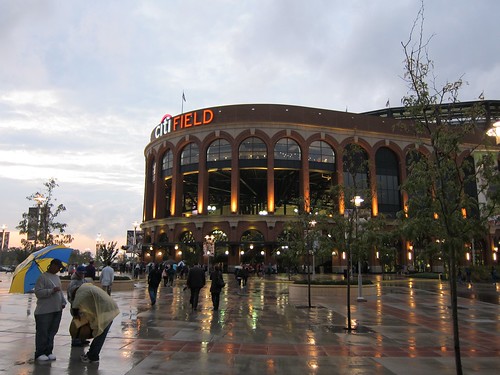
I wish I could say I had as much fun on my first trip to Citi Field as I had on my first visit to the new Yankee Stadium. Like that game, we had a rain delay, but this one happened before the game and held the first pitch until just before 8 PM. However, the rain delay allowed me to try the soft tacos, which I had heard were the best food option at the ballpark. I didn't try anything else (except a Nathan's hot dog) but I can unequivocally say yes, the tacos are worth the trip. My friend Jeremy came with me to the game and I thank him again for keeping me well-fed last night.
The game was dreadful. First of all, we were competing with the Jets-Ravens game, the Yankees-Rays game in Tampa, and the mens' final at the US Open. And it rained. And the Mets and Pirates both stink this year. One would think a 0-0 tie going into extra innings would be exciting, and from the perspective of those who enjoy good pitching, it was a great game. But the Pirates found themselves in great scoring situations, once with the bases loaded with two outs, only to have the pitcher's spot come up in the order. The Mets didn't fare any better until the bottom of the 10th when pinch hitter Nick Evans' single scored Ruben Tejada to give the home team the win. I admit I was bored for most of the game. I don't need high-scoring with lots of home runs, but I would have liked it if the Pirates had managed to put at least one run on the board when they had a chance. Pat at WHYGAVS wrote a couple of posts analyzing the bunt laid down by Jose Tabata in the top of the 10th inning. I don't know much about baseball and I couldn't figure out why Tabata bunted in that situation. After that half-inning I went for a walk around the concourse and saw the Mets' winning hit from the far side of the stadium. Rather than being upset about the loss, I was just happy I could go home, having seen the entire game.
I did get some good photos of the players at the plate, so there's that.
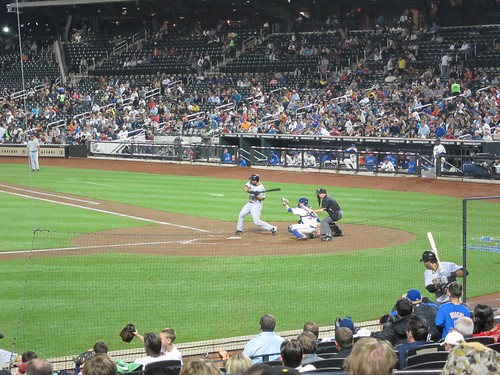
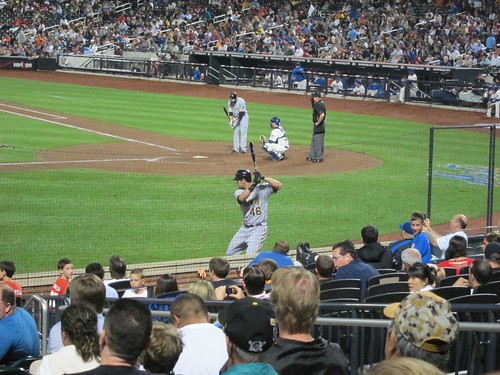
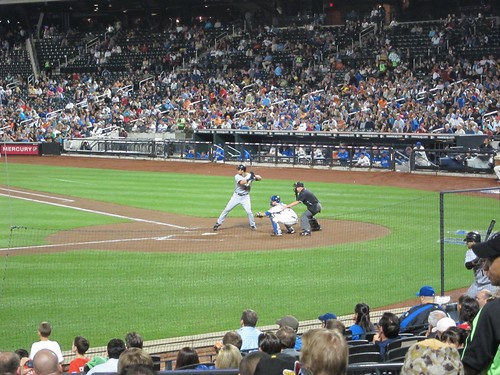
I'm going back on Wednesday, and perhaps the Pirates will have a better outing. I don't want to have to wear my team hat in shame on the 7 train again.
Wednesday, September 08, 2010
I was in Pittsburgh over Labor Day weekend on a semi-secret mission. We ate ribs, toured the Warhol Museum, avoided a Bret Michaels concert, had some delicious Indian food in Oakland, and walked all over the city. I flew JetBlue again and this time there were no incidents whatsoever. Both flights were as unremarkable as possible, which is just what I want out of a trip.
I'm still thinking about the NYRO preview and other ways I can promote the orchestra's upcoming season. Rehearsals begin Thursday night and I can't wait to get back to playing every week.
I'm still thinking about the NYRO preview and other ways I can promote the orchestra's upcoming season. Rehearsals begin Thursday night and I can't wait to get back to playing every week.
Thursday, September 02, 2010
Coming soon to this space
I hope that posting about something I plan to write is just as valid as actually writing it. With another NYRO season upon us, I'm going to write a preview of some of the music we're playing this year. If I feel particularly energized, it will happen in the next 48 hours; if not, look for it here early next week.
Subscribe to:
Posts (Atom)