I checked my Facebook page when I got home from work last night and saw that one of my friends was watching All The Right Moves, a movie about small-town high school football filmed in my hometown of Johnstown, PA. I replied that I am in the bleachers for the big football game and that I should get out my copy of the movie, find myself, and post the screencap. That's how I wound up watching the football game scene a couple of times.
In the movie, Ampipe High School is the blue-collar, smaller team facing off against Walnut Heights High School, the bigger and stronger white-collar team. Ampipe plays tough but trails most of the game. They take a 14-10 lead late in the fourth quarter and only need to keep Walnut Heights out of the end zone with less than four minutes to play. It starts to rain and, in true movie fashion, the field turns into a muddy pit in about 30 seconds. Walnut Heights throws the ball (in the rain!), moves the chains and they get to the Ampipe 10-yard line. Walnut Heights throws for the end zone and Stefan, Tom Cruise's character, gets called for pass interference on the play. Stefan protests, but it's the most blatant pass interference call in movie history. Walnut Heights gets the ball on the 1-yard line, but somehow Ampipe's defense holds. Ampipe gets the ball back on their own 1-yard line with a few seconds left. The coach (played by Craig T. Nelson) calls for a running play but the quarterback and halfback fumble the exchange. Walnut Heights recovers the ball in the end zone for the touchdown and the 17-14 win. Later, in the locker room, Coach berates Stefan for the pass interference call, without which he claims Walnut Heights wouldn't have been in position to score. Stefan gets kicked off the team and later in the movie Lea Thompson takes her shirt off.
I'm no football expert, but I could have won that game for Ampipe. All the coach had to do was order the quarterback to run out of his own end zone for a safety. That makes the score 14-12, but Ampipe gets to free-kick the ball back to Walnut Heights. Ampipe's defense had just kept a superior team from scoring from the 1-yard line. With only a few seconds left in the game, even if Walnut Heights got the ball back at midfield they have a small chance of scoring or even getting to field goal range. Unless they throw it at Stefan, who's just going to wrap up his man for another interference call. But why try a risky running play from your own end zone with the field a wet, muddy mess? In that situation, even a swing pass from the 1 is a better call than a run. A catch or an incomplete pass run time off the clock, which is your main opponent at that point. If the QB or receiver gets tackled in the end zone, it's still a safety and it's still 14-12, Ampipe wins.
I did find a shot from the movie which may or may not have me in it. About 36 minutes in, there's a shot of the crowd in the stands with a small boy in the lower-left corner of the screen cheering his head off. He's wearing a green and brown jacket with a red and white snow cap. It might be me, but I'll have to ask my mother. I remember going to the stadium for one of the nights of filming the big game scenes. I was about nine years old and it was a cold night in October. They started with a few hundred people in the stands but as the shooting went on the crowd shrank to about a hundred or so huddled in one section. At some point my mother noticed the cameras filming people standing at the railing at field level, so she sent me down there to push my way into the shot. I stood there for a while and watched the cameras moving back and forth. They told us to look at the field, not the cameras. I don't remember being told when to cheer, so I'm not sure the kid in the shot is me. If it is, do I get my own page on IMDB?
Thursday, September 24, 2009


Wednesday, September 23, 2009
Gilbert and the NY Philharmonic play Mahler, make blogger euphoric
It's difficult for me to be write objectively about music I love, such as Mahler's symphonies. So if the following review is more than a little gushing, please keep that in mind.
I expected to be impressed with Alan Gilbert's interpretation of Mahler's Symphony No. 3 and I was not disappointed. From the beginning of the symphony to the closing chords, Gilbert was in complete control. He held together the immense forces before him yet stayed out of the way and didn't let his direction overshadow the music. I noticed elements of the score that I hadn't heard before, and I like to think I know this music well after years of listening to it and even playing it once. The quietest drumbeats were as clear as the loudest declarations from the brass section. Gilbert did an excellent job keeping the musicians together despite the distance between them, especially when a solo violin played a duet with the principal horn. During the third movement's offstage post-horn solo, the audience was quieter than I've ever heard in that hall. It was as if time had stopped while the unseen soloist played. When the rest of the orchestra joined him a few measures later, you could feel the audience relax. And when the last movement started, I felt the same chills I had three years ago when I played this symphony with NYRO. At the climax of the movement, when the entire orchestra plays the theme, the strings did something I rarely see from a world-class orchestra: they bowed freely. I remember running out of bow on each note of that section. The Philharmonic's strings avoided that problem by bowing each note freely. It looked odd but sounded brilliant. I don't think I've ever heard a D major chord as gorgeous as the one at the end of last night's performance. The hall got a little dusty as the music came to a close.
I expected to be impressed with Alan Gilbert's interpretation of Mahler's Symphony No. 3 and I was not disappointed. From the beginning of the symphony to the closing chords, Gilbert was in complete control. He held together the immense forces before him yet stayed out of the way and didn't let his direction overshadow the music. I noticed elements of the score that I hadn't heard before, and I like to think I know this music well after years of listening to it and even playing it once. The quietest drumbeats were as clear as the loudest declarations from the brass section. Gilbert did an excellent job keeping the musicians together despite the distance between them, especially when a solo violin played a duet with the principal horn. During the third movement's offstage post-horn solo, the audience was quieter than I've ever heard in that hall. It was as if time had stopped while the unseen soloist played. When the rest of the orchestra joined him a few measures later, you could feel the audience relax. And when the last movement started, I felt the same chills I had three years ago when I played this symphony with NYRO. At the climax of the movement, when the entire orchestra plays the theme, the strings did something I rarely see from a world-class orchestra: they bowed freely. I remember running out of bow on each note of that section. The Philharmonic's strings avoided that problem by bowing each note freely. It looked odd but sounded brilliant. I don't think I've ever heard a D major chord as gorgeous as the one at the end of last night's performance. The hall got a little dusty as the music came to a close.
Tuesday, September 22, 2009
Alan Gilbert is already making changes
I missed this article in yesterday's New York Times about New York Philharmonic music director Alan Gilbert's changes to the orchestra so far. On opening night, I noted the new seating arrangement for the orchestra, which puts the violin sections on either side of the conductor and the lower strings in the middle. Several musicians spoke to the Times about the changes and most of them seem happy with the new arrangement. One of the violists, Irene Breslaw, liked the change, saying that she can now hear what's happening in the wind section. However, the Philharmonic's tubist, Alan Baer, may have gotten the short end of the stick. He hasn't moved, but the basses have, to the opposite side of the stage. Since the low instruments usually play together, Baer has to listen for the basses from the other side and match them.
Speaking of the Philharmonic, this evening is my first subscription concert of the new season. The orchestra is wrapping up three performances of Mahler's 3rd Symphony and as my regular readers know, if they're playing Mahler, I'm there. I thoroughly enjoyed Gilbert's interpretation of Mahler's 1st Symphony last spring, and I can't wait to hear what he does with this immense work tonight. I'm also going to a performance this weekend, after I received an e-mail offering bargain prices for Brahms and Schoenberg. And I'm going to another concert next Wednesday when my mother and her boyfriend will be here. I may have an addiction.
Speaking of the Philharmonic, this evening is my first subscription concert of the new season. The orchestra is wrapping up three performances of Mahler's 3rd Symphony and as my regular readers know, if they're playing Mahler, I'm there. I thoroughly enjoyed Gilbert's interpretation of Mahler's 1st Symphony last spring, and I can't wait to hear what he does with this immense work tonight. I'm also going to a performance this weekend, after I received an e-mail offering bargain prices for Brahms and Schoenberg. And I'm going to another concert next Wednesday when my mother and her boyfriend will be here. I may have an addiction.
Monday, September 21, 2009
Did the Steelers lose, or did I affect the outcome?
I have an unhealthy number of superstitions when it comes to watching the Steelers play. I wore the same clothes for every game in the Steelers playoff run last season, and they won the Super Bowl. I hadn't bought a Steelers jersey since 1996 until I bought the Harrison jersey last week. I wore my new #92 for the game yesterday and even put a photo of myself in full regalia on my Twitter feed. Was that hubris? When the Bears started moving the ball on the Steelers, I moved myself to the kitchen. I watched a few of the Penguins' playoff games from my kitchen and they seemed to play well when I did that. The kitchen didn't work for me yesterday. Or maybe it was working, but then I moved back to the couch because the food I made was ready to eat? And that's where I was when Jeff Reed miss his second field goal of the night. What if I'd stayed in the kitchen for the second kick? Would he have made it?
And what about the new jersey? Does this loss taint it? Does it have bad "mojo" now? Or was it the kitchen? Maybe I should have worn my old black jeans to watch the game instead of blue jeans. Sure, they're out of style, a size too big, and worn out, but I wore them throughout the 2008 playoffs.
These are the questions I ask myself the day after a Steelers loss.
And what about the new jersey? Does this loss taint it? Does it have bad "mojo" now? Or was it the kitchen? Maybe I should have worn my old black jeans to watch the game instead of blue jeans. Sure, they're out of style, a size too big, and worn out, but I wore them throughout the 2008 playoffs.
These are the questions I ask myself the day after a Steelers loss.
Wednesday, September 16, 2009
New York Philharmonic Opening Night Live Blog
It's opening night for the 2009-10 season of the New York Philharmonic. It's also Alan Gilbert's debut as music director of the orchestra, taking over for Lorin Maazel. Tonight's program begins with Magnus Lindberg's EXPO, a world premiere of a composition for the Philharmonic. Renee Fleming will appear as soloist for Olivier Messiaen's Poemes pour Mi, and the concert concludes with Hector Berlioz's Symphonie Fantastique.
I'm watching this concert on PBS, from the comfort of my couch. I could have gone to Lincoln Center to watch the concert on a big screen with my fellow music lovers, but I decided to stay home for a few reasons. So, here I am. Updates will appear at the bottom, since I don't have sophisticated live-blogging software at my disposal.
7:59: The TV is on PBS and channel Thirteen wants me to know how valuable I am as an audience member. Thankfully, it's not pledge week.
8:02: Jack Donaghy is the new host of the Philharmonic's broadcasts. I saw Alec Baldwin at a concert last June but I wasn't allowed to talk to him. Next time, I'm asking him about Button Classic.
8:04: Alan Gilbert is wearing a white tie & tails. When I've seen him conduct before, he's gone with a black smock-like thing. And they're opening with the national anthem. All the musicians stand up, except for the cellists.
8:06: I don't know anything about Magnus Lindberg, so I'll have to refer to his Wikipedia page. He's the Philharmonic's composer-in-residence for the next few years so I expect I'll get to know his music soon enough.
8:10: Looks like Gilbert went with the 19th century seating arrangement for the orchestra. The 1st and 2nd violins are on either side of the conductor, at the edge of the stage, the violas and cellos are in the middle, and the basses are on the conductor's left, behind the cellos and 1sts.
8:14: I like this new work. It's modern, but melodic and tonal. Interesting harmonies, too.
8:19: Renee Fleming appears in a picture-in-picture window to talk about the Messiaen piece. The composer wrote this work, a song cycle, as a tribute to his wife and their young marriage. We played one of Messiaen's compositions last season in NYRO. I didn't really care for it, but it wasn't the worst thing I've ever played. Faint praise, I know.
8:22: Uh oh. Of course, the text is in French and it's subtitled. I have to pay attention to what's going on now.
8:24: The "Thirteen" logo in the bottom right of my screen obscures some of the words in the subtitles. That's OK, I don't care that much what Fleming is singing.
8:29: My mother told me about a Pittsburgh Symphony Orchestra concert she and my father attended many years ago where the orchestra was playing one of Messiaen's works. Apparently the audience reception was so bad that the conductor had to ask patrons not to leave and to give the piece a chance.
Wait, what is this song about? That last line was something like "chunks of flesh will pursue you and haunt your dreams." I thought this was a song cycle about a happy marriage?
8:32: I found the program notes on the Philharmonic's web site. Here's the text I just saw flashed on my screen (and in my nightmares later):
OK, then. Messiaen wrote the words as well as the music, by the way.
8:39: That was cool. The piccolo had an out-of-time solo, during which Gilbert stopped conducting with his right hand (the one with the baton) and cued the soloist with his left hand, almost like he was teasing the melody from the instrument. It's hard to describe, obviously.
This next song is not what I would have expected. Messiaen writes about two people in battle. But I think it's really about sex. It's the line about "sacramental warriors" and the other one about how two people become one. Messiaen was deeply religious, and many of his works were influenced by Catholicism. But he also viewed sexual love as a divine gift (according to Wikipedia, my sole source of Messiaen facts tonight).
8:48: "Oh, some flowers for Renee Fleming!" The TV voice-over announcer sounded surprised. The soloist always gets flowers.
8:51: That's intermission. Fleming and Baldwin are talking about the Messiaen work. Fleming says the work needs some preparation for the listener so you can know the story behind Messiaen and his wife. That would have helped with the warrior song, I'm sure.
8:56: Gilbert and Baldwin are discussing Berlioz's Symphonie Fantastique. Gilbert says the piece is as fresh today as it was in 1830 when it was premiered. The interview ends with that little awkward thing where the two men stand there waiting for the director to tell them they're clear.
9:00: For anyone reading this who doesn't know the story told by Berlioz's work, here's a quick summary I wrote for a friend a few years ago:
Hector Berlioz was a French composer in the mid-19th century. This work is an excellent example of "programmatic music," music that tells a story without words. At 23, Berlioz was hopelessly in love with an actress, Harriet Smithson. She became the inspiration for this symphony. The story behind the music is that an artist, also desperately in love, and with an active imagination, has taken an overdose of opium. He falls into a fevered series of dreams, the contents of which are described by the different movements of the symphony. Each movement contains a theme, called the idee fixe, which represents the girl he (the artist) loves. (It's the same theme in each movement, so once you hear it, you will recognize it each time it returns.) The second movement is a ball, during which the artist sees the girl at the dance. The third movement has them in the countryside, calling out to each other. In the last two movements, the artist first dreams that he is being hanged for murdering his beloved, and then that he is the guest of honor at a witches' sabbath, where the idee fixe appears in a grotesque transformation into a dance tune.
As far as Berlioz was concerned, he wrote letters to Smithson but she ignored him for years and eventually left Paris. Several years later, she heard this symphony and realized she was the reason behind it. She met Berlioz and they were married in 1833. Unfortunately, they divorced nine years later -- they weren't such a good match.
9:04: Cartoonist Richard Thompson wrote a blog post earlier this week about Berlioz as a subject for drawing and caricature. I like what he came up with (scroll down the page).
9:09: This is what I love about Alan Gilbert at the podium. I know the members of the Philharmonic have played this piece dozens, if not hundreds, of times. It's difficult to get excited about a work that's so familiar. But he brings a fresh spirit to the music. Maybe it's because he's new and new to them so they have to pay closer attention to his gestures and interpretation. But I'd prefer to think that he's imparting a younger, more vibrant energy to the orchestra.
9:15: I'm "air-conducting." I'm surprised it took me this long. I'd go get my score of the symphony from the bedroom, but then I'd have to stop the live-blog.
9:26: I almost bought tickets for tonight's concert. As a subscriber, the Philharmonic sent me numerous e-mails about opening night. The ticket prices weren't as outrageous as I expected. But I'm going next Tuesday for Mahler's 3rd Symphony, and I've spent plenty of money on the Philharmonic already this year. Plus, I think I would have had to go in my tuxedo and get my picture taken for all the high society magazines.
9:32: I could not disagree more, Mort. The only thing I'll grant you is that the audio for this concert has little depth, so it's hard to get a sense of what this concert sounds like in the hall. But I don't hear Rachmaninoff at all. As for the clarinet solo, I was about to point out that this is the first opening night in decades where Stanley Drucker hasn't been playing clarinet.
9:40: Sorry, I got caught up in the March to the Scaffold.
9:45: More air-conducting here. I used to "conduct" this piece in my room in front of my stereo, imagining I was in front of a real orchestra.
9:52: Bravo! I love a slam-bang ending.
Well, that was fun. Maybe next time I'll live-blog a Met Opera broadcast. Thanks for watching and listening along with me tonight.
I'm watching this concert on PBS, from the comfort of my couch. I could have gone to Lincoln Center to watch the concert on a big screen with my fellow music lovers, but I decided to stay home for a few reasons. So, here I am. Updates will appear at the bottom, since I don't have sophisticated live-blogging software at my disposal.
7:59: The TV is on PBS and channel Thirteen wants me to know how valuable I am as an audience member. Thankfully, it's not pledge week.
8:02: Jack Donaghy is the new host of the Philharmonic's broadcasts. I saw Alec Baldwin at a concert last June but I wasn't allowed to talk to him. Next time, I'm asking him about Button Classic.
8:04: Alan Gilbert is wearing a white tie & tails. When I've seen him conduct before, he's gone with a black smock-like thing. And they're opening with the national anthem. All the musicians stand up, except for the cellists.
8:06: I don't know anything about Magnus Lindberg, so I'll have to refer to his Wikipedia page. He's the Philharmonic's composer-in-residence for the next few years so I expect I'll get to know his music soon enough.
8:10: Looks like Gilbert went with the 19th century seating arrangement for the orchestra. The 1st and 2nd violins are on either side of the conductor, at the edge of the stage, the violas and cellos are in the middle, and the basses are on the conductor's left, behind the cellos and 1sts.
8:14: I like this new work. It's modern, but melodic and tonal. Interesting harmonies, too.
8:19: Renee Fleming appears in a picture-in-picture window to talk about the Messiaen piece. The composer wrote this work, a song cycle, as a tribute to his wife and their young marriage. We played one of Messiaen's compositions last season in NYRO. I didn't really care for it, but it wasn't the worst thing I've ever played. Faint praise, I know.
8:22: Uh oh. Of course, the text is in French and it's subtitled. I have to pay attention to what's going on now.
8:24: The "Thirteen" logo in the bottom right of my screen obscures some of the words in the subtitles. That's OK, I don't care that much what Fleming is singing.
8:29: My mother told me about a Pittsburgh Symphony Orchestra concert she and my father attended many years ago where the orchestra was playing one of Messiaen's works. Apparently the audience reception was so bad that the conductor had to ask patrons not to leave and to give the piece a chance.
Wait, what is this song about? That last line was something like "chunks of flesh will pursue you and haunt your dreams." I thought this was a song cycle about a happy marriage?
8:32: I found the program notes on the Philharmonic's web site. Here's the text I just saw flashed on my screen (and in my nightmares later):
"Bloody scraps would follow you into the
shadows Like vomitous retching, And the noisy rapping of rings on the
unmendable door Would sound the rhythm of your despair."
OK, then. Messiaen wrote the words as well as the music, by the way.
8:39: That was cool. The piccolo had an out-of-time solo, during which Gilbert stopped conducting with his right hand (the one with the baton) and cued the soloist with his left hand, almost like he was teasing the melody from the instrument. It's hard to describe, obviously.
This next song is not what I would have expected. Messiaen writes about two people in battle. But I think it's really about sex. It's the line about "sacramental warriors" and the other one about how two people become one. Messiaen was deeply religious, and many of his works were influenced by Catholicism. But he also viewed sexual love as a divine gift (according to Wikipedia, my sole source of Messiaen facts tonight).
8:48: "Oh, some flowers for Renee Fleming!" The TV voice-over announcer sounded surprised. The soloist always gets flowers.
8:51: That's intermission. Fleming and Baldwin are talking about the Messiaen work. Fleming says the work needs some preparation for the listener so you can know the story behind Messiaen and his wife. That would have helped with the warrior song, I'm sure.
8:56: Gilbert and Baldwin are discussing Berlioz's Symphonie Fantastique. Gilbert says the piece is as fresh today as it was in 1830 when it was premiered. The interview ends with that little awkward thing where the two men stand there waiting for the director to tell them they're clear.
9:00: For anyone reading this who doesn't know the story told by Berlioz's work, here's a quick summary I wrote for a friend a few years ago:
Hector Berlioz was a French composer in the mid-19th century. This work is an excellent example of "programmatic music," music that tells a story without words. At 23, Berlioz was hopelessly in love with an actress, Harriet Smithson. She became the inspiration for this symphony. The story behind the music is that an artist, also desperately in love, and with an active imagination, has taken an overdose of opium. He falls into a fevered series of dreams, the contents of which are described by the different movements of the symphony. Each movement contains a theme, called the idee fixe, which represents the girl he (the artist) loves. (It's the same theme in each movement, so once you hear it, you will recognize it each time it returns.) The second movement is a ball, during which the artist sees the girl at the dance. The third movement has them in the countryside, calling out to each other. In the last two movements, the artist first dreams that he is being hanged for murdering his beloved, and then that he is the guest of honor at a witches' sabbath, where the idee fixe appears in a grotesque transformation into a dance tune.
As far as Berlioz was concerned, he wrote letters to Smithson but she ignored him for years and eventually left Paris. Several years later, she heard this symphony and realized she was the reason behind it. She met Berlioz and they were married in 1833. Unfortunately, they divorced nine years later -- they weren't such a good match.
9:04: Cartoonist Richard Thompson wrote a blog post earlier this week about Berlioz as a subject for drawing and caricature. I like what he came up with (scroll down the page).
9:09: This is what I love about Alan Gilbert at the podium. I know the members of the Philharmonic have played this piece dozens, if not hundreds, of times. It's difficult to get excited about a work that's so familiar. But he brings a fresh spirit to the music. Maybe it's because he's new and new to them so they have to pay closer attention to his gestures and interpretation. But I'd prefer to think that he's imparting a younger, more vibrant energy to the orchestra.
9:15: I'm "air-conducting." I'm surprised it took me this long. I'd go get my score of the symphony from the bedroom, but then I'd have to stop the live-blog.
9:26: I almost bought tickets for tonight's concert. As a subscriber, the Philharmonic sent me numerous e-mails about opening night. The ticket prices weren't as outrageous as I expected. But I'm going next Tuesday for Mahler's 3rd Symphony, and I've spent plenty of money on the Philharmonic already this year. Plus, I think I would have had to go in my tuxedo and get my picture taken for all the high society magazines.
9:32: I could not disagree more, Mort. The only thing I'll grant you is that the audio for this concert has little depth, so it's hard to get a sense of what this concert sounds like in the hall. But I don't hear Rachmaninoff at all. As for the clarinet solo, I was about to point out that this is the first opening night in decades where Stanley Drucker hasn't been playing clarinet.
9:40: Sorry, I got caught up in the March to the Scaffold.
9:45: More air-conducting here. I used to "conduct" this piece in my room in front of my stereo, imagining I was in front of a real orchestra.
9:52: Bravo! I love a slam-bang ending.
Well, that was fun. Maybe next time I'll live-blog a Met Opera broadcast. Thanks for watching and listening along with me tonight.
Tuesday, September 15, 2009
Appearing tomorrow night in this space...
I have fantasies of writing about classical music, and I can't think of a better time to start down that path than Wednesday evening. The New York Philharmonic will broadcast its opening night concert on PBS starting at 8 PM. It's Alan Gilbert's debut as the orchestra's new music director, and they will performing the world premiere of a new composition, a seldom-heard piece by Olivier Messiaen with soloist Renee Fleming, and Hector Berlioz's wonderful Symphonie Fantastique. And I'm going to live-blog the performance from my living room. I have no idea if an orchestral concert (or the TV broadcast of the same) can be live-blogged, but I'm going to find out tomorrow.
Monday, September 14, 2009
I'm ready for some football
I know you're all dying to see how I look in my new #92 James Harrison jersey, so here you go.
From the front:

And from the back:
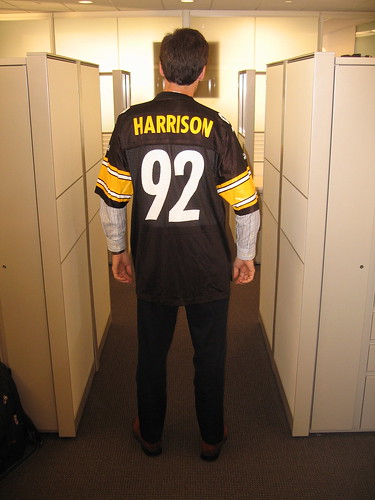
Contrary to my appearance in these photos, I do not have anything wrong with my shoulders.
From the front:
And from the back:
Contrary to my appearance in these photos, I do not have anything wrong with my shoulders.
Not my best day on the bike, but a good day anyway
I woke up at 4:30 AM on Sunday for the annual TA New York City Century bike ride. Let me rephrase that. The words "woke up" imply that one was asleep at some point prior to the alarm. I didn't sleep at all on Saturday night. I'm not sure what caused the insomnia but the possibilities include:
I took the subway to the start in Central Park and picked up my marshal kit and vest. The vest was a heavy-duty one made of some raincoat-like fabric that didn't breathe well. During the cool morning hours I didn't mind the retained body heat, but as the day wore on and the sun came out, the vest became a mobile sauna. I took it off late in the ride and felt immeasurably better. Next year, I'll bring my own orange vest, thank you.
With the lack of sleep and my general feeling of crappiness from the previous day, I ruled out a trip to the Bronx early on in my day. I kept telling myself that if I could make it to Astoria Park I would be only a few miles from the end of the ride and an hour from home. My mood and physical condition improved the more I rode, and I considered riding the Bronx part of the route after all. I didn't want to skip the Bronx, since that would mean I'd miss out on the official 100-mile route. It would be a personal disappointment, as well as a volunteer one. I was a 100-mile marshal, and I wanted to fulfill my obligation.
Around mile 60 the route took us to the Kissena Park Velodrome, a bike race track that has become a landmark on the ride. I always get a little excited to ride a lap around the velodrome, and I kicked my bike into high gear when I got onto the loop. I must have kicked it a bit too hard, because I felt a slight twinge in my right knee. I rode the quarter-mile to the next rest stop, aware that something was wrong with that knee. It ached every time I pedaled. I managed to get through the next 20 miles to the Astoria Park rest stop, but my knee was giving me some serious trouble. I had reached my early-morning goal, and now I knew that riding through the Bronx was a foolish idea. I sat for about a half hour in Astoria Park, enjoying the weather and trying not to fall asleep. When I started out again, the knee was slightly better, but not enough that I could finish the whole route. The pain was especially intense climbing the stairs on the Triborough Bridge. I coasted as much as I could the rest of the way and returned to Central Park with 89 miles on my bike odometer.
After another break and some stretching, I decided to try to ride home. It was a beautiful day, the pain wasn't that bad once I got started riding, and I really wanted those last 10 or so miles on my odometer. So I rode home. I rode slower than usual, and every time I pushed off with my right leg I winced. But the knee pain didn't get any worse or any sharper so I assumed I wasn't doing any permanent damage. I got home about 6 PM, with 101.3 miles on the odometer. While I was disappointed I didn't ride the full Century, I was happy to be home and able to walk without too much pain.
I spent the rest of my evening on the couch watching TV, icing my knee and taking ibuprofen. My knee feels better today. But I feel old. I may be 35, but I've always thought of myself as much younger. I guess I've reached the physical age where things are going to start breaking down. I see more ibuprofen in my future.
As for the ride itself, I think I need to try a different volunteer job next year. 2009 was my tenth time on the ride either as a participant or a volunteer marshal. I used to think of the Century as my favorite day of the year on my bike. But the past few years my attitude has changed. I still enjoy the ride, but the thrill has faded. The route doesn't change much from year to year and while I love seeing the outer boroughs on my bike and helping people, I don't like the early wake-up call or the shlep to Central Park on the subway. However, the Brooklyn Bridge is about 20 minutes from my apartment by bike. Riding across the bridge at dawn is one of my favorite things about the Century. Why not make that the focus of my volunteer experience? If I volunteered for the bridge crew I could sleep a few precious minutes longer and I'd spend my morning working at my favorite location on the route. And I could still ride part of the route after all the riders cross the bridge, or I could go home and go back to bed. Either way, it's a change of pace and I'll still get to be a part of a great ride.
- an overactive mind thinking about the next day's ride and waking up at an ungodly hour
- being overstimulated from watching football and talking to my brother before bed
- spending Saturday afternoon drinking beer (slowly! and with plenty of water!) and eating barbecue.
I took the subway to the start in Central Park and picked up my marshal kit and vest. The vest was a heavy-duty one made of some raincoat-like fabric that didn't breathe well. During the cool morning hours I didn't mind the retained body heat, but as the day wore on and the sun came out, the vest became a mobile sauna. I took it off late in the ride and felt immeasurably better. Next year, I'll bring my own orange vest, thank you.
With the lack of sleep and my general feeling of crappiness from the previous day, I ruled out a trip to the Bronx early on in my day. I kept telling myself that if I could make it to Astoria Park I would be only a few miles from the end of the ride and an hour from home. My mood and physical condition improved the more I rode, and I considered riding the Bronx part of the route after all. I didn't want to skip the Bronx, since that would mean I'd miss out on the official 100-mile route. It would be a personal disappointment, as well as a volunteer one. I was a 100-mile marshal, and I wanted to fulfill my obligation.
Around mile 60 the route took us to the Kissena Park Velodrome, a bike race track that has become a landmark on the ride. I always get a little excited to ride a lap around the velodrome, and I kicked my bike into high gear when I got onto the loop. I must have kicked it a bit too hard, because I felt a slight twinge in my right knee. I rode the quarter-mile to the next rest stop, aware that something was wrong with that knee. It ached every time I pedaled. I managed to get through the next 20 miles to the Astoria Park rest stop, but my knee was giving me some serious trouble. I had reached my early-morning goal, and now I knew that riding through the Bronx was a foolish idea. I sat for about a half hour in Astoria Park, enjoying the weather and trying not to fall asleep. When I started out again, the knee was slightly better, but not enough that I could finish the whole route. The pain was especially intense climbing the stairs on the Triborough Bridge. I coasted as much as I could the rest of the way and returned to Central Park with 89 miles on my bike odometer.
After another break and some stretching, I decided to try to ride home. It was a beautiful day, the pain wasn't that bad once I got started riding, and I really wanted those last 10 or so miles on my odometer. So I rode home. I rode slower than usual, and every time I pushed off with my right leg I winced. But the knee pain didn't get any worse or any sharper so I assumed I wasn't doing any permanent damage. I got home about 6 PM, with 101.3 miles on the odometer. While I was disappointed I didn't ride the full Century, I was happy to be home and able to walk without too much pain.
I spent the rest of my evening on the couch watching TV, icing my knee and taking ibuprofen. My knee feels better today. But I feel old. I may be 35, but I've always thought of myself as much younger. I guess I've reached the physical age where things are going to start breaking down. I see more ibuprofen in my future.
As for the ride itself, I think I need to try a different volunteer job next year. 2009 was my tenth time on the ride either as a participant or a volunteer marshal. I used to think of the Century as my favorite day of the year on my bike. But the past few years my attitude has changed. I still enjoy the ride, but the thrill has faded. The route doesn't change much from year to year and while I love seeing the outer boroughs on my bike and helping people, I don't like the early wake-up call or the shlep to Central Park on the subway. However, the Brooklyn Bridge is about 20 minutes from my apartment by bike. Riding across the bridge at dawn is one of my favorite things about the Century. Why not make that the focus of my volunteer experience? If I volunteered for the bridge crew I could sleep a few precious minutes longer and I'd spend my morning working at my favorite location on the route. And I could still ride part of the route after all the riders cross the bridge, or I could go home and go back to bed. Either way, it's a change of pace and I'll still get to be a part of a great ride.
Wednesday, September 09, 2009
Really early thoughts on iTunes 9
I seem to have become an early adopter. I had to grab iTunes 9 as soon as it "dropped" this afternoon. It took me about 25 minutes to download the 82 Mb installation file and roughly two minutes to install it. I launched iTunes and after the usual licensing page it went into "updating iTunes Library" mode. I had left my Time Machine backup disk connected to the laptop, and while iTunes claimed to be updating my library, my Time Machine disk was running. I didn't pay much attention at first, as Time Machine regularly backs up the disks during the day. But after 10 or 15 minutes and no change in the status, I took a chance and forced iTunes to quit. Then I disconnected the backup drive and re-launched iTunes. This time iTunes came right up. It must have detected a copy of my iTunes library on my backup disk and started to organize it. That's bad, iTunes. Leave my backups alone!
There's a slightly different look and feel to the interface. The icons along the left side have subtle changes. The smart playlists now have a gear icon instead of a note, so it's clear from the icon and the color that those playlists are different. The list view shows artists on the left and songs on the right, and the grid view has a white background instead of the older dark gray background. You can change the columns in the list view, and you can switch back to the older view with the columns on top. I'll have to play with it for a while to see which way I like it. The Podcasts page mimics the iPhone podcasts view by using a half-filled circle to indicate which podcasts you've listened to only in part.
More importantly for me, there's also an iPhone update to version 3.1. There are some video tricks and MMS enhancements in there, but the feature I like most is the ability to drag and drop your iPhone apps from iTunes. When the iPhone is connected to the computer, the Apps page shows you all of your iPhone apps by the "page" on the iPhone. You can move apps from one page to another and remove apps from the phone with the mouse. Now I can roughly organize my apps by type: one page for music-related apps, one for productivity, one for restaurants and movies, and so on.
Apple also introduced iPod Nanos with video cameras, updated the iPod Touch line with new hardware with more memory and faster video chips, and bumped the iPod Classic to 160 GB. I should say that they bumped it back to 160 GB, because I own a 160 GB Classic I bought two years ago. But this new Classic uses a one-platter hard drive, so it's thinner. But it's good to know that Apple still has an iPod for geeks like me who want to carry around all their music. And if my old Classic dies, I can replace it without spending too much or sacrificing space.
There's a slightly different look and feel to the interface. The icons along the left side have subtle changes. The smart playlists now have a gear icon instead of a note, so it's clear from the icon and the color that those playlists are different. The list view shows artists on the left and songs on the right, and the grid view has a white background instead of the older dark gray background. You can change the columns in the list view, and you can switch back to the older view with the columns on top. I'll have to play with it for a while to see which way I like it. The Podcasts page mimics the iPhone podcasts view by using a half-filled circle to indicate which podcasts you've listened to only in part.
More importantly for me, there's also an iPhone update to version 3.1. There are some video tricks and MMS enhancements in there, but the feature I like most is the ability to drag and drop your iPhone apps from iTunes. When the iPhone is connected to the computer, the Apps page shows you all of your iPhone apps by the "page" on the iPhone. You can move apps from one page to another and remove apps from the phone with the mouse. Now I can roughly organize my apps by type: one page for music-related apps, one for productivity, one for restaurants and movies, and so on.
Apple also introduced iPod Nanos with video cameras, updated the iPod Touch line with new hardware with more memory and faster video chips, and bumped the iPod Classic to 160 GB. I should say that they bumped it back to 160 GB, because I own a 160 GB Classic I bought two years ago. But this new Classic uses a one-platter hard drive, so it's thinner. But it's good to know that Apple still has an iPod for geeks like me who want to carry around all their music. And if my old Classic dies, I can replace it without spending too much or sacrificing space.
Friday, September 04, 2009
It's football season... where's my jersey?
The NFL season starts next week, and I realized a few days ago that I haven't fulfilled one of my offseason goals: buying a new Steelers jersey. My last jersey purchase was in 1996, when I bought a reversible home/away Greg Lloyd jersey. Lloyd retired a few years later. The Steelers had a couple down years in the early part of this decade, and I didn't want to risk buying a jersey with a name of a guy on the team who wouldn't be with the team the following season. But it's 2009 and the Steelers have won two championships in the past four years. I've worn a "Here We Go Steelers" long sleeved t-shirt for the past few playoff runs and while I'm usually a "if it ain't broke, don't fix it" guy, in this case I think it's OK for me to trade up. I can always go back to the t-shirt for the playoffs.
The question is which player's jersey do I want? I grew up a Terry Bradshaw fan. While I can get a custom-made Bradshaw jersey, that would strain credulity. I'd like to be able to walk into a Steelers bar in the city and NOT have fans laugh at me. I'd like to stay away from the other offensive star players. I love Ben Roethlisberger, but #7 jerseys are plentiful and I don't want to be perceived as a bandwagon guy. The same goes for Hines Ward, Santonio Holmes, and Willie Parker. On the defensive side, I'm tempted by Troy Polamalu's #43, but when I think of defense I think linebackers. So that leads me to James "Silverback" Harrison's #92. Harrison had the second most memorable play of last year's Super Bowl when he ran back a goal-line fumble 100 yards for a touchdown. Sure, he lost his mind in the second half and earned a costly penalty, but the Steelers won the game and the championship so all is forgiven. Plus, Harrison just signed a contract extension, so he's going to be with the team for a few more years. There's low risk and high reward in celebrating my team's recent championships with a #92 jersey.
Here's the real question: can I get away with paying $80 for a replica jersey? Or am I not considered a true fan unless I pay $275 for the authentic game-day jersey? I'm leaning toward the former. I bleed black and gold, but I'm not made of money.
The question is which player's jersey do I want? I grew up a Terry Bradshaw fan. While I can get a custom-made Bradshaw jersey, that would strain credulity. I'd like to be able to walk into a Steelers bar in the city and NOT have fans laugh at me. I'd like to stay away from the other offensive star players. I love Ben Roethlisberger, but #7 jerseys are plentiful and I don't want to be perceived as a bandwagon guy. The same goes for Hines Ward, Santonio Holmes, and Willie Parker. On the defensive side, I'm tempted by Troy Polamalu's #43, but when I think of defense I think linebackers. So that leads me to James "Silverback" Harrison's #92. Harrison had the second most memorable play of last year's Super Bowl when he ran back a goal-line fumble 100 yards for a touchdown. Sure, he lost his mind in the second half and earned a costly penalty, but the Steelers won the game and the championship so all is forgiven. Plus, Harrison just signed a contract extension, so he's going to be with the team for a few more years. There's low risk and high reward in celebrating my team's recent championships with a #92 jersey.
Here's the real question: can I get away with paying $80 for a replica jersey? Or am I not considered a true fan unless I pay $275 for the authentic game-day jersey? I'm leaning toward the former. I bleed black and gold, but I'm not made of money.
Sunday, August 30, 2009
The Quest for Pizza III: The Pizzaning
If it's the Sunday two weeks prior to the TA Century, then you'll find me riding the bike route with my fellow marshals as a training mission. I met the group in Prospect Park at 8:30 AM to get the cue sheets and instructions from the ride coordinator. She asked us to ride the entire Brooklyn, Queens, and Bronx sections of the route and said she thought we should get to the end of the ride in Central Park by 2 PM. I didn't want to be the negative voice in the group, but I warned her that on pre-rides past, things have not gone as planned and that I would be shocked if we got to Central Park before 5 PM. We set off around 8:45 AM and followed the usual route to Coney Island and a slight variation out to the Rockaways. Our group was about 15 people, a mix of experienced marshals and people who were new to the ride and to marshaling.
The ride leaders kept changing. We stayed together as a group for most of the day, but there were many times when a large portion of the group would sprint ahead, leaving me and my cue sheet behind. Other times they would stop at every deli we passed, or stop for several minutes to argue about where to mark a particular turn on the road. More than once I sprinted ahead of them to make up for lost time, only to have them catch and pass me. The trouble with this group was that they relied too much on the road markings, which were faded or not always clear. I lost count of the times I saw them fly past a turn because they weren't looking. To be fair, some of the turns they missed were marked on the sidewalks instead of the street, and a few of the turns weren't marked at all. After I got past my initial frustration, I tried a different tactic. There was no way they were going to let me lead the group without passing me, so I tried to keep up with them and called out the turns from the cue sheet. The riders in front of me called out the turn to the riders ahead of them, and so on. This process worked most of the way through Queens to Astoria Park. We had a can of spray paint with us and we re-marked some faded markings as we made the turns. It helped that the route was mostly the same as in previous years, so when there was any question if the turn was correct, I could rely on my memory and confirm we were going the right way.
My cell phone rang just as we got to Astoria Park at 3 PM. I pulled over to answer it and watched the rest of the group fade in the distance. The ride organizer called to let us know we could skip the Bronx part of the route and just ride straight back to Central Park from the Triboro Bridge. That was welcome news. While the day had started out cloudy, gray, and cool, the sun had burst through the clouds when we reached the Rockaways. The temperature seemed to rise from 68 to 80 degrees in a matter of minutes. By the time I reached Astoria Park I was feeling the effects of the heat and looking forward to a few minutes' rest before taking on the Bronx.
Energized by the knowledge that my assigned ride was nearly over, I looked for my fellow cyclists but didn't see them. Two other riders from the 75-mile group had caught up to me, so we rode to the Triboro Bridge together. I dropped them on the bridge path when I caught sight of my group below me on the Randall's Island path. I flew down the bridge ramp in an effort to catch up with them and warn them not to turn for the Bronx. At the bottom of the ramp I saw that they must have received the message, as they'd taken the turn for Manhattan. I kept my speed up all the way back but didn't catch up to the group until I arrived at Central Park. They were all sitting on the grass enjoying hot, delicious pizza and comparing notes on the route. A few slices of pizza and some water did wonders for my tired muscles and I set out for Brooklyn at 4:30 PM. I got home about an hour later, exhausted but excited that the ride had gone as well as it had. We didn't get lost, we stayed together as a group, and I was able to maintain a positive outlook on the day whenever something unexpected happened. I just hope that the "bad rehearsal, good concert" saying doesn't apply to bike rides. We had a good pre-ride compared to the past couple of years, so I hope today's experience bodes well for the full century in two weeks.
My computer showed 90 miles for the day and 953 miles for this year. That's more mileage than usual for this time of year. I might crack 1200 miles before the weather gets cold.
Thursday, August 27, 2009
Block Island Day 4 - Thursday, August 20
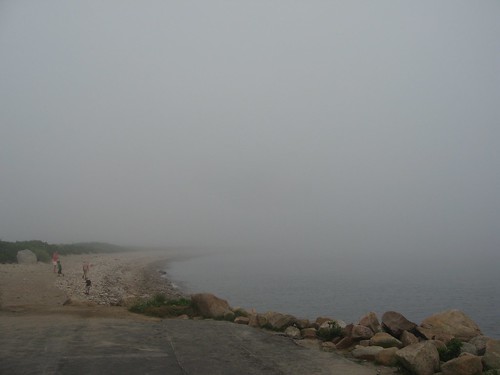
I skipped Thursday's sunrise and woke about an hour later to go on a solo bike ride around the island. It was much foggier that morning and visibility decreased as I rode higher, up to the southern lighthouse and the bluffs. I found my way back to the northern tip of the island, which seemed almost otherworldly in the fog and early morning calm. I thought about the beach scenes in The Road and wondered if this gray quiet was what Cormac McCarthy had imagined for his post-apocalyptic world. Any further thoughts of a life after a cataclysm were shattered when a young family rode up on their bikes and set off on foot for the lighthouse.
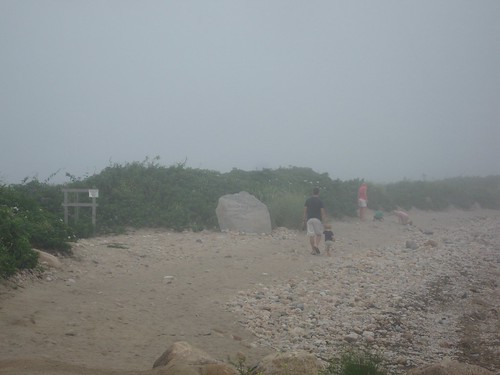
I rode back to the hotel and we packed our things. We had just enough time to get breakfast at a local coffee shop and pick up some salt water taffy before getting on the ferry for the return trip to the mainland. The fog hadn't lifted yet, and every few minutes during the crossing our ferry let out a loud blast from its foghorn. Occasionally another passing ferry or boat would sound its own horn, and it was a little creepy to hear the horns but see no ships. It reminded me of the opening scene from "Master and Commander," and I half-expected to see cannon flashes in the mist. Even when we arrived at Point Judith just after noon, the docks and beaches were shrouded in dense fog.
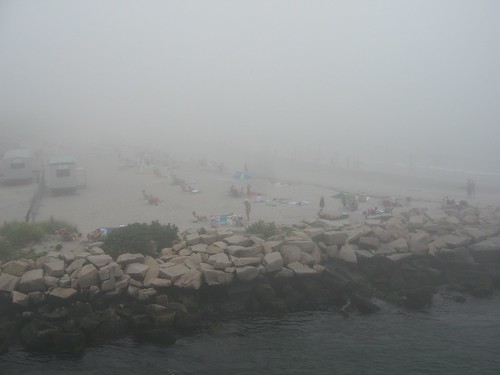
Of course, this boat was just a ferry, and the experienced crew guided us around other boats and into the dock without so much as a wayward bump. Loading the car took much less time than it had on Monday morning, and a few hours later we were back in Brooklyn.
Our all-too-brief vacation had come to an end. But we could look forward to returning to Block Island next summer. I really enjoyed the entire trip. Block Island is quiet like the beach I used to visit in North Carolina, but it's a family destination like the New Jersey shore of my childhood. Since it's so small, we saw the same families and couples throughout our stay, and I got the impression that frequent visitors will be remembered for repeated stays. I'd love to make a long weekend or few days off at Block Island a permanent part of my summer plans. I liked the place that much.
Wednesday, August 26, 2009
Block Island Day 3 - Wednesday, August 19
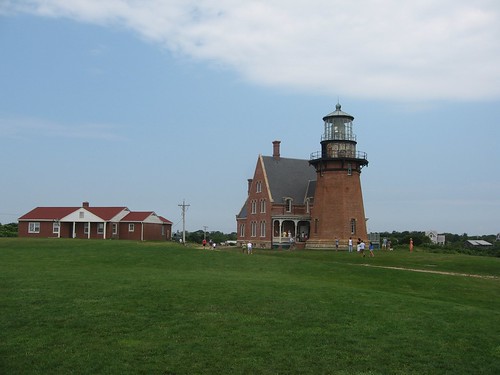
As we expected, we woke on Wednesday to find that our backs were sunburned and painful. To avoid our desperate hunger issues from the previous day, we had a big breakfast before setting out. While we'd sorted out most of the mechanical problems with Kate's bike, we couldn't do anything about her old bike seat. She was in some discomfort from Tuesday's ride, so we opted to walk the mile and a half to the southern lighthouse and Mohegan Bluffs. By forgoing the bikes, we also forgot to bring along our water bottles.
The bluffs and the beach were a short walk south from the lighthouse, and the beach itself was at the bottom of a long, steep wooden staircase that ended in a rocky climb down to the sand.
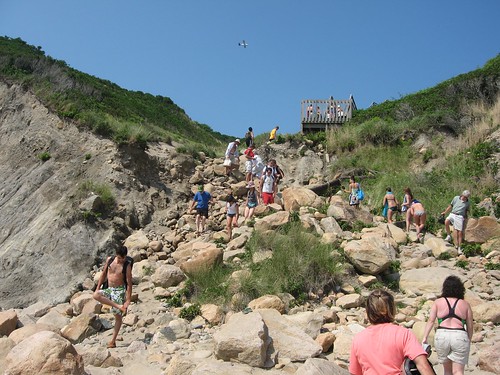
The walk down didn't bother me at all, but I was worried about the walk back up and then to the harbor since we had no water. I felt much better about the heat once we reached the beach and tried the waves. For whatever reason the water on the southern side of Block Island was warmer than on the other sides. The beach had some large rocks which helped create larger waves than on the other shores.
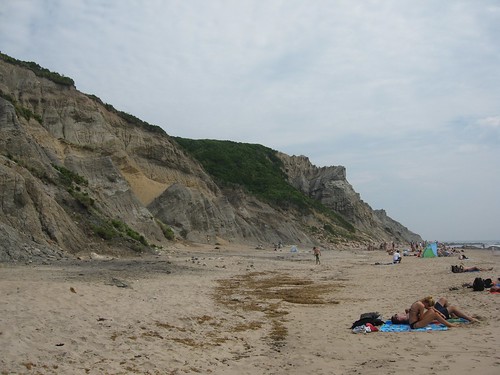
While I could have stayed in the ocean all day, by early afternoon we decided we'd had enough of the beach and started back to the hotel. The walk up the staircase wasn't much worse than the "Exorcist" steps in Georgetown, but the walk back down the road to town was brutal.
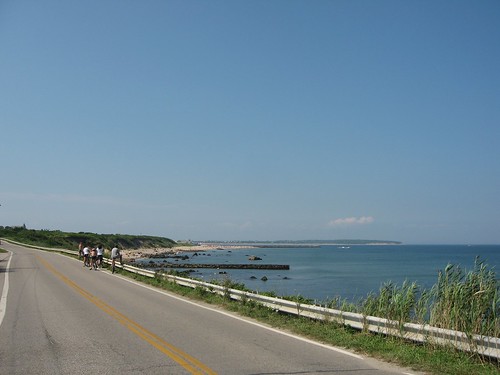
Every cyclist and moped that passed us seemed to have water bottles glistening in the afternoon sun, tempting us with their cool delicious nectar. Kate was in the mood for a pina colada and we considered stopping at a hotel bar part of the way back instead of waiting until we got to town. But I couldn't bear the thought of having to walk again after taking a break to cool off, and since it was less than two miles on a well-traveled road, we pushed on. When we got to the hotel we ordered a couple of frozen drinks and some water and spent the rest of the afternoon sitting in the shade, drinking, and people-watching. Between the heat, the sunburn, and the long walk, pina coladas have never tasted so good before.
We thought we should aim a little higher for dinner on our last night on the island. We walked past Eli's, a small restaurant with a more distinguished menu than what we'd tried thus far. Another couple passed us and stopped to recommend the place, saying it was the best meal they'd had so far. And after we ate there we decided they were right. We had an appetizer of fried calamari with a sambal dipping sauce, and for dinner Kate tried the pesto-crusted mahi mahi while I had the scallops and lobster lasagna. Kate's fish was grilled on a bed of rice and vegetables, and my entree was the seafood in a tomato cream sauce with mushrooms and asparagus, all layered between sheets of fresh pasta. It was a meal worthy of a Manhattan restaurant and far surpassed the more touristy fare we'd had. We went for a long walk after dinner, then we went back to town for ice cream from the other parlor. The mint chip was decent but not much better than the ice cream we get in Brooklyn. (Stick with Aldo's if you go to Block Island.)
While we waited in line, we got to see some poor parenting in action. There was a woman with four kids behind us in line. Two of the boys were dark-skinned and -haired and were clearly brothers. The other brother and sister were light-skinned and blond. The mother had dark hair but it was difficult to tell which of the pair were hers as none of the kids really looked like her. But the whole group was in her charge that night. The younger dark-haired brother kept shoving the younger blond boy, despite the blonde girl's and the mother's efforts to get him to stop. First Mom told the dark-haired boy to stop, then she told him he was in trouble, then she warned him that he wouldn't get any ice cream if he didn't stop shoving the little boy. The dark-haired boy complained that the blond boy was trying to cut in line for ice cream. Mom reminded him that she was paying and that none of them were cutting in line. The shovings stopped, but the dark-haired kid kept making fun of the little blond kid. At this point, Mom said something about all of them being equal and that they'd all get ice cream eventually. Then she said something like "it doesn't matter if they're liberals." Kate and I exchanged a look. We had no idea what this woman was talking about. We lost track of them after we left the shop so we didn't know if the "bad" kid got his ice cream before the other boy.
After our dessert we walked back down to the beach to check out the stars. The sheer magnitude of the night sky was one of the highlights of the trip. Sitting on a wooden piling on a darkened beach, we were able to pick out stars and constellations I hadn't seen in years. I could have sat out there for hours, like I did back home growing up.
Tuesday, August 25, 2009
Block Island Day 2 - Tuesday, August 18
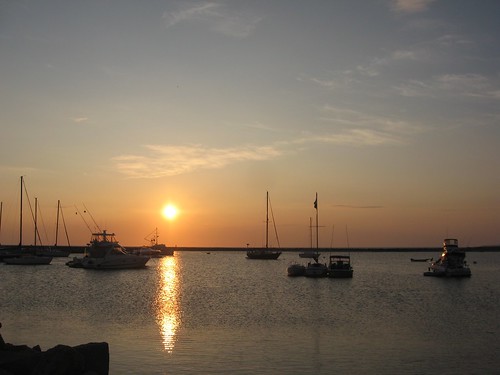
I woke up at dawn on Tuesday and Wednesday mornings to take photos of the sunrise over the harbor. I have fond memories of waking up early as a kid on beach vacations to see the sun rise over the ocean, and I didn't want to miss the show at Block Island. I think the rewards were worth the effort.
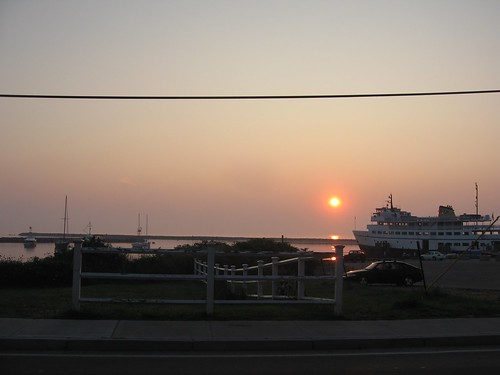

Both mornings I was able to go back to sleep for a while after waking up early. After all, I was on vacation.
On Tuesday morning we rode up to the northernmost point of the island to check out the lighthouse there. We'd hoped to swim at the beach as well, but signs and the rocks indicated that swimming was against the rules. Instead, we walked along the beach up to the lighthouse and beyond. The northern beach was bleak and foreboding. It bordered on a wildlife preserve and, except for the tourists wandering along the seaweed-strewn sands, the area was deserted.


A couple of hardy people defied the rules and went for a swim, but we decided to ride south and choose another beach. On the way back Kate led us off the main road to a beach she had visited last summer. This beach was much more crowded than the one we'd visited on Monday but after a hot ride and a long walk we didn't care about all the people and we just went into the water. The water was just as cold as it had been on Monday. Kate didn't seem to mind the temperature and made fun of me shrieking like a little girl every time a wave hit me. I kept shouting "I'm having a great time!" despite shivering and tucking my hands into my armpits.
We rode back toward the harbor for lunch, looking for a sandwich shop or a deli for a quick bite. We couldn't find anything like that and with hunger quickly taking control of our senses, we stopped at the first restaurant we found. It was the Albion Pub, a sports-bar-type place with HDTVs in the corners. We talked with the bartender (and owner?) who said that business on the island had been slow all summer long. Many residents had put off scheduled renovations or improvements to their homes, and the usual tourist crowd was down from previous years. The bar was nearly empty when we were there, but it was nearly mid-afternoon so we'd missed the lunchtime rush.
After lunch, we rode back to a nearby beach and spent the rest of the afternoon soaking up the sun, literally. We had been applying sunscreen religiously, but the SPF 30 Banana Boat lotion didn't prevent us both from getting our backs sunburned. I read and Kate dozed, and when I looked over at her she had turned a bright shade of crimson where the sun had hit her back. We went shopping before dinner for better sunblock and aloe lotion, fully aware of the pain that awaited us on Wednesday. Despite our pain we were able to enjoy dinner that night at Ballard's. Kate ordered the New England clambake (a combination platter of steamed clams, lobster, corn, and potatoes) and I had the surf & turf. I'm not sure what cut of meat my steak was, as it was perfectly square.

But it was a steak, and it was seasoned and cooked to my satisfaction. The lobster wasn't bad either. We had dessert at Aldo's, one of the two main ice cream parlors on the island. It was definitely some of the best chocolate/peanut butter cup ice cream I've ever had.
One thing I didn't realize about going on a beach vacation in New England is that the weather cooled off considerably at night. The humidity fell and the temperature dropped into the 70s, and with the constant ocean breeze it became downright chilly. We hadn't thought to bring jackets or sweaters with us, so we had to buy some Block Island sweatshirts from a local tourist shop. On the positive side, I'd wanted a hooded sweatshirt for a long time and I wanted something with "Block Island" on it as a souvenir. Thanks to the weather, I came home with both.
Monday, August 24, 2009
Block Island Day 1 - Monday, August 17
Kate and I left Brooklyn at about 7:30 AM Monday morning, headed for Point Judith, RI and the ferry to Block Island. We had loaded her car with a few days' worth of clothes, some food for the road, and our bikes. I had my Trek hybrid and Kate had an old 10-speed bike she recently bought from a former roommate. We had struggled with her bike on Sunday evening getting the front wheel off to fit the bikes in the trunk, but I had the procedure down to a lean 10 minutes. It took us about four hours to reach Point Judith, and we had about 15 minutes to walk a few blocks to the next ferry for Block Island. If we'd missed that boat we would have had to wait an hour for the next one. We walked our bikes and our luggage as fast as we could and got onto the boat with a few minutes to spare. It was a foggy but uneventful crossing, and by the time we approached the island the fog had disappeared and we could see our destination clearly.
Once we were off the ferry, we locked up our bikes across the street from our hotel and checked in. Our room wasn't ready so we decided to get some lunch. We walked about a block to Finn's, the closest thing to a "clam shack" on the island. Nearly all of the restaurants and bars on Block Island are within walking distance of the Old Harbor where the ferry docks so we didn't have far to go. Our room was ready right after lunch, so we changed into our swimsuits and rode to the beach. Kate took point and I followed, for two reasons. First, she had been to Block Island before and knew her way around. The other reason was that we had had some mechanical troubles with her bike beyond the aforementioned front wheel and I wanted to keep an eye on it. I didn't want to ride up front and leave her behind if her chain popped off, which it did several times that afternoon. We found our way to a rocky but secluded beach on the west side of the island and nearly jumped in the water. It was colder than I expected but refreshing after riding a few miles in the hot sun.


We sat on the beach for a few hours, watched a couple of dogs wander past us without paying us any attention, and only saw a few other people. We left a few hours later and nearly got lost on our way back but a few friendly joggers pointed us in the right direction. Along the way we saw a saddled but riderless horse trot past us and make a turn down a driveway that led to a stable. We didn't see a horseless rider following, and I wish I'd gotten a picture of the horse. We ate dinner that night at Beachhead Tavern, a few blocks north of our hotel, and had the first of several lobster dinners that week. The food wasn't bad, but the menus at most of the restaurants were typical beach fare: seafood, steaks, and pasta. The disappointing aspect of the dining on Block Island was that the restaurants didn't serve much in the way of fresh-from-the-ocean seafood. Most of the fish came from the mainland on the ferry.
Once we were off the ferry, we locked up our bikes across the street from our hotel and checked in. Our room wasn't ready so we decided to get some lunch. We walked about a block to Finn's, the closest thing to a "clam shack" on the island. Nearly all of the restaurants and bars on Block Island are within walking distance of the Old Harbor where the ferry docks so we didn't have far to go. Our room was ready right after lunch, so we changed into our swimsuits and rode to the beach. Kate took point and I followed, for two reasons. First, she had been to Block Island before and knew her way around. The other reason was that we had had some mechanical troubles with her bike beyond the aforementioned front wheel and I wanted to keep an eye on it. I didn't want to ride up front and leave her behind if her chain popped off, which it did several times that afternoon. We found our way to a rocky but secluded beach on the west side of the island and nearly jumped in the water. It was colder than I expected but refreshing after riding a few miles in the hot sun.
We sat on the beach for a few hours, watched a couple of dogs wander past us without paying us any attention, and only saw a few other people. We left a few hours later and nearly got lost on our way back but a few friendly joggers pointed us in the right direction. Along the way we saw a saddled but riderless horse trot past us and make a turn down a driveway that led to a stable. We didn't see a horseless rider following, and I wish I'd gotten a picture of the horse. We ate dinner that night at Beachhead Tavern, a few blocks north of our hotel, and had the first of several lobster dinners that week. The food wasn't bad, but the menus at most of the restaurants were typical beach fare: seafood, steaks, and pasta. The disappointing aspect of the dining on Block Island was that the restaurants didn't serve much in the way of fresh-from-the-ocean seafood. Most of the fish came from the mainland on the ferry.
Sunday, August 23, 2009
brief vacation report
I'm back in Brooklyn and wrapping up my last day off before returning to work. I've written up a full report on my trip to Block Island, but it's about 2500 words. I'm going to parcel it out over the next few days so as not to overwhelm the reader. Look for the first day's report sometime tomorrow, or whenever I remember to click that "publish" button.
Friday, August 14, 2009
VACATION VACATION VACATION
I haven't had a proper vacation in about four years. By that I mean a trip outside of New York as well as a total separation from anything resembling work. For years, any time spent away from work has still involved checking work e-mail and thus worrying about (or at least thinking about) some issue at the office. Until recently, the only remote device I had that was capable of sending and receiving my personal e-mail was my company Blackberry. When I read my personal e-mail, I had no way of avoiding my work e-mail as well. And if I were checking one account I might as well check both. When I've been away for more than a few days, there has always been some issue that comes up that is my responsibility. Even if I knew someone else would be able to handle the problem in my absence, I would still worry that they would either call me for help or make some odd change to fix the issue that wouldn't be the way I would have fixed it. Regardless, I end up spending part of my vacation thinking about something at work and thus not enjoying my time away from my job, which is usually the point of taking the time off in the first place.
Step one in breaking out of this habit was buying the iPhone. Now I have a hand-held e-mail device of my own that is completely separate from work. I couldn't check my work e-mail on my iPhone even if I wanted to.
The other problem with my vacations the past few years is that they haven't involved leaving everything else behind. I've either gone to visit family or I've stayed in the city for a now-trite "staycation." My initial plan for next week was to visit family, or failing that, to stay in the city and avoid any part of my regular workday routine. But when an opportunity to actually get out of New York and go somewhere new came up, I jumped at it. Next week I will spend a few days on an island, away from my computer, my Blackberry, and hopefully anything resembling a reliable cell phone signal. I'm looking forward to having nothing to do but read, eat, sleep, and enjoy a new environment. It will be refreshing. I can't wait to come back even a little bit recharged.
Step one in breaking out of this habit was buying the iPhone. Now I have a hand-held e-mail device of my own that is completely separate from work. I couldn't check my work e-mail on my iPhone even if I wanted to.
The other problem with my vacations the past few years is that they haven't involved leaving everything else behind. I've either gone to visit family or I've stayed in the city for a now-trite "staycation." My initial plan for next week was to visit family, or failing that, to stay in the city and avoid any part of my regular workday routine. But when an opportunity to actually get out of New York and go somewhere new came up, I jumped at it. Next week I will spend a few days on an island, away from my computer, my Blackberry, and hopefully anything resembling a reliable cell phone signal. I'm looking forward to having nothing to do but read, eat, sleep, and enjoy a new environment. It will be refreshing. I can't wait to come back even a little bit recharged.
Wednesday, August 12, 2009
I'll keep my bare feet to myself, thank you
I bought a pair of flip-flops on Tuesday evening. I hate sandals of any kind and I especially hate flip-flops. But I bought them because I'm going to the beach for a few days next week and I didn't want to get sand in my sneakers. Don't expect to see me wearing these shoes anywhere but the beach, or possibly when I take out the trash at home.
I don't understand people who wear flip-flops everywhere in the summer. I live in New York. The streets are filthy year-round but even more so in the summer. I know it's hot but I don't want to think about having that kind of grime anywhere near my bare feet. I've seen people wearing flip-flops at baseball games and on the subway and I shudder to think what kind of bacteria they've picked up during their day. (Gothamist enlightened us on that last point yesterday.) Suffice it to say that there are some nasty infections awaiting anyone wearing flip-flops with open cuts on their feet.
It's even worse when I see women wearing them in the office. I may be alone in thinking that flip-flops are not proper work footwear, but the double standard makes it worse. If I flipped and flopped my way around the office all day, my boss would send me down to Century 21 to buy a real pair of shoes. But it's fine for women to flap-flap-flap around the hallways in the same shoes I bought for $10. I don't want to hear about the difference between "beach" shoes and "fashion" sandals; if it makes that noise, it doesn't belong in the office.
I know I'm in the minority, and I have sometimes held extreme positions only to abandon them in the face of immense opposition. (See my past blog posts about not being an "Apple" guy and avoiding the iPod for examples.) But I don't want to ever be a sandals guy. I can say with complete and utter certainty that you will never see me in a pair of "mandals" or any other kind of exposed footwear. The world doesn't need to see my bare feet even if it's 100 degrees outside. I will wear real shoes on the hottest days and be proud of it.
I don't understand people who wear flip-flops everywhere in the summer. I live in New York. The streets are filthy year-round but even more so in the summer. I know it's hot but I don't want to think about having that kind of grime anywhere near my bare feet. I've seen people wearing flip-flops at baseball games and on the subway and I shudder to think what kind of bacteria they've picked up during their day. (Gothamist enlightened us on that last point yesterday.) Suffice it to say that there are some nasty infections awaiting anyone wearing flip-flops with open cuts on their feet.
It's even worse when I see women wearing them in the office. I may be alone in thinking that flip-flops are not proper work footwear, but the double standard makes it worse. If I flipped and flopped my way around the office all day, my boss would send me down to Century 21 to buy a real pair of shoes. But it's fine for women to flap-flap-flap around the hallways in the same shoes I bought for $10. I don't want to hear about the difference between "beach" shoes and "fashion" sandals; if it makes that noise, it doesn't belong in the office.
I know I'm in the minority, and I have sometimes held extreme positions only to abandon them in the face of immense opposition. (See my past blog posts about not being an "Apple" guy and avoiding the iPod for examples.) But I don't want to ever be a sandals guy. I can say with complete and utter certainty that you will never see me in a pair of "mandals" or any other kind of exposed footwear. The world doesn't need to see my bare feet even if it's 100 degrees outside. I will wear real shoes on the hottest days and be proud of it.
Monday, August 10, 2009
The problem with perception
I spent part of my Monday afternoon wandering around one of the floors in our offices checking the signal strength of our wireless network. Someone from the IT department had conducted a demo for some lawyers last week and reported problems with the signal and connectivity during the meeting. I went over there to check things out for myself and found that the wireless network was perfectly functional, though the signal strength meter in my Windows system tray flickered between green and yellow. The software that controls the wireless card reported 40-60% signal strength in the problem areas indicated last week by our colleague. I didn't notice any trouble connecting, reading and sending e-mail, or browsing the Internet despite the periods of "yellow" coverage.
I considered what the people who use that conference room might be thinking. They might see the yellow indicator on their computers and think that they have a problem, when in fact they are connected and working. Computers don't need a full 100% signal in order to transmit and receive data. I think the wireless signal indicators on computers are about as accurate as the bars on a cellphone. Since Wi-Fi and cellular signals are radio waves, they fluctuate depending on interference from other devices, walls, buildings, and so on. Full bars on either one doesn't mean that a phone or computer will have a robust, strong connection. Wireless networks are designed to work with less than 100% signal. A computer can connect to a wireless network with a 20% signal and still be able to send e-mail and download movies. There might be a speed drop-off, or there might not be. And even if there is a difference, it might not be noticeable without a speed test application.
But the perception is that a weak signal means a weak connection, and that's bad for network adminstrators. Most people don't understand the way wireless networks function, and to be fair, it's not necessary for everyone to know the link (or lack thereof) between signals and connectivity. The challenge for network administrators like me is whether to explain 802.11a/b/g/n networking to the general user community, or if it's better to saturate the office with access points so that the laptops always show "green." Many of my daily struggles with technology in the workplace boil down to these two choices: explain a problem to the users and how to work around it, or just throw money at the problem and make it go away. I'm not sure how this particular situation will play out. I suspect we'll choose the latter option.
I considered what the people who use that conference room might be thinking. They might see the yellow indicator on their computers and think that they have a problem, when in fact they are connected and working. Computers don't need a full 100% signal in order to transmit and receive data. I think the wireless signal indicators on computers are about as accurate as the bars on a cellphone. Since Wi-Fi and cellular signals are radio waves, they fluctuate depending on interference from other devices, walls, buildings, and so on. Full bars on either one doesn't mean that a phone or computer will have a robust, strong connection. Wireless networks are designed to work with less than 100% signal. A computer can connect to a wireless network with a 20% signal and still be able to send e-mail and download movies. There might be a speed drop-off, or there might not be. And even if there is a difference, it might not be noticeable without a speed test application.
But the perception is that a weak signal means a weak connection, and that's bad for network adminstrators. Most people don't understand the way wireless networks function, and to be fair, it's not necessary for everyone to know the link (or lack thereof) between signals and connectivity. The challenge for network administrators like me is whether to explain 802.11a/b/g/n networking to the general user community, or if it's better to saturate the office with access points so that the laptops always show "green." Many of my daily struggles with technology in the workplace boil down to these two choices: explain a problem to the users and how to work around it, or just throw money at the problem and make it go away. I'm not sure how this particular situation will play out. I suspect we'll choose the latter option.
Friday, August 07, 2009
Possible NY Philharmonic ticket problems
I received my 2009-10 New York Philharmonic season tickets in the mail a few days ago. I opened the envelope expecting to find a few sheets of perforated card stock with my tickets ready to be torn off as needed. Instead, this year the Philharmonic packaged their tickets in little tear-out books, like the kind you get from a bank for loan payments.
My problem with this format is that the ticket books are by seat, not by concert. I have two tickets for each concert on my subscription. One booklet is for seat BB105 and the other is for seat BB106. So I have to remember to take one ticket from each book for each concert. I'm paranoid about forgetting my tickets so I don't foresee any trouble for myself. But has anyone at the Philharmonic's ticket printing (or ordering) office noticed that many of their patrons are older and less, shall we say, aware of whether they have the correct tickets in their pockets? I think there will be more than a few instances of people bringing the wrong tickets to concerts this season. I'd better move up my Avery Fisher arrival time by a few minutes to account for any trouble.
My problem with this format is that the ticket books are by seat, not by concert. I have two tickets for each concert on my subscription. One booklet is for seat BB105 and the other is for seat BB106. So I have to remember to take one ticket from each book for each concert. I'm paranoid about forgetting my tickets so I don't foresee any trouble for myself. But has anyone at the Philharmonic's ticket printing (or ordering) office noticed that many of their patrons are older and less, shall we say, aware of whether they have the correct tickets in their pockets? I think there will be more than a few instances of people bringing the wrong tickets to concerts this season. I'd better move up my Avery Fisher arrival time by a few minutes to account for any trouble.
Subscribe to:
Posts (Atom)