Friday, August 06, 2010

Vacation report, part 7: Durnstein and on to Vienna

IMG_0914
The ruins of the castle above Durnstein


Friday was the last day of the Backroads part of my vacation.  We had the option of a short loop ride along the Danube or a hike up to the castle ruins above Durnstein.  I chose the ruins, as I love old castles and King Richard the Lionheart had been imprisoned there.  


There isn't much of the castle left, but the view of the town, the river, and the surrounding countryside was spectacular.  


IMG_0935


IMG_0940


IMG_0943


We also got to tour the church in Durnstein, which served as a preview of the kind of ornate decoration I would see in the churches in Vienna.


IMG_0951


IMG_0952


IMG_0955


IMG_0958

We said farewell to our guides and boarded a bus for Vienna.  I got to my hotel around 1 PM, dropped off my bags, and went out sightseeing.  


My first stop was St. Stephen's Cathedral, the most prominent building
in the city.


IMG_0981


IMG_0989


IMG_0996


IMG_1003


I took the elevator to the top of the spire and had a panoramic view of half of Vienna.  (The roof of the cathedral blocked my view of the other half of the city.)


IMG_1008


IMG_1020


Next up was the Hofburg, the residence of the Habsburgs, once the ruling family of the Austrian Empire.  On the way I stopped at Michaelerkirche (St. Michael's Church) and saw the incredible decorations on the altar and columns.  


IMG_1047
Michaelerkirche (St. Michael's Church)


The altar at Michaelerkirche


IMG_1042
The entrance to Hofburg


My guidebook recommended that I skip the Imperial Apartments at the Hofburg and see something else, so I skipped them in favor of the Kunsthistoriches  (Art History) Museum.  


IMG_1059
Kunsthistoriches (Art History) Museum


The museum reminded me of the Metropolitan Museum in New York, with the Greek and Roman exhibits, the Egyptian mummies, and room after room of portraits and landscapes.  Although the Met doesn't have a room full of art by Rubens, or this portrait of a young Franz Josef II (note the resemblance to Jeffrey Jones) and his brother, the Grand Duke.


IMG_1086


I left the Kunsthistoriches Museum just before closing and wandered past the Staatsoper on my way to the Haus der Musik, Vienna's homage to its musical heritage.  The museum dedicated its first floor to the Vienna Philharmonic, with artifacts from the orchestra's 180-year history and a theater showing their most recent New Year's Eve concert.  The second floor had exhibits on how sound works and I can see the appeal for children.  The third floor was the big payoff for me - rooms devoted to Vienna's musical masters: Haydn, Mozart, Beethoven, Schubert, Johann Strauss, and Mahler.  


The Mahler room.  I liked the nature theme.
The Mahler Room at the Haus der Musik


Finally, the fourth floor had more interactive exhibits and a game system that let you put together your own sonic composition.  I ended my day with dinner at Greichenbeisl, a restaurant once frequented by Beethoven, Schubert, and Brahms, though presumably not all at the same time.  


IMG_1110
Greichenbeisl


Sitting there drinking wine, eating strudel, and people-watching was a satisfying way to finish my first evening in Vienna.


Thursday, August 05, 2010

Vacation report, part 6: Melk Abbey

Durnstein as seen from the others side of the Danube
Durnstein as seen from the opposite bank of the Danube


Thursday's ride was a loop from Durnstein to Melk and back.  The main route was 47 miles, but there was a 54-mile option with some steep hills.  Since it was our last full day on the bikes, I was seriously tempted to go for it.  But Wednesday's ride had been a little taxing and our guides told us that we could do two of these three options: 1) ride the 54-mile loop, 2) stop for lunch in Melk, 3) visit Melk Abbey, the monastery that dominated the town.  They warned us that it was nearly impossible to do all three and get back to Durnstein in time for dinner.  Having ridden 41 miles and a major hill the day before, I opted for lunch and the abbey.  After all, I was on vacation!  


IMG_0833
Austria!


IMG_0836
Your humble correspondent


Melk
Melk


The abbey was worth the visit, as the photos will attest.  


Melk Abbey
The entrance to Melk Abbey


Melk Abbey


Melk Abbey


The Baroque design of the church in particular was a prelude of all the churches I would see in Vienna.

The church at Melk Abbey


Interior of the church at Melk Abbey


Melk Abbey


Melk Abbey


Melk Abbey


Melk Abbey


We missed a turn on the way back to Durnstein and nearly rode onto what might have been an army base.  I wasn't sure we were going the wrong way until I heard gunfire from what I assumed was a firing range.  I try to avoid machine gun fire on my vacations, so we turned around and found the correct bike path.


IMG_0899
Another castle on the Danube


When I returned to the hotel, I bid a fond farewall to the bike and parked my trusty steed in the "I'm hiking on Friday" area.  My bike tour was over, but I wasn't done with my vacation or Durnstein yet.


Wednesday, August 04, 2010

Vacation report, part 5: Ottenstein to Durnstein, Austria

We took a bus from Cesky Krumlov to an old castle in Ottenstein, Austria.  Along the way I learned that there are no longer any passport controls at the borders between EU nations, so I didn't get an Austrian stamp in my passport.  We sped through the former border checkpoint so quickly that I couldn't even take a photo of the empty drive-through booths.  Lunch was a picnic provided by one of our guides, followed by a brief lecture on the history and culture of Austria.  Then we were off and riding again. It was one of the hottest days of the trip, and even three full water bottles weren't enough. For the first time I wished I'd brought my Camelbak along.


IMG_0782
Castle in Ottenstein where we had lunch


IMG_0785
Ancient castle near Ottenstein


There was another big climb on the route that day that I wasn't about to miss.  I rode up the hill with Doug, one of the strongest cyclists in the group.  Just before we started the climb, we met an older Austrian gentleman who asked us (in broken English) where we were going and then insisted on getting out of his car and helping us with our directions. I think we convinced him we weren't lost and that we were riding up the hill for fun.  He said he'd learned English from 1940 to 1945 and we suspected he hadn't spoken it much since then.  We also wondered if he might be one of the Von Trapp children.


IMG_0794
The stream at the bottom of the big climb


Doug and I kept the same slow pace as Bob and I had used on Monday and again it worked to conserve our energy.  But it was so hot that we were running low on water.  I had one full bottle left and Doug was on his last bottle.  We didn't see our support vans at all.  While we rode through small towns on our way up the hill, we saw no stores where we could buy water.  I scooped up some cold water from a small stream next to the road, useful for pouring on my head but questionable for drinking.  Finally, near the top of the hill, I spotted an outdoor spigot at a deserted tennis court. There was no gate or door and no one to ask for permission, so we helped ourselves.  The water was delightfully cool and refreshing.  


IMG_0798
The view at the top of the climb


IMG_0799
Another view from the top


A few kilometers later we were speeding down the other side of the hill on another roller-coaster-like, hairpin-turn-filled ride.  The end of the route led us through vineyards into Durnstein, site of the imprisonment of King Richard the Lionheart and our base for the next two evenings.


IMG_0804
Vineyards outside Durnstein


At dinner that evening, we found out what had happened to the support vans.  Some of the people in the group had opted for a ride to the tops of the hills, then rode their bikes down.  And other riders took longer than expected to finish the day's ride, so the vans was out looking for them.  Doug and I got caught in the middle with no support so we had to improvise.  But all's well that ends well and we'd had a good time on a challenging hill.

Tuesday, August 03, 2010

Vacation report, part 4: Cesky Krumlov

Tuesday's ride was a 45 km loop from Cesky Krumlov to Chvalsiny and back, giving us time in the afternoon to explore the town and see the castle.  Cesky Krumlov is a tourist haven, and during the day the streets were crowded with families and travelers from around the world.  We saw more than a few backpackers and cyclists with overloaded panniers passing through and spending the night in the town's hostels.


IMG_0657
The castle at Cesky Krumlov


IMG_0663
A rare quiet moment on the streets of Cesky Krumlov


IMG_0718
The castle tower


IMG_0744
Cesky Krumlov as seen from the castle


That evening, we had a Q and A session with a local historian and linguist, a walking tour of the town, and then dinner at a restaurant. We'd been promised music which I assumed would be a local band playing traditional Czech music. Well, they were locals, but they played American bluegrass songs and sang the lyrics in Czech. 


IMG_0779


My friends (who knew about my musical skills) suggested I ask them if I could sit in on a song or two on bass. I politely declined to ask.  Before we left, our guide came over to our table and offered us some Becherovka. It's another traditional Czech liqueur, and it was nearly as vile as the slivovice was.  One of my friends described it as cloves mixed with gasoline. I think we could have used it to fuel the bus we would take to Austria on Wednesday morning.


Monday, August 02, 2010

Vacation report, part 3: Monday's ride to Cesky Krumlov

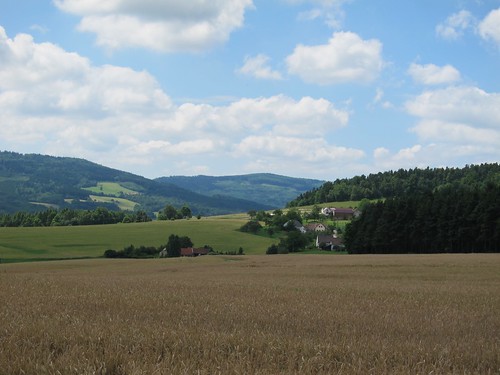
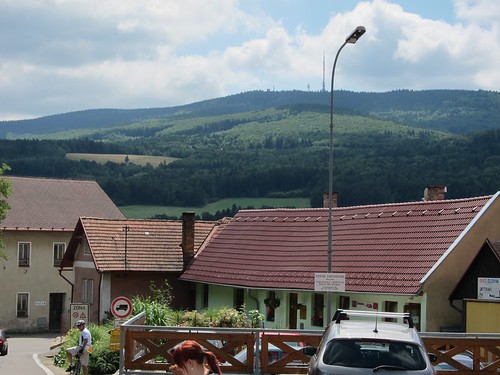
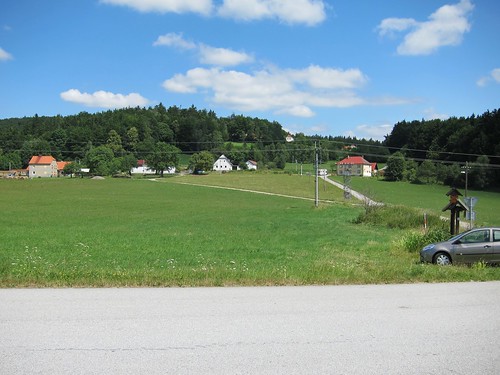
Monday's ride took us from Hluboka nad Vltavou to Cesky Krumlov, a small tourist haven situated on a triple bend on the Vltava River and dominated by an ancient castle.  Along the way we passed through farmland dotted with tiny villages, sometimes not more than a few buildings and a church.  The landscape reminded me of where I grew up in western Pennsylvania. If it weren't for the road signs in Czech I might have thought I was back home.


IMG_0573


IMG_0583


IMG_0587


IMG_0614


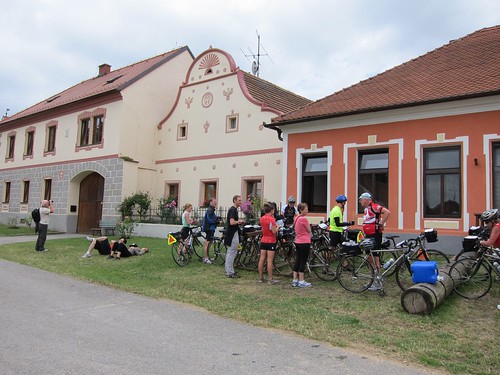
We stopped in the tiny village of Holasovice for a traditional Czech lunch of pork, dumplings, potatoes, and pancakes for dessert.  


Holasovicka Hospoda, our lunch spot.


Then the ride route took us up into some serious hills.  The biggest climb of the trip was optional: Mt. Klet, at 3600 feet. We were already about 1000 feet up so the total elevation change for us was roughly 2700 feet.  I wasn't sure I was going to attempt it.  I'd struggled up a small incline just after lunch and I didn't think my body was ready for a 15-kilometer climb.  (Backroads lists all their distances in kilometers; I'll use km for distance and feet for elevation because I'm American.)  Then I caught up to Bob, a fellow tour rider, and he talked me into it.  We had Backroads vans supporting us with water and snacks, and guides ready to bail us out if necessary. Besides, I ride up steep hills in Central and Prospect Park all the time.  How bad could a whole mountain be?


We're on our way to the antenna in the distance
We're headed to that antenna in the distance. Bob is on the lower left.


As we rode up the gradual incline, Bob started out on a slower pace than I'm used to, so I slowed down to match him and put my bike into the "granny" gear.  This was the right decision, as it forced me to pace myself and not burn up all my energy too soon.  And since we were keeping each other company we talked most of the way, another tactic that forced us to slow down.  


That little road on the right side leads to the peak of Mt. Klet.
The little road on the right leads to the summit of Mt. Klet.


The official ride route stopped about 3 km from the summit, though it indicated the way to the summit.  We decided that since we'd made it that far, we had to ride all the way to the top. As we neared the summit, another rider, Doug, came down the path toward us. He said he'd ride back up with us, saying he could use another beer. I assumed he meant later that evening at the hotel.  Our van support driver had told us that she couldn't drive up the path to get us more water so I thought that meant no cars on the path. But we'd seen a few cars coming back down the path, so I was confused. When we finally reached the summit a few minutes later I understood everything.  There was a small restaurant at the top, with a parking lot and scooter rentals.  


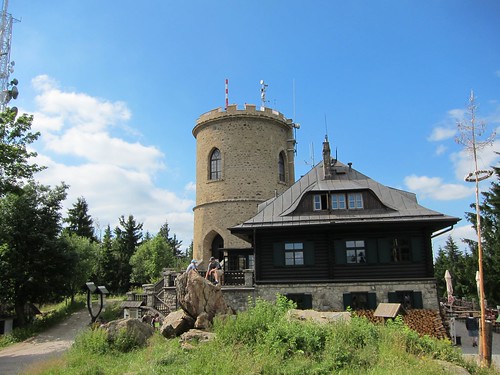
Top of Mt. Klet with 19th-century stone observatory.


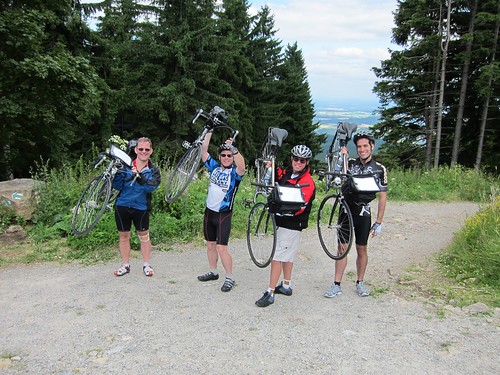
As we were about to get our celebratory beers, one of our Backroads guides and another cyclist from the tour joined us so five of us toasted reaching the summit.  


We made it! (L to R: Al, Doug, Bob, me; Bron, our guide, is behind the camera))
Al, Doug, Bob, and I at the summit of Mt. Klet


Someone suggested we put our jackets on for the descent.  Despite the heat of the day, with the altitude, the shade in the forest path, and the speed of our descent, I would have been really cold on the way down without another layer.  The ride down was utterly thrilling.  I've never experienced a descent like that before.  It was like my own little mountain stage of the Tour de France, complete with hairpin turns.


It was our first of two nights in Cesky Krumlov, and we celebrated another successful day on the bikes with a beer tasting at a local tavern and dessert at a nearby cafe.  


IMG_0638
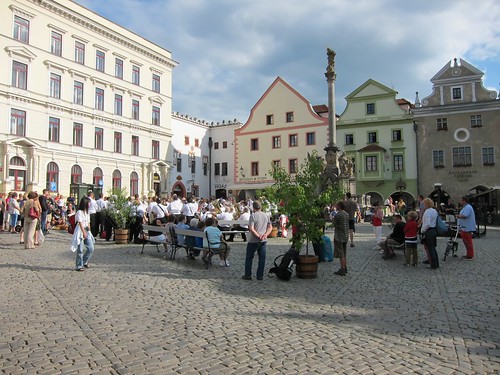
The town square in Cesky Krumlov


IMG_0671
The view from the cafe

Vacation report, part 2: The bike tour begins

I had no idea what I was getting myself into with this bike tour. I'd never done anything like it before. What if I was the youngest person there?  The oldest?  The only single person?  What if no one wanted to hang out with me?  I tried to relax and not worry about any of these things.  As it turned out I had no reason at all for any of my concerns. From the beginning of the trip, when we all met at the hotel and shuttled to a restaurant outside Prague for lunch and bike pickup, everyone on the trip was friendly and engaging.  Most of the people on the tour were older couples with grown children, though there were a few families with kids about to leave for college.  Once we all got out and rode, conversations flowed naturally, we all became friends, and I enjoyed some of the best days I've ever had on a bike.  


My trusty steed for the week
My trusty steed for the bike tour

The highlight of Sunday's ride was a stop at a slivovice distillery.  Slivovice is a Czech liqueur made from plums, though as we learned it can be made from pears and other fruits.  


Slivovice distillery tour
This is where the slivovice magic happens.


After the tour we sampled some of the distillery's product, about a thimble's worth per person. It was drinkable, if by "drinkable" you mean "an intense burning sensation the length of your esophagus."  It's the kind of drink that puts hair on your chest, which is a location where I don't need any help.  


We spent Sunday night at Hluboka nad Vltavou, a small town near the Vltava River.  There's a castle above the town that we didn't have time to tour, though I took some photos of the exterior.  The castle's onetime owners, the Schwarzenberg family, adored English Windsor architecture and rebuilt their chateau in the neo-Gothic style between 1841 and 1871.  As a result, the castle looks like a Disney movie set.  I'm not sure the following photo does the castle justice:


IMG_0559


I liked the exterior of the church in the center of Hluboka nad Vltavou as well.  It's one of the few churches I saw on my vacation that I did not get to tour.


Friday, July 30, 2010

Vacation report, part 1: Prague

IMG_0384
Charles Bridge

My first day in Prague is now a little hazy. It was hot and I was jetlagged. But I had all day to explore Old Town Square, the Charles Bridge, and Prague Castle, which is more of a massive complex than our modern concept of a castle as a fortress. 


IMG_0265
Prague Castle as seen from Charles Bridge


At its center is St. Vitus's Cathedral, which is visible from the bridge and just about any point on the Vltava River. 


IMG_0286
St. Vitus' Cathedral at Prague Castle


I walked and walked and walked some more, to the point that whenever I sat down I felt as if I could just fall asleep right there. I took a nap at the hotel before dinner, which helped matters. But after dinner and a bit more wandering around, I returned to the hotel and slept like the dead.  


After breakfast on Saturday I set out for Vysehrad, the remains of the ancient castle on the Vltava. I walked along the river then hiked up the hill to the remains, which command a spectacular view of southern Prague and the neighborhoods across the Vltava.


IMG_0446
View of Prague from wall at Vysehrad

At Vysehrad I especially enjoyed the church, built and rebuilt over the centuries to its current Neo-Gothic design, and the cemetery in which Czech luminaries such as Antonin Dvorak and Bedrich Smetana are buried.

IMG_0455
The church at Vysehrad

IMG_0459
The grave of Antonin Dvorak


Prague's National Marionette Theater is world-renowned for its production of Mozart's Don Giovanni, which originally premiered in Prague conducted by the composer. There are actually two (possibly more) productions in Prague but I found the one that claimed to be the original (with press clippings and photos of world tours to back up the claims).


IMG_0520
Prague's National Marionette Theater


I suspect it might be similar to the Ray's Pizza controversy in New York.  The show began with a marionette of Mozart as conductor, leading an unseen orchestra through the overture (the music is recorded).  The overture went a little off the rails, with the "musicians" throwing their music out of the orchestra pit and the music speeding up and slowing down. The opera itself was a delight. All of the marionettes were manipulated expertly and well-choreographed with the music.  There was a naked Don Giovanni for a bath scene and even a bit of implied marionette on marionette action during a seduction. Between scenes Mozart appeared and bumbled around, stumbling into a speaker and drinking from a tiny wine glass. During a rainstorm in a graveyard scene, he even put up an umbrella. And at the end of the opera, after Don Giovanni's demise, I'll just say that the performers tried to get their creations to end the show so we could go home, with humorous results.

I returned to my hotel and packed my bags, preparing for Sunday morning's departure for the Backroads bike tour.  I was excited about getting to see more of the Czech Republic and to meet the people who would share the experience with me.

Please check out my complete set of photos from Prague.


Thursday, July 29, 2010

I'm back...

I apologize for the long "dark" period on this blog.  If you've been following me on Twitter (and why aren't you? It's the wave of the future!) then you know I've been on vacation for the past few weeks, on a bike tour of the Czech Republic and Austria.  I had a blast while I was over there.  I enjoyed some of the best days I've ever had on a bike, I saw many, many sites I'd only read about, ate delicious Czech and Austrian food, and drank large amounts of Czech beer and Austrian wine.  I saw a marionette version of Mozart's "Don Giovanni" and heard a bluegrass band sing American classics in Czech.  I saw the excesses of the Habsburgs firsthand.  I ate in a restaurant that Beethoven, Schubert, and Brahms all  frequented.  Over the next week or so I'll have detailed posts about the trip itself and the days I spent in Prague and Vienna before and after the bike tour.  Thank you for waiting out the delay.  Your patience will soon be rewarded.

Thursday, July 08, 2010

cheating on my longtime love

It's been out for years, but I've stubbornly refused to try Google Chrome until now.  I love Firefox.  I even helped write a book about it.  But technology moves on and newer products come out, and as a geek I should make the effort to test them if I can.  So far my experience has been favorable.  Chrome imported all of my bookmarks and saved logins, so I don't even have to retype passwords in the new browser.  It does load faster than Firefox.  Chrome also uses less RAM than Firefox, but that's not a major selling point for me since I have 4 GB on my MacBook Pro and I don't usually run low on memory.

I'm going to continue using Chrome on one of my PCs at work (which only has 1.5 GB of RAM) the rest of the week and see if I notice any other benefits or drawbacks.  I don't think I'm prepared to leave Firefox behind, especially with version 4.0 coming soon.  But I'm open to experimentation.

Wednesday, June 30, 2010

"From Russia With Love:" Summertime Classics with the New York Philharmonic

The New York Philharmonic's Summertime Classics concert series isn't the type of performance I would normally seek out. They play "greatest hits" like overtures, opera arias, waltzes, and popular concertos that have been over-programmed for years.  But I had an extra ticket from last Saturday's concert that I had to use, so I exchanged it for Tuesday evening's all-Russian program, conducted by Bramwell Tovey and featuring the young Russian violinist Mikhail Simonyan.

At first glance, I didn't recognize anyone in the Philharmonic.  Was I in the right concert hall?  It looked like all of the regular string, wind, and brass principals had the night off.  For a moment I wondered if this was the Philharmonic's "B" squad.  I wouldn't fault the orchestra if it were; the subscription season ended on Saturday, and everyone deserves a vacation.  Then I noticed a few regular string players and a couple of horns I knew and felt more at home.  The audience was a bit more casual than the usual Philharmonic crowd.  While there were a few men and women who appeared overdressed for the occasion (suits and slinky cocktail dresses) there were many other people who were well-underdressed.  I saw more jeans and polo shirts than ever before.  In that way it looked more like a typical Broadway musical audience than a Philharmonic one. 

Mr. Tovey served as conductor and host, and he excelled in both roles.  As a conductor, he led the orchestra with energy and vigor and looked like he was having the time of his life.  As host, he said a few words about each piece on the program and cracked a few jokes about the music and his British heritage.  I expected his banter to be cheesy, tired old jokes but he was light and engaging.  And the audience loved him. 

The program opened with Prokofiev's March and Scherzo from The Love of Three Oranges, followed by Tchaikovsky's Violin Concerto, superbly played by Simonyan.  He's only 24 and his reading reflected his age.  It was a little rough in a few places and he and the orchestra were not always completely together.  But Simonyan's performance was exciting and he added a few touches that made the piece his own, such as taking a bit of extra time in certain places.  The work is flashy but lyrical, and he found a happy medium between the two extremes.  The audience roared its approval and Simonyan responded with a colorful gypsy melody for an encore.

The second half of the program began with selections from Alexander Glazunov's ballet Raymonda. The Philharmonic hadn't played this music in nearly forty years, and I always enjoy hearing the orchestra play something with which they're not readily familiar.  I've heard some of Glazunov's music before, but the opening to this piece sounded like the music of Richard Strauss before it settled into a more familiar Slavic tonality.  The concert closed with Tchaikovsky's Marche Slave, a rousing ode to Russian soldiers going off to fight in Serbia in 1876.  While it's the lesser-known cousin of the much more famous 1812 Overture, the work is full of its own patriotic melodies, and under Tovey's baton the Philharmonic played it with all the nationalistic fervor it deserves. 

I don't know if I would go to a Summertime Classics concert again, but I'm glad I went to this one.  I understand the appeal.  They're performances for a more casual audience, one that's less familiar with the classical repertoire.  In that respect they're not really my thing.  I'd recommend them for a prospective listener who wants to hear the Philharmonic play "popular" classical music in a fun, friendly atmosphere. 

Sunday, June 27, 2010

Lindberg and Beethoven with the New York Philharmonic

Saturday night was the final concert of the New York Philharmonic's 2009-2010 season. I was there in spirit for opening night and I thought I should be there for the closing night as well. The fact that Beethoven's Missa Solemnis was on the program didn't hurt.

The first work on the program was a new piece by the Philharmonic's composer-in-residence, Magnus Lindberg. I have a difficult time judging new music by modern composers. I have no frame of reference and I'm often afraid that it's going to be inaccessible toot-whistle-plunk-boom noise. But I've enjoyed the other Lindberg works that the Philharmonic presented this season and I was pleased with this one as well. Lindberg's music is modern but tonal. He favors energetic, frenetic passages, heavy on percussion. Al Largo reminded me of a film score, with its consonant brass fanfares and melodic lines in the strings. It didn't leave me with anything I could hum later, but it was a work that I'd gladly listen to a second time.

The major work of the concert was Beethoven's Missa Solemnis. The piece is from the same period in Beethoven's career as the Ninth Symphony and his last three piano sonatas. It's what musicians refer to as “late Beethoven.” It's more complex in tonality and harmony than his earlier symphonies, even the Ninth Symphony. The melodies are more elaborate and the interplay among the choir, soloists and orchestra is more intricate than anything in the Ninth. I know the music and I've even heard it in concert before, but I hadn't heard it quite like this. The Philharmonic projected the English translation of the Latin Mass above the orchestra, so we could all follow along with the text. Reading the words gave the piece more of a religious intensity than one would get from just listening to the performance. There were a few times in the performance that I felt almost like I was in church.  I also had to smile as I listened to the multiple false endings in the Gloria and Agnus Dei sections. They reminded me of a conversation I had with my father many years ago as I was listening to Beethoven's Third Symphony for the first time. My father poked his head in my room and said “the Eroica? Wait until you get to the end. Beethoven couldn't figure out how to end it, so he kept writing.”

The audience gave the Philharmonic and the performers a rousing standing ovation, one that I thought was well deserved. And again Alan Gilbert received the loudest applause of all. I've been thoroughly impressed with everything he's done in his first year as music director. I'm already looking forward to next season and how he'll challenge the orchestra. The New York Philharmonic is on the rise.

Wednesday, June 23, 2010

Yes, I'm taking the morning off to watch USA vs. Algeria

I've been watching the World Cup games at my desk while working, but I learned last Friday that it's much more difficult to pay attention to my job when I have an interest in the game.  I had a staff meeting during the second half of USA vs. Slovenia, and so I was more than a little distracted.  With two games in the USA's group at 9:30 AM today, I thought it best to use a half day and watch the game at home.

If the USMNT advances and we play again while I'm at work, I don't know what I'll do.  Why can't they schedule these games around my job?  Why should I have to change my plans?

Thursday, June 17, 2010

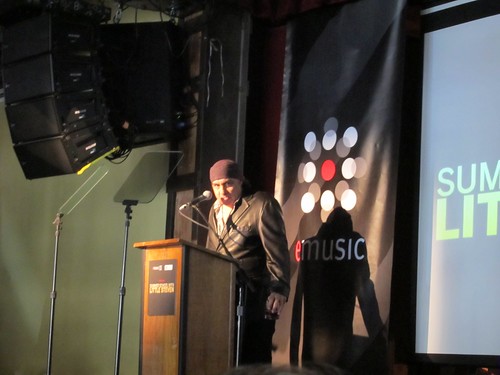
Summer School with Steven Van Zandt

On Wednesday night I had the opportunity to hear Steven Van Zandt of the E Street Band (and "The Sopranos") give a lecture at City Winery.  eMusic sponsored the event, the first in what I hope is a series of lectures and other gatherings for members of the music download service.  They billed it as a discussion of Van Zandt's ideas of what makes a great rock and roll band.  That concept initially sounded a little weak, content-wise, but I was intrigued enough to respond to the invitation anyway.  Who doesn't like free drinks and the chance to listen to a music legend?


There was a small crowd at the event, under 100 people.  Van Zandt talked for about a half-hour about the value of arrangers in rock music.  The lecture was much more interesting than I expected.  He said that all aspiring rock musicians start out as arrangers, as they learn how to play other people's music, and that being a great arranger makes you a better songwriter.  He illustrated his points with audio clips of Chuck Berry originals and The Rolling Stones' covers of those songs (some of which sounded like bootlegs from Van Zandt's collection), then he moved on to Bob Dylan and covers of his songs, and so on through the 1950s, 1960s, and 1970s.  He argued that the period from 1951 to 1971 amounted to a rock and roll renaissance.  And he said that the introduction of CDs was a scam, and that "digital music sounds so fucking bad."  I thought that was an interesting opinion considering who paid for the event.


After his talk, my friend Jessica and I went up to Van Zandt and chatted with him for a few minutes.  We thanked him for the lecture and he said that he thought it went well since he wasn't sure who the audience would be or how the material would be received.  Then we told him we are aspiring rock musicians ourselves, as a bassist and drummer, respectively.  When he heard this Van Zandt looked wary.  His eyes widened.  We thanked him again and moved along to allow others to greet him.  A moment later Jessica turned to me and said "I think he thought we wanted him to listen to our demo tape."  To our credit, we thought we looked really old for people trying to break into the business.

For more coverage of Wednesday's event, check out the Twitter hashtag #emusicsvz.  Several eMusic members, including me, live-tweeted the lecture and caught some of Van Zandt's other points that I may have missed.  I hope eMusic does other events like this one, because it's a fun way to meet other members, learn about music, and enjoy food and swag.  I'm glad I came back to the service after a brief break last year.  I just can't quit you, eMusic.

Thursday, June 10, 2010

USA vs. England in the World Cup, or A blogger divided against himself cannot stand

I'm an American.  While I'm not a “love it or leave it” kind of patriot, I love my country.  It has its problems but it's my home.  My father, on the other hand, was born in England.  He is now as American as any other guy I know, and if you met him you'd have a tough time figuring out that he isn’t originally from here.  (In fact, I'm not sure he's even aware the World Cup is taking place this month.)  I still have family living in England.  And it’s one of my favorite countries to visit.  I’ve always had a special affection for the land of my paternal ancestors.

So I have a dilemma when it comes to the World Cup and the USA vs. England match on June 12.  I want to see Team USA win the game, but I also want to see England do well in the tournament.  They haven't won the Cup since 1966, and I do enjoy seeing long championship droughts come to an end.  I think England has a much better shot at winning the World Cup than most teams, and certainly a better chance that we do.  However, I can't root against my home country and live with myself in the morning.  As Stephen Colbert used to say, “Pick a side!  We're at war!”

I'll cheer for Team USA on Saturday.  But I have to approach the match as if it were an NFL game with my favorite team playing against the quarterback on my fantasy football team.  If Team USA wins, I'll scare the neighbors with my screams of joy.  I'm sure they remember my enthusiasm for Team USA in the Olympic hockey tournament.  But if England takes us down I'm not going to be too disappointed.  Besides, with Algeria and Slovenia in our group, Team USA and England should both advance to the championship round.  Depending on the seeding, I can always hope for a rematch.