Wednesday, August 03, 2011

And now, a rant about Duke Nukem Forever


About two months ago, I pre-ordered Duke Nukem Forever for the Xbox 360.  I was a huge fan of Duke Nukem 3D in college and waited patiently but in vain for this follow-up game throughout the ‘90s.  By the time I moved to New York in 1999, I’d given up hope that the world would ever see the sequel.  I was as shocked as everyone else to find out a few years ago that the game would finally come out in 2011.

I received the game on June 14, its release date.  By that time I’d already read a couple of advance reviews and they were not positive.  But I’ve played mediocre games before, most notably the Star Wars: The Force Unleashed series, and I’ve had fun with them.  The Star Wars universe is always entertaining to me.  I hoped that I’d find a return to Duke Nukem’s world of misogyny, quips, big guns, and aliens would be as much fun as it was in 1996.  I was wrong.  I’ve actually quit playing the game part of the way through, and I’ve never quit on a game like that before.  It’s that bad.

Duke Nukem Forever is not fun to play.  It feels like work.  It’s a formulaic first-person shooter, and by that I mean you go through level after level of shooting halfway intelligent aliens and solving puzzles so you can shoot more aliens.  None of that gameplay is new to shooters, but in most shooters there’s something appealing about the effort.  For example, in Halo, the worlds in which you fight are gorgeous, lush tropical paradises, terrifying underground caverns, or creepy wrecked spaceships.  In The Force Unleashed, you play on familiar Star Wars worlds.  DNF is set in a half-destroyed Las Vegas, but there’s nothing particularly unique about the levels.  While there’s interactivity with the universe, I’m not interested in playing with toilets or making popcorn in a microwave.  Yes, you can throw objects at your enemies when you run out of ammunition (and you often run out of ammunition) but while you’re looking for a barrel or box, the aliens are killing you.

When you die, you reload the game from the last automatic save.  Duke Nukem Forever’s levels aren’t graphically intense but for whatever reason (bad coding? Bulky graphics engine? Poor overall game design?) they take over a minute to load.  And when you die often, that’s a lot of wasted time.  If I were enjoying the game play the long load times would be annoying, but in a game that feels like punching a clock, they remind you that you could be doing better things with your time.  You could be playing a better game.  At least DNF lives up to the “Forever” in its name.

After you’ve killed enough aliens, you face a big “boss.”  Again, bosses are a feature of just about every shooter I’ve ever played.  Duke Nukem’s bosses are gimmicky in that there’s a trick to defeating them.  I don’t remember the first boss I faced or how I beat it, but when I got to the “queen” alien with three giant breasts protected by impenetrable wings, I gave up.  It was such a predictable Duke Nukem thing to do.  I saw the gimmick right away: wait until the queen screams and spreads her wings, then fire rockets at the breasts.  But while you wait for her to scream, she’s throwing her offspring at you and trying to crush you with her tail (or something like that).  It was a pointless and frustrating moment in a game full of pointless and frustrating moments. 

That’s when I stopped playing.  I’ve gotten bored with games before and not finished them, or gotten distracted by another new game.  I never finished Grand Theft Auto: Vice City, GTA: San Andreas, or GTA IV, but with all three games I felt like I got my money’s worth.  (There’s always a chance I’ll go back to GTA IV if there’s a massive blizzard.)  And in the San Andreas and IV cases, I had a feeling going in that the games would be so big I’d never finish them.  I had every intention of playing Duke Nukem Forever from beginning to end, just to see where the story went and for the sheer nostalgia of shooting pig cops and flying monsters.  But I can’t do it.  I have a limited amount of time to spend on video games, and I’m not going to waste those precious hours on something that I don’t enjoy.  I played Call of Duty: Black Ops for about 45 minutes last night and had more fun in that time then in all the hours I put into Duke Nukem Forever.  There’s no chance I’ll ever put that game back into my 360.

So, does anyone want a slightly used copy of Duke Nukem Forever?

Wednesday, July 27, 2011

Chris Mueller on how to fix what went wrong in last night's Pirates-Braves game

In lieu of a half-assed rant from me about home plate umpire Jerry Meals' bad call that cost the Pirates a win in a 19-inning game, just read what 93.7 The Fan's Chris Mueller has to say about it.  Chris rants with his whole ass, and I mean that sincerely.  Also, follow Chris on Twitter and check out his call-in show.

Monday, July 25, 2011

The battlefield at Gettysburg


We spent the weekend in Gettysburg, PA, at a friend's wedding.  We arrived late on Friday night and left Sunday afternoon, so we didn't have time to spend a full day at the museum and battlefield.  So we opted to drive around the site and see as many landmarks as we could before driving back to Brooklyn on Sunday evening.

The battlefield is a national park surrounding the town of Gettysburg.  (I highly recommend looking at that link for details on the places in my photos.)  You can't walk five feet without stumbling into a memorial or monument or plaque that commemorates a regiment or a civilian hero of the battle.  But many of the key events of the battle took place on the hills and fields outside the town itself, and most of the open spaces are preserved much as they were in July 1863 when the battle occurred.  For example, when you stand on Little Round Top and look across the field at Devil's Den and the tree lines, it's not impossible to imagine what the scene must have looked like on those three days.

I want to return to the battlefield after virtual reality technology has advanced to the point where I could see an overlay of the scene in 1863 on the current landscape.  No matter how much I read about the Civil War, I'll never know what it would have felt like to be present on the field that day.  I suspect I don't really want to know.

Friday, July 22, 2011

Once again, I want to write something about my job, and once again, I will not.  You never know who's reading this thing.  It's a great job but there are times when I find it exasperating.  I shouldn't need to parse my emails as much as I do sometimes.

Friday, July 08, 2011

This week on House of PUNTE...

I'm a "special guest" on this week's House of PUNTE, AKA the KSK podcast. I talk about the Tour de France and laugh at everyone else's jokes. Please give it a listen.

Wednesday, July 06, 2011

Articles like this one by Justin Davidson make me happy to be a New York Philharmonic subscriber.  At the same time, I'm even more upset I passed on the chance to hear Magnus Lindberg's Kraft this past season.  What was I thinking?  I should have been there.

I know I should have posted a full review of the orchestra's season finale, Leos Janacek's opera The Cunning Little Vixen.  It was delightful, a spirited woodland fairy tale with creative costumes and set design.  The music was fantastic, of course, but it was almost secondary to the costumes and the set.  It was another triumph for Alan Gilbert, Douglas Fitch and his Giants Are Small production company, and the Philharmonic.  They're not doing an opera next year, but I'm confident that Gilbert and the orchestra have an impressive season ahead of them.

Tuesday, July 05, 2011

Who are these data-abusing monsters?

Gizmodo had this article about cellular carriers abandoning unlimited data plans.  In the comments, several people bragged about being grandfathered into unlimited data plans and how they used 17 GB of data last month, or in one case, 22 GB.  Who are these people?  Do they not have Wi-Fi anywhere in their immediate vicinity?  I'm the rare customer who actually likes AT&T's network, and I've rarely had problems with 3G coverage in New York.  It's slower than Wi-Fi, but it's fairly reliable.  Even so, I'd rather wait to listen to streaming radio until I'm in my apartment or office (both of which have abundant Wi-Fi coverage on fat Internet pipes) than listen to a stream while walking around outside.  And forget downloading music or apps while I'm out: I do that stuff indoors, in Wi-Fi, too.

The problem, as always, is that a small number of network users consume the most bandwidth, making it harder for the carriers to support the rest of us who use our phones sensibly.  I hope that these carrier issues will someday be a thing of the past, as Wi-Fi and WiMAX and other broadband wireless technological advances make it easier to get online anywhere.  Until then, if you believe Gizmodo, guard your unlimited data plan with your life.  Or if you're like me, get a home Internet connection, leave the house with all the music you'll ever need, and don't worry about it.

Wednesday, June 22, 2011

For my dad (who doesn't use Twitter or Facebook)

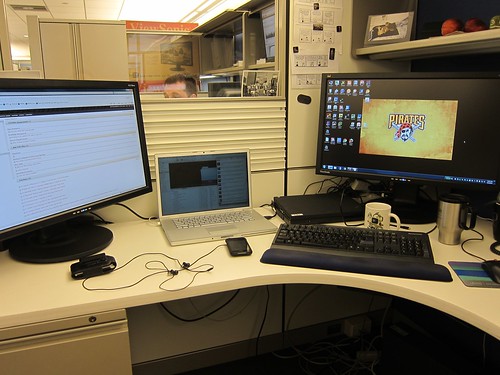
Here's a better photo of the new setup on my desk at work. And once again my MacBook Pro came to work today.

Monday, June 20, 2011

The Manhattan loop, or 30 ever-changing miles around a metropolis

I spent part of my Sunday morning and afternoon on my first Manhattan loop of 2011.  I've been riding the greenways around the perimeter of the island since 2002, and every year there's something different.  Sometimes it's different each month, if you take the never-ending construction in lower Manhattan into account.  But I always enjoy seeing the improvements in the route each year, and the areas that are still in dire need of upgrades.

I crossed the East River via the Manhattan Bridge and turned south onto the East River greenway, under the assumption that foot traffic at the South Street Seaport would still be light at 11 AM.  While it was, the NBA had set up some sort of fan festival there, so I had to take South Street all the way down to the Staten Island ferry terminal.  I took the marked bike paths around the ferry terminal (those are only a year or two old) and found myself in Battery Park.  The presence of a few Park Police squad cars convinced me to walk my bike around to the northwest exit of the park, where I picked up the West Side greenway.

There's a new detour around the World Financial Center, and I almost rode into traffic on the West Side Highway before I saw the signs directing cyclists around the back of the WFC and onto the esplanade on the river's edge.  Once I was north of the WFC the detour led back onto the greenway, which has been fully developed at least since 2002.  The path was busy but it was a straight shot all the way to the George Washington Bridge and the steepest hill I've climbed in New York.  The short but steep hill just north of the GWB is always a challenge.  I still remember when the northernmost part of this path was a rotting asphalt nightmare and riders had to take the footbridge across the Henry Hudson Parkway onto the streets near the bridge.  But it's been a well-paved path for at least seven or eight years.

I took Dyckman Street over to the Harlem River greenway, once used for horse-and-buggy races, and rode south to St. Nicholas Avenue.  I turned east onto the bike path on 120th Street, but a bike race blocked my path.  I would have loved to watch the races, but it was hot, I was getting tired, and I didn't have much in the way of food.  I doubled back onto 118th Street until I passed the race and then took 120th St. over to the northern section of the East River greenway.  The sections of this path north of 96th Street are in dire need of repairs.  Apparently the city thinks that metal barriers and orange cones are all the repairs giant sinkholes need.

The greenway took me past my old favorite park, Carl Schurz Park, where I spent many hours reading and watching the boats go by when I lived in the neighborhood.  Another construction detour forced me onto the street, so I rode over to 2nd Avenue and took that all the way down to 38th Street where I could pick up the greenway again.  Along the way, I saw all of the disruption of the 2nd Avenue Subway construction, and thought about how lucky I was that I moved before all of that work began.

The southern sections of the East River greenway haven't changed much in the past few years, though they are long overdue for a repaving.  I was grateful for the shade that the FDR overpass provides, as it was the hottest part of the day by the time I reached the Manhattan Bridge to cross the river back to Brooklyn.  I got home at 2 PM, 3 1/2 hours after I'd left, with 40 miles on the odometer.  The ride through Brooklyn to and from the Manhattan Bridge adds the extra miles, which I forgot before I set out with only a handful of energy bars and two water bottles.  Also, I say this every time, but this time I mean it: I'm leaving earlier next time.

Friday, June 10, 2011

No Concerts in the Parks this summer for the Philharmonic

On Tuesday the New York Philharmonic announced that they were canceling their free summer Concerts In The Parks for 2011.  The orchestra said that the musicians need time off and that they will perform a free concert with tenor Andrea Bocelli in September in Central Park.  But the announcement seemed to have caught parks officials and caterers (not to mention the general public) by surprise.  I can't find it now, but I read an article yesterday that quoted an Upper West Side caterer who said she had prepared bags for pre-made meals that she sells to hungry concert-goers.

I know that the orchestra is busy year-round -- their season ends in late June and begins in September, with a stop in Vail, Colorado for a music festival -- but it's odd that they used "scheduling conflicts" as an excuse.  I have a feeling that some of the sponsors decided not to participate this year.  Those concerts may be free to the public (and partially taxpayer-funded, as the New York Daily News pointed out in an editorial yesterday), but they're not free by any stretch.

I don't think the orchestra is obligated to perform in the parks each summer.  I appreciate that they do it.  For some New Yorkers, it's the only exposure they get to classical music all year.  And while the concerts have devolved into excuses for people to picnic in the park and chat with friends, sometimes to the detriment of the rest of us who are just trying to enjoy the music, I think these concerts still fulfill a vital cultural role in New York.  The Philharmonic says the concerts will return next summer.  I hope that they do.

Friday, June 03, 2011

A few quick thoughts about Thursday night at the Philharmonic

It's not a proper New York Philharmonic season for me if I don't see Anne-Sophie Mutter perform.  Her reading of Beethoven's Romance in F was lyrical and sweet.  Sebastian Currier's Time Machines, a concerto he composed for Ms. Mutter, was an unusual seven-movement work with touches of Barber, Glass, and Reich in places.  I especially enjoyed the fifth movement, titled "entropic time," in which the themes and cohesion of the music gradually disintegrated into snippets of phrases and random echoes from different instruments of the orchestra.

Bruckner's Symphony No. 2 was well-played throughout but it was the third movement that drew me into the work.  Alan Gilbert led a ferocious reading of the Scherzo that had me on the edge of my seat.  The fury of the strings combined with blasts from the brass and loud bursts from the timpani energized the orchestra and carried over to the finale.  It had been 40 years since the Philharmonic last performed this symphony.  In the program notes Gilbert states that Bruckner is a composer whose music he could conduct every day for the rest of his life.  I hope that means more Bruckner on Philharmonic programs in the future.

Friday, May 27, 2011

Return to "Foundation"

I don't have any major summer reading projects this year.  I had planned to read Infinite Jest this summer, but got pulled into an online reading project last fall and finished it in March.  I do have a sizable stack of books at home just waiting to be read, so I'll work my way through those.  One will be Noah Andre Trudeau's Gettysburg, since I'm going to a wedding there in July and I'd like to know more about the battle before I see the battlefield.  I have a few other non-fiction history books to read, such as a book on the Jewish Resistance during WWII and David McCullough's book about the Johnstown Flood.

But before I dive into all of that boring history nonsense, I'm re-reading Isaac Asimov's Foundation novels.  I devoured Asimov's fiction (and some of his non-fiction) as a kid.  I tore through the Robot novels, the Empire novels, and the Foundation series, all before I was in high school.  I remember them as fast reads but I don't recall much of the detail.  I do remember enjoying the Foundation novels more than any of his other books.  I think it was the concept of psychohistory that captivated me more than the ideas of robots solving crimes or a decaying galactic Empire. When I was home last October, I grabbed all five of the books I have in the series (not counting the two prequel novels, which Asimov wrote much later in his life) and brought them back to New York.  I think I'll read a Foundation novel, then read some non-fiction, then read another Foundation novel.  I think of them as palate cleansers.  Also, it means I'll spread out the fun over the summer.

I rarely re-read books.  The last time I remember re-reading anything was 2001, when I read the Lord Of The Rings trilogy for the third time, in preparation for the movies.  But every once in a while I think it's worth revisiting books that I've loved.  I listen to the same music over and over (though I introduce new albums all the time, I return to my favorites far more often) and I re-watch movies I love.  Why not re-read books and see what I missed the first time around?  Also, it's an excuse for me to keep all those books on my shelves.  I can always say "hey, I might want to read that again" when it comes time to clean the apartment.

Saturday, May 14, 2011

Don't kill off high school English!

As an English major in college and a fan of great reading and writing, I read Kim Brooks' essay "Death to high school English" in Salon with more than just casual interest.  Brooks' descriptions of her students' high school English classes sound similar to my own experience with the same curriculum twenty years ago.  And I could see the roots of the English education that students receive now.

My parents claim that I would read the TV Guide to them before I was two years old.  I was a "gifted" student in elementary and middle school.  In my school district, the "gifted" class was mostly a double period of English, with some special projects in other areas (never math and science, though) thrown in.  I was probably atypical even then; I would read longer books than my classmates, like novels by Asimov and Clarke, and even George Orwell's 1984 in 1984 when I was 10.  (I admit that I was too young to understand much of that book, but I wanted to read it anyway.) 

When I got to high school, the students in the "gifted" program merged into the rest of the class year, and while we had a more advanced English class, we read much of the same material as everyone else in our freshman year.  I remember reading Romeo and Juliet, then watching Zeffirelli's movie of the play.  Then we watched West Side Story, because why not?  It's the same story, or so our teacher told us.  In my sophomore English class, the material became more challenging, and our teacher assigned a few of us Faulkner's Light In August as a small group project.  We had to give a presentation to the class, and after our bumbling effort she acknowledged that the book had probably been too difficult for us.  (It definitely turned me off to Faulkner -- I haven't read any of his other books yet.)  We wrote papers and took exams as well, but there were always group projects.

I took AP English my junior and senior years, and these classes were the reason I became an English major in college.  We read some of the same books and plays as our non-AP classmates, in particular Richard III, Macbeth, and King Lear in 11th grade and Hamlet in 12th grade.   And we had group projects.  But we also had surprise essay tests in junior year, which I realized too late were meant to prepare us for the AP English test.  (I never took the AP English test.)  Our 11th grade teacher taught us the MLA style manual and worked with our AP History teacher on grammar and spelling, since many of us took history as well.  She was tough but fair, never fun and seldom funny, but we learned a lot. 

My senior year English teacher took matters a step further.  We kept a journal four or five days a week, in which we had to fill two pages.  At first, she would give us a topic every day, but as the year went on and our ability to fill those two pages (and sometimes more) increased, she would give us a "free topic."  My friends and I used those free topics to write about our lives, comment on the news, and even dabble in fiction.  I researched and wrote a long paper on humor in literature and a senior theme on science fiction.  She was also tough but fair, and she encouraged us to be creative and find our own voices. 

I think I enjoyed my music and history classes a little more, but when I think about high school I remember reading Beckett's Waiting For Godot aloud as a class and writing an almost passionate explanation of Godot as God.  I think about writing that science fiction paper and editing it until it was perfect.  I think about those English classes and how they prepared me for college-level writing.  I left for Georgetown thinking that I would major in history, but my experiences in high school English and a few classes with excellent professors showed me that English was the better path.  But I was in high school English classes with other bright, creative thinkers.  I don't know what the rest of my classmates were doing, but I have a feeling it was more along the lines of what Brooks describes.

Brooks points out all the deficiencies of the modern high school English curriculum but doesn't offer any suggestions on how to improve it. Problems like class size, teacher workload, and classroom time aren't going away and are likely to get worse.  She talks about the need for greater emphasis on teaching how to research and on teaching style and grammar.  But the bottom line is here, from a discussion with her friend Amelia Shapiro, a writing tutor in Hawaii:

When I ask her why she thinks there's such resistance to prioritizing and teaching writing, given its numerous applications, given its overlap with critical thinking skills, analytical skills, basic communication skills, she hesitates for a moment, then answers in three words: "It's not fun."
My experience in high school was that writing was something fun.  I looked forward to writing in that journal senior year.  I still look forward to writing, even if it's just emails at work.  Despite all the obstacles, I hope that more students can see the value of good writing skills, and that those skills are the most important thing they can take away from their twelve years in the school system.  Any animal can eventually pound out a barely coherent email or text message.  Writing is what makes us human.   

Wednesday, May 11, 2011

Were you voted "most likely to succeed?"

I was voted "Most Musical" in high school and I think I've lived up to that as best I could. But I hadn't thought about it at all until I saw this article.  If you're 30 and still dwelling on something from high school, you might want to talk to a professional.  You've got bigger problems on your plate.

Also, this (from Gawker writer Jeff Neumann):

The takeaway here? High school still sucks long after it's over.

Amen, brother.

Sunday, May 01, 2011

Emanuel Ax and Mahler at the NY Philharmonic

Saturday evening's concert opened with a solo performance of Debussy's Pagodes, a “slide show” for piano (as Ax and music director Alan Gilbert explained before the concert).  Gilbert said that they decided earlier in the week to perform the Debussy work back-to-back with Olivier Messiaen's Couleurs de la cité céleste, as the two pieces were similar in style and theme.  The Debussy was a short but pleasant work, and Ax's work was delightful and charming.  Gilbert, who had been standing at the podium through Ax's performance, then cued the small ensemble (horns, trumpets, trombones, winds, and percussion) for the Messiaen piece.  I'm not a fan of Messiaen's music.   The only thing I could think during the performance (which was excellent, by the way) was that his music sounds like what happens when you try to make sense of a two-year-old banging on a piano.  His music doesn't sound like music to me.  It's barely controlled random notes.  And I say this having performed Messiaen with NYRO a few years ago.   I didn't understand it then either.


After intermission, I returned to the hall to a stage filled with chairs and percussion for Mahler's Symphony No. 5.  I heard Gustavo Dudamel lead the Philharmonic in this work a little over two years ago, and I think Saturday night's performance with Alan Gilbert was ever so slightly better.  Gilbert was in full control at the podium, using every inch of space he had to hold the massive ensemble together.   Each movement had moments that gave me chills and I hung on nearly every note.  Phil Smith on trumpet and Phil Myers on horn were both magnificent, and each received well-deserved cheers at the end of the piece.   I've been to every New York Philharmonic Mahler concert this year, and I think this one was my favorite.  I'm going to be thinking about this performance for a long time, or at least until they open next season with Mahler's Symphony No. 2, my all-time favorite.

Friday, April 22, 2011

The Philadelphia Orchestra's bankruptcy filing and the state of classical music today

I was as dismayed as everyone else in the classical music community when I read that the Philadelphia Orchestra had declared bankruptcy.  It's a tough time for American orchestras.  The Detroit Symphony Orchestra's musicians' months-long strike ended just a few weeks ago.  The New Mexico Symphony Orchestra folded, as have a few others recently.  But Philadelphia is one of the most renowned American orchestras, on a level with the New York Philharmonic, the Cleveland Orchestra, and the Chicago Symphony Orchestra.  It's difficult to see an orchestra with that kind of history in financial straits.  However, bankruptcy is not the end of a business.  It's a chance to reorganize, get clear of debt and continue operating.  It's a bad thing for an organization's credit, but it's better than shutting down completely.  The Philadelphia Orchestra isn't going anywhere. 

But as this commenter on the New York Times pointed out, modern orchestras are not lean, mean musical machines.  They're bloated, with far more musicians on the regular payroll than are required by most classical works.  They have a limited repertoire.  They play the same concert three to five times a week.  And let's not even get into the aging audience for this music. 

On the other hand, I like this quote from Arts Beat's Daniel Wakin:
Some have argued too that there is nothing wrong with orchestras serving — in part — the function of museums, keeping the classics on view.
That's an argument for the status quo.  Bach, Beethoven, and Mozart aren't writing any new music, and there's a good reason orchestras keep programming Beethoven's Fifth Symphony: people will pay to hear it.  No one complains when Bruce Springsteen sings "Born To Run" in concert for the 10,000th time. And regardless of whether you listen to classical music, it's a link to our shared musical past.  It's important to keep this art form around, just as we wouldn't throw out a Picasso painting or a Giacometti sculpture.

I do hope the Philadelphia Orchestra finds a way through its current financial problems and comes out the other side stronger than ever.  But I think it will take some serious re-evaluation of the presentation and performance of classical music to get there.  Other orchestras should keep a close watch on developments in Philadelphia before their organizations reach the same state.

Thursday, April 14, 2011

Masur conducts Liszt, Gubaidulina and Brahms with the New York Philharmonic

Last night's concert by the New York Philharmonic was something of a "greatest hits" show bookending a brand-new song.  And we had the rare experience of seeing two different conductors on the same program.  Kurt Masur, the scheduled conductor for the program, had an temporary eye infection that "[impeded] his ability to see the score" (according to a program insert from the Philharmonic), so he conducted the opening and closing works on the program, and stepped aside in favor of New York Philharmonic Assistant Conductor Daniel Boico for Sofia Gubaidulina's Two Paths: Concerto for Two Violas and Orchestra.

The Philharmonic opened the concert with Franz Liszt's symphonic poem Les Preludes, one of my favorites.  Masur took the podium and received loud cheers before the orchestra made a sound.  He conducted this work (and the Brahms symphony after intermission) from memory and without a baton.  Throughout the concert, his conducting consisted more of cues and occasional indications of tempo changes than what I think of as actual conducting.  But Masur is in his 80s and while he moved well, he looked his age.  He is also Music Director Emeritus of the Philharmonic, and as his audience reception showed, he is still beloved by audiences and familiar with the orchestra and its musicians.  I got the feeling that Masur could have communicated whatever he needed to the musicians with his eyebrows and the concert would have been fantastic.  And opening with Les Preludes is sort of like Bruce Springsteen opening a show with "Born To Run."  It's a great piece of music, an audience favorite, a showcase for the entire orchestra, and music everyone in the group knows well.  And it was exciting to hear.  The brass fanfares were impressive, but what I enjoyed even more was the balance among all the instrument groups.  I heard melodies in the piece that I hadn't heard before.  I think I say that often, but it was certainly true last night. 

Daniel Boico took the podium for the Gubaidulina concerto.  His conducting was almost the polar opposite of Masur's: clear and precise beats for every measure, left hand cues when necessary, and he kept a close eye on the score.  To be fair, these concerts are only the second time the Philharmonic has performed this piece, so everyone in the room was paying extra attention, including Boico.  He had the task of being pressed into service as conductor for this piece at the last minute, and to a neophyte conductor like myself, that seems like a massive challenge.  But what an opportunity!  Boico performed admirably, managing the music and the soloists.  Principal Violist Cynthia Phelps and Associate Principal Rebecca Young were equally impressive as the soloists (they also premiered this work with the Philharmonic in 1999, under Masur).  Phelps took the higher part while Young explored the lower registers of the viola.  The music became a conversation between the soloists and the rest of the orchestra, including solo turns from Carter Brey on cello, Michelle Kim on violin, and from the winds.  It was a melancholic and mysterious piece, and well suited to the dusky tones of the violas.  I really enjoyed it, and not just as a violist.  I'll have to listen to the radio broadcast of this concert to hear it again.

After intermission, Masur returned to the podium for Johannes Brahms' Symphony No. 1, another personal and audience favorite.  Phelps and Young also returned to the stage, as the first stand in the viola section.  I thought that was interesting; I'd expected them to have the rest of the night off since they had already performed as soloists.  Masur took the tempi in the Brahms just a touch slower than other versions I've heard.  Maybe the two were unrelated, but I thought that the slightly slower tempi enhanced the tension in the first movement and brought out some of the melodies and harmonies that might otherwise remain hidden.  At the end of the work, the rousing finale brought most of the audience to its feet and Masur received another loud and extended ovation.  The audiences in New York really love his work.  I hope he keeps coming back here to conduct as long as he's able to do so.

Sports bloggers as Muppets

I don't know if there's anyone who reads my blog and doesn't follow me on Twitter or Facebook, but if you're out there, you need to read Dan Levy's post on sports bloggers as characters from the Muppets, Sesame Street, and Fraggle Rock.  I've enjoyed Dan's daily podcast for three or four years now and I'm going to miss having it as part of my daily routine.  This post is possibly the best farewell I've ever seen.  It's a labor of love that deserves a read.

Monday, April 11, 2011

Supporting the Prospect Park West bike lane

This morning I rode my slowest mile in recent memory, but it was for a great cause.  Park Slope residents organized We Ride The Lanes, a family- and community-oriented ride in support of the Prospect Park West bike lane.  Kids and adults on bikes of every shape and size rode from Grand Army Plaza to the traffic circle at 15th Street.  I didn't partake, but there were cupcakes, lemonade, and smiles all around at the end of the ride.  (Then I rode 18 miles in the park, because why not.)  There's a video of the event here, and I can be seen at about the 0:55 mark in the extreme upper left corner, waiting my turn to ride the lane.

As I was riding along the bike lane with hundreds of fellow cyclists, I realized that I just don't understand the fight over this bike lane.  It's just a bike lane!  We have much bigger problems in New York than this 20-block stretch of pavement alongside a public park in a residential neighborhood.  Transportation Alternatives, Councilman Brad Lander, and others have pointed out the safety benefits of the lane.  The traffic data shows cars are moving slower on Prospect Park West and that accidents for pedestrians and cyclists are down.  This lane is a good thing for the neighborhood.  I would hope that those opposed to this lane realize the sheer ridiculousness of the argument and turn their activism toward more urgent causes.

Friday, April 01, 2011

Wikipedia has all the answers

I was watching the 25th anniversary Les Miserables concert on PBS and it finally bothered me that all of the lower-class characters speak and sing with British Cockney accents.  Why?  Why not French accents?  Don't get me wrong: I love this musical.  But I've always wondered: why the British accents for the characters?

Wikipedia knows: it's used to represent Parisian criminal 'argot.'

Well, that was anticlimactic.

Friday, March 11, 2011

The NSO takes on Messiaen's "Turangalila"

My brother and his girlfriend are going to hear Olivier Messiaen's gargantuan "Turangalila-Symphonie" performed by the National Symphony Orchestra this weekend in Washington, DC.  I'm not a big fan of Messiaen's music but I'd go see this work in concert in a heartbeat.  It calls for a massive orchestra with obsolete instruments and makes demands on the players and audiences that few pieces do.  In short, it's a spectacle.  And I love spectacles, musical or otherwise.  It's disappointing that there were "hundreds of empty seats" at the Kennedy Center last night.  I think that New York audiences would turn out for this piece.  (A quick check of the New York Philharmonic's history shows that they've performed it twice, in 1988 and 2000, so it must have been popular enough for a second hearing.)  I look forward to hearing my brother's review of the performance.

Saturday, March 05, 2011

At the Philharmonic: Szymanowski and Mahler

I got a ticket for this concert for Mahler's Symphony No. 4, so Karol Szymanowski's Violin Concerto No. 1 with concertmaster Glenn Dicterow as soloist was a bonus. The orchestra for the concerto was easily the largest I've ever seen for a solo work: lots of strings, full wind and brass sections, an armada of percussion, a piano, celeste, and I'm sure I'm forgetting something. It was a formidable mass of instruments for guest conductor Daniel Harding to manage against Dicterow's solo violin. The music was dense and thick, as one might expect with forces of that size. Harding kept the orchestra from overwhelming the soloist, while Dicterow played with conviction. He's not a flashy soloist, more conservative than risk-taking, but he plays as if the violin was an extension of his body. I've watched Dicterow for a number of years both as a soloist and as concertmaster, and he always looks as if the violin is as much a part of him as his arms or legs. Szymanowski's music straddled a line between late Romanticism and early modernism, with Asian melodic lines sprinkled throughout. I wasn't about to leave the concert humming any of the tunes, but I'd listen to this piece again, especially if Dicterow is playing.

Harding is only 35, but he showed no signs of hesitation or tentativeness on the podium. His crisp movements reminded me of other young conductors I've seen, like the Philharmonic's own music director, Alan Gilbert. Harding didn't waste motion or conduct with an overly flashy or fluid style. He was precise and exact. I can't imagine what it would be like to be that young and that talented, to command the respect of musicians twice his age with decades of experience. He seemed unaffected by the position and the orchestra appeared to have enjoyed working with him. I hope he returns to Avery Fisher Hall soon.

After intermission the Philharmonic returned to the stage for Mahler's Symphony No. 4. It's Mahler's smallest symphony, both in terms of length and in orchestration. He excluded the trombones and tuba from his orchestra, reduces his normal battalion of percussion, and only has four horns and a more manageable wind section than his usual oversize symphonies require. It's long been my least favorite Mahler symphony. I first heard it (or saw it) on TV in England in 1989 while on vacation visiting my grandparents. It was a terrible way to see and hear this work. I didn't get any sense of the musical flow, I thought the melodies made no sense at all, and the finale, a soprano solo song about life in Heaven, underwhelmed me. So I avoided this symphony for a long time. It's only recently that as I've explored Mahler's music in depth that I returned to the Fourth and discovered how wonderful and lovely this symphony can be.

The second movement was interesting to watch as associate concertmaster Sheryl Staples switched violins several times with a spare, deliberately out-of-tune instrument on a chair in front of her. The interplay among her, clarinetist Mark Nuccio, and principal horn Philip Myers was entertaining as well. The massive E major chord in the third movement, signifying the glorious light of Heaven, gave me chills. The end of the third movement flowed directly into the finale as soprano Lisa Milne walked from the rear of the stage to the front to sing the words that describe Heaven as a place of childlike wonder, where everyone is free from worry and enjoys unimaginable food and drink prepared by saints and angels. It reads a bit hokey but it was blissful to hear. At the end of the symphony, the last notes came from the bass section and were barely audible. As they faded out, Harding kept his baton up, barely moving it as the sound faded. There were several seconds where no sound could be heard and no one in the audience dared to so much as breathe. I've never heard a concert hall go silent like that. At last, Harding lowered his hands, and the audience applauded vigorously for what was a fantastic performance.   

Wednesday, March 02, 2011

James Levine resigns as Boston Symphony Orchestra music director

One day after cancelling the remainder of his appearances this season with the Boston Symphony Orchestra, music director James Levine stepped down from his post, citing his ongoing health problems as preventing him from fulfilling his duties.  He's missed many performances in Boston and with the Metropolitan Opera in New York over the past few years.  He had rotator cuff surgery and other surgeries during that time.  His continued absences made things difficult for both organizations.

It's too bad that Levine's tenure in Boston has to end this way.  And I'm a little surprised that it happened so quickly.  But like a professional athlete, he knew that it was time to go.  The workload of managing a top-flight symphony orchestra is heavy enough, and adding his responsibilities at the Met (a post that he will maintain) was clearly too much for someone with his health problems.  With only one job, Levine will be able to focus on the Met's needs and appear as a guest conductor with orchestras if he wants.  I've enjoyed watching him at the Met and I hope he's able to continue in that position for as long as he wants.

Monday, February 28, 2011

Today in "I feel old..."

Daniel Harding is 35 and making his debut with the New York Philharmonic this weekend.  I tried to remember if I ever conducted a rehearsal of anything when I was 16.  I don't think so.  If I did, it certainly wasn't Schoenberg's Pierrot Lunaire.  It would have been something like an arrangement of songs from Les Miserables or The Phantom of the Opera, both staples of my youth orchestra's repertoire.  A videotape of those pieces wouldn't be worth much today.

If anyone does have footage of my brief appearance on stage at Georgetown University's Gaston Hall conducting the Georgetown U. Orchestra with a plastic chicken, I'd like to see it.

Thursday, February 17, 2011

RIP Sidney Harth

My mother passed along the obituary for Sidney Harth, who passed away a few days ago.  I never got to hear him play the violin, but I saw him conduct the Pittsburgh Symphony Orchestra in 1987 at Indiana University of Pennsylvania and then I had the privilege of working with him a few years later at the 1991 MENC All-Eastern Orchestra Festival in Pittsburgh.  OK, "worked with" is being generous, since I was in the far back of the viola section.  He was a firm and knowledgeable conductor for that weekend.  We only played one piece, Tchaikovsky's Francesca da Rimini, and he made sure we were fully prepared to play every note.  We were so well-prepared that one afternoon of the three-day festival he decided we would sight-read instead of rehearse.  So he split the orchestra in half (by having us take turns) and half of us read Schumann's Symphony No. 3 while the other half read a Brahms symphony.  I got to play the Schumann, which was a real treat for me as it quickly became one of my favorite symphonies.  I still have the recording of our rendition of the Tchaikovsky.  I only wish we'd been able to play at Heinz Hall instead of a massive concrete hall in the Lawrence Convention Center; the sound would have been so much better in a proper space.

It's hard for me to believe that was twenty years ago.  I remember it like it was last week.

Saturday, January 29, 2011

Beethoven, Sibelius, and Nielsen: "New" music at the New York Philharmonic

This weekend's New York Philharmonic concerts featured works by Sibelius and Nielsen that the orchestra hasn't performed in years, if at all.  There was Beethoven too, if you like hearing music you've heard dozens of times before.  (Not that I have any problems with Beethoven -- I love the guy -- but it's wonderful to hear something unfamiliar now and then.)  The music wasn't unfamiliar to me, though; I played the two Beethoven works and the Nielsen symphony with NYRO several years ago.

The concert opened with Beethoven's Symphony No. 8 in F.  I would call it a boisterous reading, with great work from the two horns in the third movement, excellent attention to dynamics (especially the recapitulation in the first movement, when the upper strings and winds play fortississimo and drown out the melody in the cellos) and I especially enjoyed watching the timpanist playing like mad on three drums at the end of the piece.  (Although there's only two drums in the score, so I don't know what he was doing, but it looked amazing from where I sat.)

A smaller Philharmonic came onstage for Beethoven's concert aria "Ah, perfido!"  Soprano Karita Mattila brought the singer's words to life, portraying a scorned woman going through a variety of emotions through ten minutes of music.  Music Director Alan Gilbert kept the orchestra out of her way, but also brought out the woodwinds when their lines and Mattila's intersected and complemented each other.

After intermission, the Philharmonic and Mattila performed three songs by Jean Sibelius.  I'd never heard these songs before (and neither had New York audiences -- two of the three had never been performed by the Philharmonic before, and the third one not since 1965) but they were unmistakably Sibelius.  I'd know those harmonies anywhere.  Once again, Mattila's voice was perfect for this music.

Finally, the Philharmonic marshaled all of its forces for Carl Nielsen's Symphony No. 2, "The Four Temperaments."  I've noted before in this space that Nielsen's music is not as popular here as it would seem to deserve.  I hope that's changing.  In the program notes, Gilbert wrote of his love for Scandinavian music (from his years as music director of the Royal Stockholm Philharmonic Orchestra) and his puzzlement at the lack of exposure to Nielsen's works.  He wrote that he plans to program all of Nielsen's symphonies over the next few years, which excites me as a musician and a fan.  The last time the Philharmonic had played Nielsen's 2nd was in 1973, shortly before I was born.  That's too long.

The first movement was crisp and stormy, with the winds and brass completely on point with short, loud blasts.  The second movement, with its languid phrases, put some of the people around me to sleep.  The ones who weren't sleeping applauded between movements, which baffled me.  Who are these people?  We don't clap between movements here!  Yes, I'm a stickler for concert etiquette.  The third movement, representing melancholia, was moving and powerful.  I just adore the long brass and string melodies in this movement, and the orchestra played them beautifully.  The last movement was spirited and bold and brought the concert to a close that the audience really seemed to appreciate.  I felt sorry for the few patrons I saw leaving at intermission.  What a treat they missed!

Wednesday, January 26, 2011

Another crazy ride on Amtrak

I don't have a great record with Amtrak and the regional trains to Maryland over the past few years.  In October 2009 I had a long delay for "police activity" and a sick passenger in Wilmington, DE.  Then in December 2009 Penn Station lost power to the tracks for several hours, turning a three-hour trip into an all-day ordeal.  These problems are unusual, but what's not unusual is that the regional trains are routinely late or delayed for reasons unknown.  And I had another such experience this past Friday night.

I was supposed to take a 6:20 PM train from Penn Station to New Carrollton, MD, arriving at 9:20 PM.  When I got to Penn Station at 5:45 my train was already 30 minutes delayed.  Five minutes later the delay increased to 50 minutes.  The PA announcer said that our train would be in the station and ready for boarding by 7:10 PM.  I called my dad and told him that I'd be at least an hour late.  We boarded the train a few minutes after 7, but we did not leave on time.  As we sat on the platform at Penn Station the train conductor read what sounded like the entire information sheet for the train, covering oft-unmentioned items such as "there are bathrooms in each train car,""don't ride in the vestibules," "a wide variety of snacks are available in the cafe car," and "we hope you are having a lovely evening in New York and we apologize for the delay."  A woman across the aisle from me asked to no one in particular "when are we leaving?"

We finally departed around 7:30 PM.  Arriving at Newark, NJ a few minutes later, we sat at the platform there for at least five minutes, which was about four minutes longer than usual.  Around 9 PM, outside of Trenton, the lights went out in the train and we ground to a halt.  The train conductor said we'd lost power and that the engineers were trying to fix the problems but until they could do so, we were "dead in the water."  I started to get a bad feeling about the whole trip as I remembered another Amtrak train stuck on the tracks between Philadelphia and Baltimore during the December blizzard.  Another conductor came into our car to apologize for the delay and to tell us that we had a "helper engine" on the way to rescue us.  The power came back on a few times, only to go off again a few minutes later.  I tried to read my book by flashlight and not think about how bad things could get.  I'd had dinner, I had used the bathroom before the power went off, and I had several warm layers in my bag.

My fellow passengers were not as outwardly calm as I was.  The woman across from me continued her running commentary, possibly on her phone, though I think she was just talking to herself.  When the conductor apologized again and suggested that we call 1-800-USA-RAIL with any complaints, a man a few rows up called them.  He demanded action on this stalled train issue and wanted a full refund.  Apparently, they told him to call back once he reached his destination.  I don't think that was the answer he wanted.

The aforementioned helper engine appeared around 9:45 PM and towed us to Philadelphia.  The conductor told us that they would change engines in Philadelphia, requiring another delay.  Or we had the option of changing to the next Washington, DC-bound train when it arrived on the opposite platform.  But Amtrak didn't say how long the engine change would take.  The chatty woman said "I ride these trains every day.  An engine change takes a half hour or 45 minutes.  I'm leaving."  Everyone in my car began packing their belongings, except for the young couple behind me.  She and I had been discussing Infinite Jest and I considered staying where I was, since I was comfortable, already late and whoever was going to pick me up in New Carrollton would have to stay up anyway.  But when the next train appeared, the car emptied out except for this couple.  She said to her boyfriend "we'll have the car to ourselves.  We can make out."  I smiled at them and said "Now I'm switching trains.  Have a good night."  I found a seat on the other train and a few minutes later we were on our way.   I wonder how long it was before that train moved.

I arrived in New Carrollton at about 12:30 AM, over three hours late.  My girlfriend (who had driven all the way from Ohio for the weekend) met me at the station, and after the ordeal I'd been through she was a most welcome sight.  In retrospect, it wasn't the worst time I'd ever had on a train, but it wasn't any fun at all.  I don't think it's too much to ask that for my $150 I get to my destination as close to on-time as possible.  Three hours is definitely not close to on time.

Some of my friends suggested that I take the Acela next time, saying that the regional trains are always unreliable.  While the Acela doesn't seem to stop at New Carrollton, I might be able to manage going to Baltimore or BWI or even Union Station instead if I could work out the schedules.  So rather than abandon Amtrak entirely, I'll give that a try next time.  Otherwise I might take advantage of one of those rental car deals that keep popping up in my e-mail.  Or one of those DC buses that are ridiculously cheap.  But I think I'm done with the regional trains for a while.

Monday, January 24, 2011

See you in Dallas in two weeks...

I hope this feeling of excitement never gets old.  The Pittsburgh Steelers are back in the Super Bowl for the third time in six seasons.  Six years ago I could only hope that this team would make it back to the championship game after a long drought.  Now, with two rings and another within our grasp, I'm just as giddy as I was in 2006 and 2009.  I can't believe I'm going to watch the Steelers play the Green Bay Packers in Super Bowl XLV in Dallas in two weeks.

I watched Sunday's AFC Championship game in Maryland with my family, as I owed them a visit after missing them at Christmas.  My stepmother and I screamed at the TV on almost every play, which was more screaming than might have been completely necessary.  As we built a seemingly insurmountable 24-3 lead before halftime, we all dared to dream about what we'd do for the Super Bowl: where we'd watch the game, who would travel, and so on. I tried to keep calm.  There's plenty of football left.  I took comfort from CBS's note that the Steelers led the Broncos 24-0 in the AFC Championship in 2006 and went on to win.

Then the New York Jets came out after halftime and cut the lead to 24-10 and ultimately to 24-19.  My heart was pounding (although that might have been from the giant sandwich and metric ton of seven layer dip I'd consumed in the 1st quarter).  I watched the clock tick down, moving far too slowly. Like the Patriots did last week, the Jets took their time marching down the field in the 4th quarter.  With 3 minutes left, they kicked off deep instead of kicking it onside (my greatest fear at that point was that they'd recover an onside kick).  I kept thinking “one more first down. Just one.”  The Jets used up their timeouts before the 2-minute warning.  One more first down was all we needed.  And when Ben Roethlisberger hit Antonio Brown for those precious few yards, my dad said “that's the game!” and I laughed and stood up and waved my Terrible Towels (I have two now) and everyone thought I was going to cry.  Ike Taylor threw his hands in the air, Rex Ryan threw his headset, and the Steelers kneeled to seal the game.

Now we move on to Dallas and the Packers.  Green Bay is a solid, dangerous team and I am not about to underestimate them.  The Steelers have experience on both offense and defense and a coaching staff that knows what it's like to play on the game's biggest stage.  I'd like to think those are advantages, but New Orleans came into last year's game against Indianapolis and proved that they could beat a talented quarterback and a recent Super Bowl champion.  Green Bay will not let Pittsburgh have a 24-0 lead by halftime.  We are in for a fight in two weeks.  We played these Packers on my birthday last year (a game I was supposed to attend until a snowstorm kept me in New York) and we only beat them at the last minute.  These are two evenly matched teams.  I think it's going to be a great game.  I'm thrilled to be a part of it.

One more thing: my superstitions might be getting out of control.  When I'm at home by myself, I wear my Steelers shirt, a Harrison jersey, carry two Terrible Towels, and I make chili (and watch the game from the kitchen sometimes) and that usually leads to victory.  Since I was at my dad's house, I couldn't make chili or watch the game from the kitchen.  Instead of ignoring my superstition for the foolishness that it is, I came up with a new one.  We all stayed seated for for most of the first half as we were eating and drinking, and the Steelers looked like world-beaters.  In the second half, my brother and his girlfriend got up to get drinks and dessert and spent a few minutes in the kitchen.  The Jets scored a touchdown.  Then my brother got up to get another drink in the 4th quarter and the Jets got a safety.  I realized that we'd been in our seats in the first half and the Steelers had played well.  I nearly ordered everyone to sit where they'd been sitting in the first half, because who knew if that had been helping the team?  I tweeted that I was threatening to tie everyone to their chairs.  My father had to use the bathroom and waited until the 2-minute warning to get up.  OK, I felt a little bad about that one.  But a trip to the Super Bowl was on the line!  You do whatever it takes to help the team.

I will try to calm down a bit for the Super Bowl, but it's going to be tremendously difficult. We're going for our seventh championship. I need to remember that nothing I do can affect the way the Steelers play. Except for what I wear, and where I watch the game, and where I hang my Steelers banner, and what I eat....

Wednesday, January 19, 2011

My computer is like an old car

When I was growing up, my mom used to talk about how her cars would always start to fall apart just when they were out of warranty.  I'm not sure if that was really the case, but it did seem that her Datsun 310 had more problems at the end of its five-year warranty than ever before.  Of course, she drove that car everywhere and it was on its third clutch by the time we traded it in for a Toyota Corolla in 1986.  Nevertheless, her words have come back to me the past few months as my Macbook Pro nears the end of its three-year warranty.

When I invested in this computer in February 2008, I knew it wouldn't last forever.  I always assumed it would hold up for about three years and then I'd buy another one.  But I didn't think its demise would be so obvious.  My Windows desktop PCs always deteriorated gradually.  Each one needed a new hard drive sometime in its lifespan, but other than that entire components didn't just fail out of nowhere.  They just started performing slower and slower until I couldn't take it anymore and bought a new desktop PC.

However, the MacBook Pro has declined in marked stages.  One evening in October it refused to come out of sleep mode or boot up.  A two-night stay at the Apple Store in midtown Manhattan resulted in a new logic board (which I assume is the motherboard).  A few weeks later I noticed that the keyboard and touchpad would stop working periodically.  They usually came back after a reboot, but by mid-December the problem was serious enough that I took it to the Genius Bar at the Apple Store in Chelsea.  That was a three-day stay (and a trip back to the mothership in Houston) for a new "top case" of a keyboard and touchpad.  I got the laptop back a few days before Christmas and it was great to have a fresh keyboard and non-worn-out touchpad, plus a fully functional 9 key.  But I suspected that something else would break sooner rather than later.

A few days ago I opened the laptop and saw that the speaker icon in the status bar was grayed out.  When I tried to play music I didn't hear anything.  System Preferences claimed that the internal speakers weren't there.  I plugged in headphones and external speakers and they worked, so the audio system itself was OK.  After a reboot my internal speakers came back.  But now they're not working again.

I'm wondering if it's worth the trouble of taking it back to the Genius Bar again in the next few weeks before the warranty runs out.  I suppose it is; if it's possible to fix the problem for free, I should do it.  Once the warranty is up I'm not getting anything fixed.  And I'm planning to buy a new MacBook Pro later this year when Apple refreshes their laptop lineup.  I just need to hold out until later this spring and hope that nothing else happens to this computer.  And I need to keep getting regular backups.  You never know when you'll lose a hard drive.

Saturday, January 08, 2011

Mozart, Mahler, and Adès at the New York Philharmonic

Friday night's New York Philharmonic concert featured music director Alan Gilbert at the podium once again.  If that wasn't enough of a draw for me, the program of Mozart's Symphony No. 40, Mahler's Kindertotenlieder, and the New York premiere of a new piano concerto by Thomas Adès pulled me in.  

I don't remember the last time I heard Mozart's 40th Symphony in concert.  It's such a well-known work that it's possible I haven't ever heard it performed live before.  Gilbert led the orchestra in a lively, exciting, and, dare I say it, ferocious reading of the work.  The first movement was energetic and forceful, highlighting the power of Mozart at his most emotional.  In the second movement, I liked the balance of the winds and the strings.  I heard suspensions in the harmonies that I've never noticed before.  The minuet and trio were well-played, with lovely work from principal horn Phil Myers, and the finale, marked "Allegro assai" was nearly a "Vivace."  The fury with which the strings played their runs and tossed the melodic lines back and forth gave me chills.

Baritone Thomas Hampson took the stage for Mahler's Kindertotenlieder, a song cycle of poems written by Friedrich Rückert after the deaths of his two children from scarlet fever.  Mahler took five of the 428 poems and set them to wrenching, heartbreaking music.  I'd seen Hampson in concert with the Philharmonic on TV, and his voice was even more impressive in person.  He took Mahler's tragic melodies and brought them to life.  I could feel the pain of the poet, lamenting the demise of his daughter as he remembered her running into a room after his wife.  The words and music painted a truly affecting picture.

After intermission, Gilbert and composer (and soloist) Thomas Adès took the stage and talked to the audience about this new concerto.  Gilbert asked Adès how the piece and the images that accompanied it (projected on a screen above the orchestra) had come about.  Adès worked with Tal Rosner, an Israeli visual artist, to create the concerto and the images together, each using the other's work as inspiration.  The result was a musical tableaux of the seven days of Creation, with abstract images that moved along with the rhythm of the music.  I enjoyed the visual effects, and it's clear that Rosner is a skilled artist in his own right.  But I also thought that the images distracted me from the music.  There were some really complex and enthralling things going on with the music and I wasn't able to focus on them with the images floating above the orchestra.  The music was at times jangly, atonal, dissonant, but then there were serene moments of shimmering tonic chords from the strings and brass.  I'd like to hear the music without the images to get a better sense of what Adès was trying to say.  But once again I enjoyed the Philharmonic's effort to get New York audiences interested in contemporary classical composition.  They got me in the door with Mozart and Mahler, and I was all too happy to stick around to see what Adès had to offer.   And I was not disappointed.

Tuesday, January 04, 2011

The Pro Football Hall of Fame


One of the good things about dating someone who lives in a state that I haven't visited extensively is the opportunity for me to be a tourist.  On New Year's Eve, my girlfriend and I went to Canton, OH to visit the one and only Pro Football Hall of Fame.  The pilgrimage was her idea, as she'd never been there either.  We're both Steelers fans, and yet we both neglected to wear anything remotely football-related (unlike most of the other people at the Hall that day, many of whom wore football jerseys or shirts).

The first stop on the tour is the history of the pro game.  There are exhibits of old uniforms and protective equipment and features on early professional teams.  Other panels and displays trace the development of the NFL and its merger with the AFL in the late 1960s.  Next, there's a section dedicated to the NFL's 32 teams, with helmets and team records and facts.  Famous Detroit product Jerome Bettis gets the honor of representing the Steelers.

The next room is the heart of the Hall, with the well-known bronze busts of all the honorees.  I couldn't resist taking pictures of all of my favorite players and coaches (the Hall has a liberal photo policy).  Touchscreen computer displays help you find your favorite Hall members and show highlights and interview clips.  Terry Bradshaw's interview, which must have been filmed for his induction in 1989, shows him wishing for one more chance to run a two-minute drill in a Super Bowl with all of his players.  He says "I could still play two minutes."  I love Bradshaw more than any other former NFL great, but even in 1989 he'd have had a hard time running a few plays.  Other exhibits in the Hall show highlights from past Super Bowls and feature memorabilia from current NFL players.  I liked the exhibit panels for other leagues, like the now-defunct WLAF.  (Scottish Claymores forever!)

The final stop on the tour is the Hall's theater, playing "The Road To The Super Bowl."  I hoped the film would be a retrospective on past Super Bowls, or show how tough it is to get through an entire season and win a championship.  While we waited for the theater to open, video screens on the ramp showed training camp footage from past seasons.  It was fun to see now-fired coaches hollering at their players.  The movie started with playoff highlights from last year, then the theater rotated 180 degrees to show a larger screen on which we saw the NFL Films' reel from Super Bowl XLIV.  We watched as New Orleans beat the Indianapolis Colts, with all the miked-up hits and cheers reverberating around us at top volume.  It wasn't bad at all, but the film made me wish I'd visited the Hall last year so I could have seen the Steelers' victory over the Cardinals in Super Bowl XLIII.

The Hall has plans to expand further, and some of the displays (especially the history of pro football) are low-tech and antiquated and could use some modernization.  I'd like to go back in five or ten years and see how the Hall has updated their exhibits.  And I'm sure that a decade from now they'll have busts of more former Steelers for me to fawn over.  I like this idea.

Thursday, December 23, 2010

My blog is now smartphone-enabled!

Thanks to Blogger in Draft, you can now read my blog on your mobile device of choice in a tiny-screen-friendly format.  I've been waiting for this feature.  Despite the relative dearth of content, it's been a big year for the blog.  Another redesign, the most pageviews I've ever had, and now I've gone mobile.  Maybe 2011 will be a bigger year. 
I've been busy for the past few days, which is better for me than not being busy, which usually gives me time to think about the fact that I don't write much here.  (I have a tumblr as well and you're welcome to follow me, but I don't imagine writing anything there if I'm not using writing here.)  I keep saying this, but maybe next year I'll make this site a true music blog and just stick to that.  Otherwise I'll never reach my goal of a job writing for the New York Philharmonic.

Wednesday, December 15, 2010

Another set of open mic videos, this time with actual editing!

My friend James played a few songs at Hank's Saloon in Brooklyn last Friday evening, and I was there to document it.  Rather than just upload the videos, I discovered that iMovie has some really cool features to enhance your projects.  You can put titles in front of your videos!  And did you know iMovie comes with fade-in and fade-out transitions?  Totally cool!  So I punched up this set of videos with some sweet effects, thanks to those wizards at Apple.  Seriously, those guys make some cool stuff.  Have you seen this phone that they sell?  I think it's called the iPhone!


Wednesday, December 08, 2010

NY Philharmonic, December 7, 2010: Beethoven & Mahler

I was interested in last night's concert more than usual, as the program featured a Mahler work that I hadn't heard before: Des Knaben Wunderhorn, or "The Youth's Magic Horn," a collection of songs that inspired Mahler throughout his career.  But before I could experience the thrill of "new" Mahler, there was the small matter of Beethoven's Symphony No. 2.

I played Beethoven's 2nd with NYRO a few years ago, so I'm more than a little familiar with the music.  I spent most of the first half of the concert comparing the Philharmonic's (and Sir Colin Davis's) interpretation with ours. Davis had a sparing conducting technique for the Beethoven.  He rarely used his left hand, and doing little more with his right than keeping the beat and giving an occasional cue.  The orchestra showed a good dynamic contrast throughout the work, and I noticed a different bowing than NYRO's for a critical section of the second movement.  I had trouble paying attention for the last movement as I was trying to suppress a cough until the end of the piece. Still, it was a energetic reading of the piece that reminded me how much I enjoyed playing it.

I knew of the Wunderhorn as a source of material for Mahler's symphonies, but not as a stand-alone work.  The texts are sad, funny, and slightly profane, with words that nearly beg to be set to music.  As the Philharmonic's program notes mentioned, many composers utilized the poems, including Schumann, Mendelssohn, and Brahms.  Mahler incorporated some of the poems into his symphonies, and the rest became a song cycle.  I especially enjoyed "Des Antonius von Padua Fischpredigt" ("St. Anthony of Padua's Sermon To The Fishes") as I recognized the music immediately.  Like many other composers (Bach, Handel, Beethoven, and Mozart, just to name a few off the top of my head) Mahler was not above reusing his music in different works.  I'd forgotten that Mahler also used the music from this song setting as the third movement of his Symphony No. 2.  "Revelge" ("Reveille") and "Der Tamboursg’sell" ("The Drummer Boy") were haunting, with martial fanfares posed against mournful melodies and lyrics.  "Lob des hohen Verstandes" ("Praise from an Advanced Intellect"), which described a singing contest between a cuckoo and a nightingale judged by a donkey, was as funny as it was musical.  Clarinetist Mark Nuccio deserved recognition for his role as the cuckoo.  And I liked the interplay between soloists Dorothean Roschmann and Ian Bostridge, who acted out some of the dialogue in the texts in addition to their singing.  At first they were hard to hear over the orchestra but their voices grew stronger throughout the performance.  Davis kept the entire ensemble balanced and kept the orchestra out of their way.  I might have to seek out a recording of Des Knaben Wunderhorn to add to my already-extensive and ever-growing collection of Mahler's music.

Wednesday, December 01, 2010

Stradiwho-vius?

On my visit to the Smithsonian's American History museum last Friday, I saw their small (compared to New York's Metropolitan Museum of Art) collection of musical instruments.  What the collection lacked in size it made up in content.  They had an entire Stradivarius quartet of instrument, including the only Stradivarius viola that I can recall seeing in person.  In fact, I wasn't entirely aware that Stradivari made any violas.  It seemed a shame to have the instruments locked away in display cases, but from the audio clips playing in the gallery I assume they see an occasional performance.

I also got to see the World War II memorial for the first time.  I was against the construction of this memorial when it was proposed back when I still lived in Washington, DC.  I'm still not convinced that the veterans of WWII deserve a more majestic memorial than the veterans of the Korean or Vietnam wars.  But the WWII memorial pays tribute to our country's role in that war while fitting into the expanse of the National Mall.  Walking around the fountains and reading the names of the major battles of the Atlantic and Pacific theaters, I remembered the scope of that conflict and the sheer effort the entire country devoted to it.  If we're going to have a monument to our role in that war, I think that memorial was the best we could do.

Wednesday, November 24, 2010

I'm breaking my own law tomorrow

It's been ten wonderful years since I last went home for Thanksgiving.  For Thanksgiving 2000, my then-wife and I rented a car (which turned out to be a minivan when it was the last car they had) and drove from Greenwich Village to Johnstown after work on the night before the holiday.  The drive home only took six hours, even with a long wait to get through the Holland Tunnel, and we arrived at my mom's house around 1 AM.  I don't remember much of the holiday itself, though I think we ate well, watched football, saw a movie, and I occasionally dialed into my office network to check e-mail as there was a massive rollout going on in Brussels that weekend.

The return trip was another story.  We left Johnstown around noon on Sunday, expecting to be back in New York for dinner.  We got stuck in traffic on the Pennsylvania turnpike, and then in a long traffic jam of post-game traffic near the Meadowlands.  I think we returned the car around 9 or 10 PM, just before the office closed.  After that experience, we vowed never to travel for a four-day holiday weekend again.  Over the next decade, we had Thanksgiving dinner at home or at restaurants with friends or by ourselves, then after my divorce, I had dinner with friends at various locations.  It's been a delicious run.

This year, I'm going home again.  I'm putting my faith in Amtrak and taking a train to Maryland at 9 AM tomorrow morning, which will hopefully get me to my dad's house in time for an early-afternoon feast.  May God have mercy on the rail system if there's another Penn Station power outage or other mishap tomorrow morning.  I'm coming back to the city on Saturday afternoon to avoid the crush of people returning on Sunday.  It all feels a bit like a fool's errand, but it will be great to be home for dinner.  I'll miss the Macy's parade, but I think I'll live.  There's only so much inane banter I can take from my morning show hosts.

Happy Thanksgiving!  Safe travels to everyone.

Monday, November 15, 2010

My weekend in classical music

I was back at Avery Fisher Hall on Saturday night for the New York Philharmonic's performance of Mendelssohn's oratorio Elijah, featuring bass-baritone Gerald Finley in the title role.  The New York Times had given this week's concerts a middling review, saying that the performance lacked energy and that the chorus and soloists needed to enunciate more clearly to be heard over the orchestra.  Maybe Alan Gilbert tweaked the dynamics between Wednesday night and Saturday, because I didn't notice any of those problems.  It's a fast-moving oratorio; Mendelssohn doesn't waste time with long, repetitve arias, something that I appreciate after sitting through performances of Bach's St. Matthew Passion and Handel's Messiah.  (I love both works, but 3+ hours of music with no action is hard on the ear and the brain.)  Elijah came in at just under 2 1/2 hours and it never lacked for drama.  Finley was captivating in the title role, and the scene where he challenged the chorus (playing the role of the priests of Baal in the scene) to implore their god to light a fire under a sacrifice, was especially exciting.

On Sunday evening I went to Barbes for a recital by violist Jennifer Stumm.  I heard about the recital when she mentioned it on Twitter last week.  I found her through her friend Susie Park, a violinist who performed with NYRO last February.  It's the power of Twitter!  Anyway, Jennifer played a challenging program of music by modern Hungarian and Polish composers before some more conventional works by Britten and Bach.  In particular, I enjoyed her first work, a sonata by Georgy Ligeti played entirely on the C string.  The piece had some impossibly high harmonics on that string.  Notes on that string that are close to the bridge can be difficult to reach because of the viola's size, but she had no trouble hitting any of them.  Jennifer's last piece was Bach's Cello Suite No. 5 in E flat, one of my favorites.  I liked her interpretations of the different movements, a few of which I've attempted to play (poorly) over the years.  Listening to her play made me want to run home and practice more.

Wednesday, November 10, 2010

Saturday at the Rock and Roll Hall of Fame

I was back in Ohio last weekend to see my girlfriend (who lives in Kent) and she suggested that we spend part of my visit at the Rock and Roll Hall of Fame, located on the shore of Lake Erie near downtown Cleveland.  We drove up on a gray, snowy Saturday morning, a cold wind whipping off the lake and making the Hall the only destination we'd want to visit in Cleveland proper that day.

From the outside, the Hall reminded me of the pyramid entrance to the Louvre in Paris, which makes sense as I.M. Pei designed both.  I've been to the Experience Music Project in Seattle, so I had an idea of how a museum might present the history of rock.  Many exhibits showed off guitars donated by legendary musicians, and I enjoyed playing "I recognize that one!" based on my limited knowledge of guitars from my friend James.  Our visit to the Hall began on the lower level, with a display of Elvis Presley costumes and memorabilia.  There was a temporary exhibit of Elvis photos by Alfred Wertheimer, a few of which I saw in the Brooklyn Museum's "I Shot Rock and Roll" show in January. Other displays on this floor featured the Beatles, the Rolling Stones, and rock musicians and bands from Ohio.  Another exhibit showed costumes and instruments from bands such as U2, The Band, and The Who.  I may or may not have bowed in an "I'm not worthy!" fashion in front of The Who's display, which included Roger Daltrey's fringed suit from The Rolling Stones' Rock & Roll Circus and one of John Entwistle's bass guitars.  Another display had Michael Jackson's zombie costume from the "Thriller" video.  The Hall has a strict "no photos" policy, so the images of these artifacts will have to live on in my memory alone.

Another part of the Hall presented the history of sound recording, starting with Thomas Edison's wax cylinders and early phonographs through wire recorders, tape decks, and finally the iPod.  Guitar innovator and legend Les Paul had his own display as well, with examples of his initial attempts at electric guitars.  The centerpiece of the Hall was the inductee gallery.  Video screens at the entrance showed highlights from induction ceremonies in years past.  The gallery itself is a large theater where three giant screens played songs and videos from each inductee.  A circular walkway leading up to the next level featured an honor wall with names and signatures of each inductee in alphabetical order.  The hour-long inductee video looked like it would be fun to watch in its entirety if you wanted to take a break from walking around, but we only watched about a minute of it.  At the end of the walkway, outside of the theater, were several touchscreen computer terminals with access to nearly every song ever recorded by each inductee.  I enjoyed looking at all of the inductees' names on the wall, and I think eventually the best presentation of the inductees might be a combination of the wall, the video, and the computer terminals.  Let visitors choose which artists they want to learn more about by touching the name on the wall and listening to music by that artist.  It's not technically practical right now, but that's the way I imagine the exhibit might work in the future.

At the uppermost level of the museum was the temporary gallery, currently featuring an exhibit on Bruce Springsteen.  I'm not a huge Bruce fan, but I was excited to see the Fender Esquire guitar from the covers of Born to Run and Born in the USA just hanging on the wall.  The gallery also held his outfit from the cover of Born in the USA and notebooks with lyrics and song notes.  This part of the museum would be worth the price of admission for any and all Springsteen fans.  It's only there through the end of the year, so if you're looking for an excuse to go to Cleveland, go forth and rock.

Wednesday, November 03, 2010

In the aftermath of Tuesday's elections, I'm keeping in mind what I wrote six years ago when George W. Bush won re-election.  I'm not married anymore, but I do have two cats who don't care who's in power in Washington.  They need to be fed every day no matter who's making policy.  Their lives (and mine) won't change as a result of a power shift.

Also, I'm so apathetic about politics now that I doubt much will get accomplished with a divided Congress and an antagonistic Republican party running the House.  Hooray for more of the same.

Wednesday, October 27, 2010

Scheherazade

On Thursday night, NYRO begins rehearsals for our December concert.  The program will be Samuel Barber's Music For A Scene from Shelley, Schumann's Cello Concerto with Eric Jacobsen as soloist, and my all-time, top of the list favorite piece of classical music, Nikolai Rimsky-Korsakov's Scheherazade.

I fell in love with Scheherazade early in high school.  I'd heard excerpts from it on the radio but it wasn't until I bought a cassette recording of the piece that I was able to listen to the entire work from beginning to end.  I adored the structure of the work, the way Rimsky-Korsakov used music to tell stories from the Arabian Nights.  And the orchestration is amazing.  Scheherazade was the first orchestral score that I bought, and I spent hours looking through it and conducting from it in front of the stereo in my bedroom.

I've been waiting for twenty years to play this piece.  I missed it by one season when I played with the Johnstown Symphony Orchestra.  I graduated from high school in 1992 and went to college at Georgetown, and the JSO performed it in the spring of 1993.  I came home for the concert, and while I enjoyed hearing my colleagues play, I dearly wanted to be on the stage with them.  A few years later, I was out of college and living in Washington, DC when I heard that the Georgetown University Orchestra planned to play Scheherazade.  I contacted the music director and she welcomed me back to the group.  But after a couple of rehearsals we'd only played part of the fourth movement and it was clear we weren't going to pull off the entire work.  So I pulled out.  Thus ended my brief orchestral comeback of 1999.

To say that I'm excited about playing Scheherazade would be a bit of an understatement.  I'm positively giddy.  But I've looked at the music and realized why I never looked at the viola part before.  It's almost all filler.  Rimsky-Korsakov was a master of orchestration, and the viola part fills in the harmony and only occasionally plays something resembling the melody.  It's not going to be a "fun" part to play.  But I'm still looking forward to taking the piece apart and putting it back together again in rehearsals.  I just hope I don't get sick of it by December 18.

Tuesday, October 19, 2010

No love for Carl Nielsen?

This weekend, the New York Repertory Orchestra is performing Carl Nielsen's Symphony No. 4, "The Inextinguishable."  Before we started rehearsing the symphony, I didn't know much more about the piece than its two sets of timpani that "duel" in the last movement.  The entire work has grown on me over the past six weeks and I can't wait to play it on Saturday night.  As of yesterday, my mother was still thinking about coming to New York for the concert, in part because Nielsen 4 is one of her favorite pieces and she's never heard it live before. I found that hard to believe, given the popularity and accessibility of the symphony.  In addition to the fireworks of the outer movements, the second movement is a quiet showcase for the winds and the third movement features a sweeping melody that gives the symphony its "inextinguishable" character.  I assumed that she'd heard it in concert at some point during her many years as a Pittsburgh Symphony Orchestra season-ticket holder.

The PSO doesn't have a database of its performance history, but my other favorite orchestra, The New York Philharmonic, does.  I looked up Carl Nielsen and I was surprised to see that of his six symphonies, only four of them have ever been performed by the orchestra.  Symphonies No. 4 and 5 have been played the most, with four and five subscription performances (sets of concerts), respectively.  Neither one has been on a Philharmonic program since 2003.  Nielsen's Symphony No. 2, "The Four Temperaments," which NYRO played in May 2007, has had only one NY Philharmonic subscription performance, in 1973.  Symphony No. 3 had one subscription performance in 1965.  By way of comparison, Jean Sibelius's Symphony No. 3, not one of his most famous works (but one that NYRO has also performed recently), has had eight performances, the last in 2006.

Looking elsewhere in Nielsen's body of work, his Violin Concerto has has two performances, though none since 1989.  That may have more to do with the work's place in the virtuoso repertoire than the Philharmonic's program choices.  And Nielsen's Clarinet Concerto had two performances by the orchestra's now-retired longtime principal, Stanley Drucker, the last in 1982.

The point is that if Carl Nielsen's music is this unpopular with the New York Philharmonic, one of the busiest orchestras in the world, one could assume that his music is equally unpopular with other major orchestras.  I do realize that I'm extrapolating from a small sample size, but I can only work with the data I have.  Maybe someone well-placed at the Philharmonic will hear our concert this weekend and more of Nielsen's music will find its way onto upcoming programs.

The Slater story comes to an end (for now)

As I expected all along, Steven Slater pleaded guilty to two counts of criminal mischief this morning and took a deal that would keep him out of jail.  He'll have to pay JetBlue $10,000 to cover the cost of the emergency slide as well.

I have yet to be contacted by the media for my thoughts on the story, so I'll put them here.  Don't call me:  I couldn't care less what happens to this guy.  Although I fully expect that he has a future in reality TV.  He'll be the host of a show on Bravo or some other two-bit network within a year.  He has to find some way to pay that fine.

Wednesday, October 13, 2010

A weekend back home


I've traveled a lot in the past few months.  There was a trip to Chicago, my vacation in Europe, and my infamous trip to Pittsburgh in August for Walkoff Walk's HEIST that featured a flight attendant's bizarre behavior on my way home.  And I threw in a quick visit to see my family in Maryland for good measure.  But I hadn't been back to Johnstown in almost two years, so when I saw an opportunity to go home for a weekend, I booked another JetBlue flight to Pittsburgh.

I knew that we'd have trouble with the traffic in Pittsburgh, but I wasn't quite prepared for the 90 minutes it took us to get from the airport to Monroeville.  We became increasingly annoyed with the GPS receiver's (nicknamed "Carol") constant updates on our ETA and reminders that "you are still on the shortest route" so we turned her off and decided to navigate from memory.  Both of us grew up in Johnstown (we went to school together) and we assumed we'd know the way home.  However, in the dark we got a little confused, made a wrong turn, and we wound up going the wrong way for about 15 miles.  We gave up and let Carol guide us back to town.  And we let her direct us back to the airport on Sunday afternoon.

Since the weather was gorgeous, we looked for outdoor activities for Saturday.  Neither of us had been to Ligonier in years so we drove over to walk around and explore Fort Ligonier, an old British outpost from the French & Indian War.  On the way, we realized it was Fort Ligonier Days, an annual festival scheduled around the date of the Battle of Fort Ligonier.  While the festival meant we'd have lots of company in town, it also meant we'd have arts, crafts, and food options.  Nearly every little kid we saw had a hand-carved pop-gun, many of which I assume wound up "lost" in the back of a closet at home once the kids fell asleep.

The highlights of the visit to the fort included a cast of re-enactors dressed as soldiers (British and French), Native Americans, and civilians.  Inside the fort, meat roasted over open pits and the re-enactors looked like they were prepared to camp out all weekend.  They fired off several cannons, each one louder and smokier than the last.  Then they re-enacted the battle, though with a much smaller cast than was present in 1758.  I did appreciate the re-enactors' commitment to the costumes.  Despite the sunny weather and temperatures in the upper 70s, they all wore wool coats and vests and long socks.  But I can't explain why one guy wore what looked like a Civil War-era Union uniform.  Maybe it was "dress in period costume, get in free" day.

Thursday, October 07, 2010

A few overdue NY Philharmonic items

If you read my blog for New York Philharmonic news (and who doesn't?) then you might enjoy Alan Gilbert's new blog over at Musical America.  His first post started out perfectly, with the declaration that he wasn't going to expound on what it means to be the music director of a major American orchestra in 2010.  Instead, his blog focuses on the little things, like the daily life of a modern music director.  He discussed how he doesn't have as much time as he'd like to study the music he's conducting, as his day is occupied with so many other non-musical concerns like meetings and planning.  He also said he's not going to write frequently, but obviously the man has enough to do without "feeding the beast" regularly, as he puts it in his second post.

Speaking of the New York Philharmonic, I attended my first concert of the season last Wednesday (September 29), a performance of Mahler's Symphony No. 6.  I'd never heard this symphony live before and to be honest, it's a difficult one for me to get into.  The last movement in particular is long and winding, and every time I've listened to it at home or work I've been distracted.  At Avery Fisher Hall, with no distractions other than patrons coughing, I was able to focus on the music.  And it's terrifying at times.  It's easily Mahler at his most frightening. And just when triumph seems poised to break through the fear, there's a hammer blow that brings the music back to the tragic.  The hammer blows are clear on every recording I've heard, but since I'd never seen the symphony in performance I had no idea how the percussion section would play them.  I expected to see a hardware store sledgehammer and some kind of drum.  Instead, there was a large wooden box at the back of the percussion section.  Three times in the last movement, one of the percussionists walked over and took hold of the handle of a giant, cartoonish wooden sledgehammer and prepare for the blow.  A few measures before the cue, he lifted the sledgehammer over his head and, right on the downbeat, brought it crashing onto the wooden box.  It was a scary and impressive sound.  I was equally impressed with his ability to get the blow exactly on the downbeat.  And I loved the precision of the section as they moved around and changed instruments, on stage and offstage, throughout the symphony.  That's what you get with a world-class percussion section.